← All women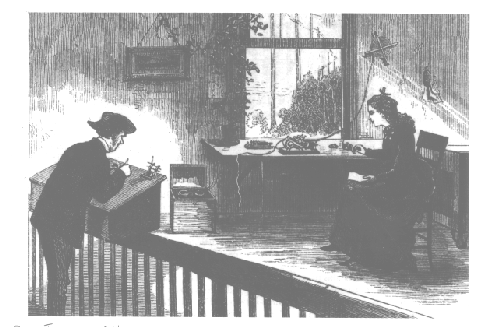
American · Activism · Politics · Literature
Sarah Bagley
April 19, 1806 – January 15, 1889
Early life and background
Sarah George Bagley was born on 19 April 1806 in Candia, New Hampshire, to Nathan Bagley, a farmer and small-scale entrepreneur, and Rhoda (Witham) Bagley.[1][5][7] She grew up in a large New England farming family whose livelihood depended on mixed agriculture and local trade, typical of rural New Hampshire in the early nineteenth century.[5][7] During her childhood the region began to experience economic change as waterways and turnpikes linked rural communities to emerging industrial centers.
In 1814 Nathan Bagley purchased land in Gilford, New Hampshire, and the family relocated to the area around what later became Laconia.[6] By 1827 they were living at Meredith Bridge, a small settlement that would be incorporated into Laconia.[6] Sarah’s early years thus combined the rhythms of farm work with exposure to small-town commerce and the growing influence of nearby mills.
Like many New England girls of her generation, Bagley is believed to have had only modest formal schooling, probably in local district schools, but she demonstrated a keen interest in reading and writing.[7][12] Her later essays for labor newspapers and her leadership in reform organizations suggest that she educated herself extensively through books, lectures, and discussion circles, acquiring a familiarity with contemporary religious, political, and reform literature.
Bagley’s rural background strongly shaped her later activism. Having seen first-hand the arduous labor of farming families, she was prepared to recognize the burdens of industrial work. At the same time, the economic limits of agriculture and the attraction of cash wages drew her toward factory employment, placing her within the larger migration of young women who left farms to become "Lowell mill girls."[12]
Move to Lowell and beginnings as a mill operative
In the mid‑1830s, Bagley joined the stream of young women traveling from rural New England to textile towns. One account notes that she went to Lowell, Massachusetts, in 1836 to work in the new spinning mills and related enterprises.[14] Other sources specify that she entered the Hamilton Manufacturing Company as a mill operative in 1837, beginning her career as one of the "Lowell girls".[2][7][13] The Hamilton mills were part of the pioneering Lowell system, which recruited unmarried farm daughters to live in company boardinghouses and work in highly mechanized textile factories.[12]
At Hamilton, Bagley initially worked as a weaver, operating power looms under strict time discipline and close supervision.[2][13] She labored in long shifts—often 12 to 13 hours per day—amid high noise levels, cotton dust, and the constant pressure to maintain speed and quality. Like many operatives, she lived in company boardinghouses governed by housekeepers who enforced curfews and moral rules.[12] These conditions exposed her to both the attractions and the dangers of industrial work: cash wages and a measure of independence, but also intense fatigue, respiratory illness, and little control over schedules or workplace policy.
Within a few years Bagley rose to become a respected, skilled worker and an informal leader among her peers.[2][13] She began to question the fairness of extended hours and low wages, especially as mills increased workloads and reduced pay during economic downturns in the early 1840s.[7][12] Her experience in the weaving rooms—combined with her reading and reflection—pushed her from private discontent into public activism.
Emergence as a labor leader and the Ten Hours movement
By the mid‑1840s Bagley had become one of the most prominent women in the New England labor reform movement. Around 1844 she helped found and then served as first president of the Lowell Female Labor Reform Association (also known as the Lowell Female Reform League), an organization dedicated to securing a ten‑hour workday for factory operatives.[6][7][12] The association, composed largely of young mill women, represented one of the earliest durable labor organizations led by women workers in the United States.
Under Bagley’s leadership the association launched an energetic campaign to reduce working hours. Between 1844 and 1845 it organized petition drives that gathered thousands of signatures from operatives in Lowell and other mill towns across the Merrimack Valley.[7][12] The petitions argued that excessively long days harmed workers’ health, denied them educational opportunities, and undermined moral and domestic life. The association also held public meetings, drafted resolutions, and engaged with sympathetic reformers.
Bagley’s activism placed her at the center of the broader Ten Hours movement in Massachusetts, part of an international push for shorter hours in factory work.[7][2] While male labor organizations had previously demanded reduced hours, the Lowell Female Labor Reform Association was distinctive in its composition and leadership: young women spoke and organized on their own behalf, challenging both male employers and male reformers.
The movement achieved partial success. By the late 1840s Massachusetts enacted legislation that effectively limited the workday in factories to ten hours, though the statute’s precise dates and the degree to which it was directly attributable to Bagley’s association are difficult to disentangle.[2][5] Nonetheless, contemporary and later accounts credit her with playing a crucial role in publicizing the issue and mobilizing operatives, helping to secure shorter hours over time.[5][6]
Testimony before the Massachusetts legislature
One of Bagley’s most notable actions came in 1845Massachusetts state legislature on behalf of the ten‑hour day.[13][7] As president of the Lowell Female Labor Reform Association, she presented her association’s petitions and spoke about the physical and moral consequences of long hours in the mills. In her testimony she described waking before dawn, working until evening, and having little time for study, religious observance, or rest.[7][12]
Her appearance was unusual: women rarely addressed legislative bodies at this time, and working‑class women almost never did. Bagley used the opportunity to assert that factory operatives were not children under employers’ paternal care but responsible adults entitled to humane conditions and a voice in public policy.[13][12] She framed shorter hours as a matter of health and citizenship, insisting that overwork "degraded" workers and undermined their capacity to be virtuous, informed members of society.
While the legislature did not immediately adopt a binding ten‑hour law in response to her testimony, the hearing helped legitimize the movement’s demands and brought public attention to women workers’ perspectives.[13][7] It marked an early instance of a woman industrial worker using formal political structures to advocate for labor reform, contributing to the gradual expansion of women’s participation in public life.
Associationism, lyceums, and broader reform work
Bagley’s interests extended beyond immediate workplace issues. Around 1844 she helped found the Lowell Union of Associationists, a group influenced by utopian socialist and communitarian ideas associated with figures such as Charles Fourier.[7] The union explored cooperative models of production and living, as well as educational and moral reforms. Bagley became an active member and, in 1846, served as its vice‑president.[7]
In 1845 she was involved in organizing the Lowell Industrial Reform Lyceum, a forum where workers and reformers could attend lectures and debates on topics including health, labor, and social justice.[7] These institutions sought to cultivate critical thinking among working people and to link factory grievances with broader critiques of industrial society.
Throughout the 1840s, Bagley participated in a wide range of reform activities. She visited prisons and asylums and advocated more humane treatment for those confined in such institutions.[11] She engaged with abolitionist circles and corresponded with reformers interested in peace, health, and communal experiments.[6][11] Her activities demonstrate that she understood labor reform as part of a comprehensive project to improve social conditions and moral life.
Voice of Industry and the working-class press
Bagley also became a central figure in the emerging working‑class press. She joined the editorial board of Voice of Industry, a weekly labor newspaper associated with the New England Workingmen’s Association, and by 1846 had become editor‑in‑chief.[6][7] As editor, she wrote regular columns and oversaw content that addressed mill conditions, wages, hours, and broader reform questions.
Voice of Industry provided a vehicle for mill operatives to articulate their experiences in print. Under Bagley’s influence it emphasized the intellectual capacities of workers and their desire for self‑improvement. She used the paper to argue that factory women were not passive victims but active agents capable of organizing, debating, and contributing to social thought.[6][13] The newspaper also helped connect Lowell workers with reform allies elsewhere, including abolitionists and advocates of cooperative communities.
Bagley’s editorial role was highly unusual for a woman at the time, particularly a working‑class woman. Her work at Voice of Industry made her one of the earliest identifiable women editors in the American labor press.[7][9] It demonstrated the importance of print culture in forging worker solidarity and influenced later generations of labor and feminist journalists.
First female telegraph operator in the United States
In 1846 Bagley made another pioneering move when she accepted a position in the Lowell telegraph office. On 21 February 1846 she became supervisor of the office and is widely credited as the first female telegraph operator in the United States.[5][7][2] Telegraphy was a cutting‑edge technology, and operating a telegraph office required technical competence and administrative skill.
Bagley’s appointment defied prevailing gender norms. Telegraph offices, like most technical and clerical posts, were staffed almost exclusively by men. Her transition from textile work and journalism to telegraphy showed that women could perform complex technological tasks and manage commercial communications.[2][10] Contemporary and later accounts treat her hiring as a landmark in the integration of women into technical occupations.
While Bagley reportedly left the telegraph post within months, partly due to dissatisfaction with pay and conditions, her brief tenure had lasting symbolic significance.[7][10] It demonstrated that women workers could be trained and trusted with responsibilities beyond the factory floor and contributed to the gradual opening of clerical and communications work to women later in the century.
Delegateships and peace petition
Bagley’s influence also extended into national reform politics. In 1846 she was selected as a delegate to the National Industrial Congress in Boston and the National Reform Convention in Worcester, Massachusetts, representing Lowell labor reformers.[7] These gatherings addressed issues such as land reform, labor hours, and economic democracy. Her presence signaled recognition of the importance of women’s labor activism and brought the voices of mill operatives into national debates.
That same year Bagley led dozens of Lowell women in signing a petition to the U.S. Congress urging the creation of a "Congress of Nations"—an international body intended to arbitrate disputes and prevent war.[11] The petition reflected the influence of peace advocates such as William Ladd and Elihu Burritt and represents one of the most notable antiwar initiatives of the 1840s led by working women.
Through these actions Bagley linked local industrial struggles to broader questions of national and international policy. She insisted that working women had a stake in issues ranging from land distribution to foreign policy and that their voices should be heard alongside those of male reformers and politicians.[7][11]
Personal life, homeopathy, and later career
For many years, standard English‑language reference works claimed that Bagley’s trail went cold after the late 1840s and even suggested that she died around 1847.[7][10] More recent research, including local radical history and genealogical work, has reconstructed a fuller picture of her later life.
After leaving Lowell, Bagley studied homeopathic medicine, attending a homeopathic college in Philadelphia.[6] In 1850, she married James Durno, a homeopathic physician.[6][15] Under the name Sarah George Durno she practiced medicine alongside her husband, and the couple lived in cities including Albany, New York, and Brooklyn, where they manufactured and sold homeopathic remedies.[6]
Following James Durno’s death in 1871, Bagley returned to Philadelphia and continued to be associated with medical and health work.[6] German‑language biographical research and genealogical sources indicate that she died on 15 January 1889 in New York City, though this information has not yet been fully corroborated in U.S. archival records.[5][15] These findings suggest that Bagley had a long second career as a practitioner and entrepreneur in alternative medicine, extending her reform interests into the realm of health.
No evidence has been found that Bagley had children, and most sources focus on her public roles rather than on domestic life.[7][6] The scarcity of detailed personal documents—letters, diaries, and family records—illustrates the broader challenge historians face in reconstructing the private lives of working‑class women.
Awards, honors, and recognition
Bagley did not receive formal awards or titles during her lifetime; as a working‑class woman reformer, she operated largely outside institutional systems of recognition. However, her contributions have been increasingly acknowledged by historians and public institutions.
The Lowell National Historical Park of the U.S. National Park Service features Bagley prominently in interpretive materials and educational videos, highlighting her role as a leader among the "mill girls" and as an early labor organizer.[2][13] Scholarly works on women’s labor history, industrialization, and the Lowell system routinely cite her as a central figure in the ten‑hour movement and the working‑class press.[7][9][12]
Modern reference works—such as Encyclopedia.com and national biographical dictionaries—include entries on Bagley that emphasize her pioneering activism, editorial work, and status as the first female telegraph operator.[7][10][5] Labor historians have also recognized her as one of the earliest women to hold leadership roles in organized labor campaigns and as a bridge between worker experience and reform discourse.
Legacy and historical impact
Sarah George Bagley’s legacy spans several domains: labor reform, women’s rights, media, technology, and health. As founder and president of the Lowell Female Labor Reform Association, she helped create one of the first enduring labor organizations led by women workers in the United States, demonstrating that young factory women could mobilize collectively around issues of hours, health, and dignity.[6][7][12]
Her petitions and legislative testimony contributed to the eventual adoption of a ten‑hour workday in Massachusetts factories, influencing broader debates about labor standards.[2][5] Bagley’s insistence that overwork harmed both body and character anticipated later arguments about occupational health and the social costs of industrial labor.
Through her editorial leadership at Voice of Industry, Bagley helped shape the early working‑class press and ensured that women’s voices were central in it.[6][7] She contributed to a tradition of labor journalism that combined reportage with moral critique, and she offered some of the earliest printed reflections by women workers on industrial capitalism and gender roles.
Her role as the first female telegraph operator in the United States has a distinct technological dimension. By entering a new communications field, she challenged assumptions about women’s capabilities and opened a path, symbolically and practically, toward greater female participation in technical and clerical occupations.[2][5][10]
Bagley’s later work in homeopathic medicine and health entrepreneurship suggests continuity in her reform commitments: she moved from advocating for healthier work environments in mills to providing alternative medical care aimed at improving individuals’ well‑being.[6] This trajectory underscores the interconnectedness of labor, health, and social reform in nineteenth‑century activism.
Historiographically, Bagley’s life illustrates both the possibilities and limitations of documenting women’s history. For decades, major reference works misidentified her death date and assumed she disappeared from public life after the 1840s, a reflection of how women who changed names through marriage or moved between regions often dropped out of the archival record.[7][10] Recent efforts by local historians and genealogists have restored a fuller picture of her extended career and long life.[6][15] Her case underscores the need for ongoing archival and genealogical research to recover the complex lives of working‑class women.
Later life and death
After her peak activism in Lowell, Bagley’s public visibility diminished, but her reformist interests continued through medicine. Living and working with her husband in Albany and Brooklyn, she practiced homeopathy and engaged in the growing market for alternative remedies.[6] These activities allowed her to maintain an independent, professional identity under the name Sarah George Durno.
Following James Durno’s death in 1871, Bagley returned to Philadelphia, where she remained until the final years of her life.[6] German‑language biographical research and genealogical records indicate that she died on 15 January 1889 in New York City, though the precise circumstances of her death are not well documented.[5][15] This later date stands in contrast to earlier English‑language sources that suggested she died around 1847, revealing how incomplete or inaccurate records can obscure women’s long-term trajectories.
By the time of her death, Bagley had lived through most of the nineteenth century, witnessing the spread of the factory system, the rise of telegraph and rail networks, the Civil War, and the beginnings of the modern labor movement. Though she is best remembered for her work in the 1840s, her full biography encompasses multiple phases of engagement with work, technology, and health. Today she is recognized as a pioneering labor organizer, an early woman editor and technologist, and a figure whose life story illuminates the broader history of women and work in industrializing America.[1][2][5][7][12]
Dated achievements
9 indexed.
- Apr191806Activism
Birth of Sarah George Bagley
Sarah George Bagley was born in Candia, New Hampshire, to Nathan and Rhoda Bagley.
View details Sarah Bagley - German Wikipedia - Dec011844Activism
Organization of Lowell Female Labor Reform Association
Bagley and others formed the Lowell Female Labor Reform Association, advocating for worker rights.