← All women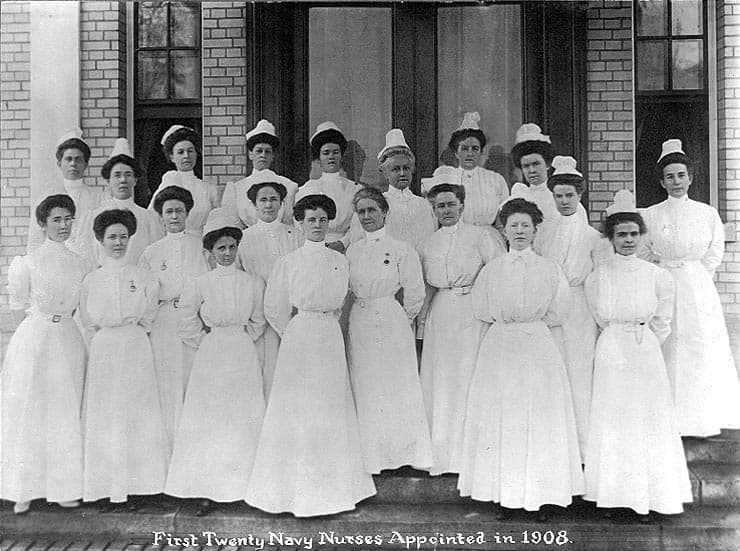
American · Medicine · Activism
Sacred Twenty
1908 – present
Overview
The “Sacred Twenty” is the collective name given to the first twenty nurses of the United States Navy Nurse Corps, the permanent nursing service of the U.S. Navy formally established in 1908. These twenty women became the first women to serve officially in the U.S. Navy, and their work laid the professional, organizational, and cultural foundations for naval nursing in the 20th century.[1][3]
Unlike many biographical subjects, the Sacred Twenty are not a single individual but a historic cohort of women. The group included a superintendent, Esther Voorhees Hasson, two chief nurses, Martha Pringle and Victoria White, and seventeen other experienced nurses. Over time, historians and veterans began referring to this pioneering cadre as the “Sacred Twenty,” highlighting the almost legendary status they acquired in Navy and nursing history.[3]
The Sacred Twenty emerged at the intersection of several trends: the professionalization of nursing, the modernization of naval medicine, and the gradual opening of military service to women. Their contributions during peacetime and in the run-up to World War I demonstrated the indispensable role of trained nurses in reducing mortality, controlling infectious disease, and sustaining the health of sailors and Marines.
Early Context and Background
Although the Sacred Twenty themselves were appointed as a group in 1908, their story begins decades earlier with the development of modern nursing and U.S. military medicine. In the mid‑19th century, figures such as Florence Nightingale had helped establish nursing as a skilled, organized profession, while the American Civil War demonstrated the need for competent nurses in military settings.[3]
Before 1908, the U.S. Navy had no permanent nurse corps. Medical care aboard ships and in naval hospitals was primarily provided by physicians, surgeons, and male hospital stewards, sometimes supplemented by civilian women who were hired locally or volunteered their services. These arrangements were inconsistent, and the quality of nursing care varied widely. The Spanish–American War (1898) and subsequent conflicts highlighted the deficiencies of this system, as outbreaks of typhoid, yellow fever, and other infectious diseases caused significant casualties among sailors and soldiers.[3]
Meanwhile, nursing education in the United States was becoming more formalized through hospital‑based training schools and emerging professional associations. Women who graduated from these programs possessed not only bedside skills but also knowledge of aseptic techniques, dietetics, and public health. They increasingly sought roles that recognized their expertise and allowed them to contribute to national service.
Within the Navy, surgeons and medical officers began to advocate for a permanent nurse corps staffed by trained women. They argued that professional nurses could improve patient outcomes, support surgical innovation, and help standardize care across naval facilities. This advocacy, combined with broader Progressive Era concerns about public health and efficiency, set the stage for legislative action.
Formation of the Navy Nurse Corps and the Sacred Twenty
The critical turning point came with the Naval Appropriations Bill of 1908. On 13 May 1908, President Theodore Roosevelt signed this bill, which included provisions to establish a permanent United States Navy Nurse Corps and authorize the appointment of the first twenty nurses.[3][4] The act created a distinct component of the Navy dedicated to nursing services and for the first time provided a formal pathway for women to serve as members of the Navy.
On the same day, the Navy constituted its initial nurse cadre: Esther Voorhees Hasson was selected as the first Superintendent of the Navy Nurse Corps, with Martha Pringle and Victoria White appointed as chief nurses, and seventeen additional nurses joining them.[3] All were graduates of reputable nursing schools and had prior clinical experience in civilian hospitals or military settings, such as service with the Army Nurse Corps or in war relief work.
Although the exact date when the twenty nurses physically reported to their first duty stations is not clearly documented, sources agree that the appointments and administrative organization trace back to this May 1908 legislative act.[1][3][4] Over time, historians and Navy personnel began using the phrase “Sacred Twenty” to refer to this founding group, emphasizing their unique status as the first women formally serving in the Navy.[1][3]
Career Beginnings and Early Service
Following the creation of the Corps, the Sacred Twenty were assigned primarily to naval hospitals and stations in the United States, including facilities in Washington, D.C., and other major ports.[3] Their early duties involved providing bedside nursing care to sailors and Marines suffering from injuries, post‑operative conditions, and infectious diseases common in crowded barracks and ships.
Superintendent Esther Hasson faced the challenge of building a new organization from the ground up. She developed recruitment standards, including requirements for formal nursing training and good moral character, and oversaw the selection and placement of new nurses. Hasson also negotiated the practical details of uniforms, accommodations, and daily routines, ensuring that Navy nurses were integrated into military life while retaining professional autonomy in clinical matters.[3]
The Sacred Twenty quickly demonstrated their value. They introduced more systematic record‑keeping, improved sanitary practices in wards, and advocated for better diet and rest for patients. Their training allowed them to assist in increasingly complex surgical procedures, contributing to lower mortality rates and better recovery times. As their effectiveness became evident, Navy medical officers supported the expansion of the Corps beyond the original twenty members.
Professional and Educational Contributions
In addition to direct patient care, the Sacred Twenty played an important role in education and training. They instructed hospital corpsmen—enlisted men assigned to medical duties—in basic nursing techniques, including wound care, medication administration, and hygiene. This training improved the quality of care sailors received aboard ships and in temporary facilities where nurses were not always present.[3]
Members of the Sacred Twenty also helped develop early nursing curricula and manuals for use within the Navy. By standardizing procedures, they promoted consistency across far‑flung naval hospitals and ensured that new nurses and corpsmen met clear expectations. Some contributed articles or reports to professional nursing journals or internal Navy publications, sharing experiences with tropical diseases, shipboard outbreaks, and surgical innovations in the military context.[3]
Their educational work extended beyond the United States. As the Navy’s global presence grew, Navy nurses were eventually deployed to overseas stations where they trained local staff and helped adapt modern nursing practices to new environments. The Sacred Twenty’s insistence on professional standards set a pattern that continued throughout the Corps’ later expansions.
Key Leaders from the Sacred Twenty
Several members of the Sacred Twenty rose to significant leadership roles within the Navy Nurse Corps, illustrating the long‑term impact of the founding group.
- Esther Voorhees Hasson served as the first Superintendent of the Navy Nurse Corps, beginning in 1908.[3] She oversaw the initial organization of the Corps, established early policies, and guided the Sacred Twenty through their formative years.
- In 1911, Lenah H. Sutcliffe Higbee, another member of the original group, became the second Superintendent of the Navy Nurse Corps, succeeding Hasson.[1] Higbee later received exceptional recognition for her leadership during World War I, including being the first woman awarded the Navy Cross for her service as superintendent.
- In 1922, Josephine Beatrice Bowman, also drawn from the Sacred Twenty, was appointed the third Superintendent of the Navy Nurse Corps.[1] Bowman continued the process of professionalization, emphasizing training, discipline, and integration of nurses into broader Navy operations.
These leadership transitions demonstrate the depth of talent within the Sacred Twenty and show how the founding cohort continued to shape naval nursing for decades. Even as new nurses joined and the Corps expanded, the early experiences and perspectives of the Sacred Twenty remained influential through their superintendents.
World War I and Expansion of the Corps
Although the Sacred Twenty themselves were appointed before World War I, their efforts created the institutional framework that made wartime expansion possible. When the United States entered World War I in 1917, the Navy Nurse Corps grew rapidly from the small founding group to a much larger organization that cared for thousands of wounded and ill personnel in the United States and overseas.[3]
The standards and policies established under Hasson, Higbee, and Bowman—each with roots in the Sacred Twenty—guided the recruitment, training, and deployment of wartime nurses. Many practices pioneered by the founding group, such as emphasis on aseptic technique, collaboration with surgeons, and structured education for corpsmen, proved essential in the crowded wartime hospitals.
While the Sacred Twenty were no longer the only nurses in the Corps by this time, their legacy was evident in the professionalism and resilience of Navy nurses who served in base hospitals, aboard hospital ships, and in expeditionary settings. The success of the Corps during World War I helped cement the idea that a permanent, uniformed nurse corps was indispensable to military readiness.
Awards, Honors, and Recognition
Because the Sacred Twenty are a collective rather than individual biography, there is no single award that applies to them as a group. However, several members received significant honors that reflect the esteem in which the founding cohort was held.
Lenah H. Sutcliffe Higbee, drawn from the Sacred Twenty, was awarded the Navy Cross for her service as Superintendent during World War I—the first woman to receive this decoration. Although the award recognized Higbee individually, it also symbolized the importance of the nurse corps and, by extension, the foundational work of the Sacred Twenty.[1]
In institutional memory, the Navy Nurse Corps has frequently invoked the Sacred Twenty in commemorations, historical publications, and educational materials. Historic pamphlets and later histories portray them as a revered founding generation who transformed Navy medicine and opened the Navy to women. Modern remembrances, including posts by institutions such as Arlington National Cemetery, describe the Sacred Twenty as the first women formally to serve in the U.S. Navy and honor their pioneering role.[4]
Personal Lives and Social Context
Detailed information about the personal lives of all twenty members is unevenly documented. Some, like Esther Hasson, are known to have had extensive careers in nursing, including prior service in war relief efforts, while others left fewer archival traces. As a group, however, the Sacred Twenty shared several social characteristics typical of early 20th‑century trained nurses.
Many were graduates of hospital‑based nursing schools, often affiliated with large urban hospitals, and came from middle‑ or working‑class families where education offered a path to professional status. Their decision to enter military nursing reflected both economic opportunities—stable employment, room and board—and ideals of service associated with Progressive Era reform movements.[3]
Socially, they navigated a world in which women’s roles were rapidly changing. The period around 1908 saw growing activism for women’s suffrage, debates about women’s work outside the home, and expanding professional options in fields such as teaching, social work, and nursing. Military service, however, remained a frontier largely closed to women, especially in uniformed roles. By joining the Navy Nurse Corps, the Sacred Twenty challenged prevailing assumptions about women’s capabilities and appropriate occupations.
Barriers Faced and Institutional Challenges
The Sacred Twenty confronted both gender-based barriers and institutional challenges. Legally, they were allowed to serve as Navy nurses, but they were not initially granted commissioned officer status comparable to male medical officers. Their pay, authority, and official recognition did not match their responsibilities, and they had to negotiate their position within a male‑dominated hierarchy.[3]
There were also social and cultural obstacles. Some critics questioned whether women belonged in military environments, citing concerns about propriety and the stresses of wartime service. The nurses themselves had to adapt to strict discipline, relocations, and the demands of working in settings that could include combat‑related injuries and infectious disease outbreaks.
Despite these obstacles, the Sacred Twenty proved that women could thrive in military medical roles. Their professionalism won the respect of many physicians and surgeons, and their effectiveness in improving patient outcomes undermined arguments against women’s presence in the Navy. Over time, these successes contributed to policy changes that improved status and conditions for Navy nurses.
Legacy and Historical Impact
The legacy of the Sacred Twenty is multifaceted, encompassing women’s history, military history, and the evolution of nursing as a profession.
In women’s history, the Sacred Twenty are remembered as the first women formally to serve in the United States Navy, breaking a barrier that had stood since the institution’s founding. Their service demonstrated that women could meet the demands of military life and contribute essential skills, influencing later decisions to open additional roles to women in the Navy and other branches.[1][4]
In military history, the establishment of the Navy Nurse Corps in 1908 marked a key step in the modernization of medical services. The Sacred Twenty’s work showed that organized nursing was indispensable to the care of sailors and Marines, especially as ships and bases became more complex and international commitments expanded. Their emphasis on training, hygiene, and discipline helped reduce disease and improve recovery rates, contributing to overall force readiness.
In nursing history, the Sacred Twenty exemplified the movement of nurses into new spheres of practice. Their service extended professional nursing beyond civilian hospitals into the military domain, where they adapted techniques to unique conditions and advocated for standards that influenced both military and civilian practice. The leadership roles of Hasson, Higbee, and Bowman demonstrated that nurses could govern large organizations and shape policy.
Today, the Sacred Twenty are frequently cited in histories of the Navy Nurse Corps, commemorative articles, and educational materials. Their story is used to highlight the long lineage of women’s contributions to the armed forces and to inspire new generations of nurses who serve in military and civilian settings.
Later Developments and Ongoing Influence
While the individual later lives and deaths of all twenty members are not uniformly documented in accessible sources, the institutional trajectory they initiated is well known. After the founding period, the Navy Nurse Corps continued to evolve, participating in World War I, World War II, the Korean War, and subsequent conflicts, with thousands of nurses serving worldwide.[3]
Policies regarding rank, pay, and status for Navy nurses improved over time, with nurses eventually receiving commissioned officer status and broader recognition for their contributions. These changes reflect not only the advocacy of later generations but also the foundational legitimacy created by the Sacred Twenty’s successful integration into the Navy.
Within the culture of the Corps, the story of the Sacred Twenty remains a touchstone. Training programs and historical briefings often reference the founding nurses, emphasizing values of professionalism, courage, and service. For historians of women in the military, the group offers a rich case study of how legislative change, professional ambition, and social reform intersected to create new opportunities.
Commemoration and Public Memory
In public memory, the Sacred Twenty are honored in various ways. Historical articles, educational websites, and institutional social media posts—such as those associated with Arlington National Cemetery—describe them as the first women formally to serve in the U.S. Navy and emphasize their pioneering status.[4]
Printed histories and pamphlets, including those digitized for public access, provide narrative accounts of their formation and early work. These materials often highlight key figures like Hasson, Higbee, and Bowman while acknowledging the contributions of the entire cohort. Within the broader narrative of U.S. military and nursing history, the Sacred Twenty occupy a symbolic role as a “founding generation” whose efforts enabled the growth and success of the Navy Nurse Corps.
Although no single monument is dedicated exclusively to the Sacred Twenty, their legacy is embedded in the recognition of the Navy Nurse Corps and in commemorations of women’s service in the armed forces. Their story continues to be relevant for discussions about gender integration in the military and the importance of professional nursing in health systems.
Conclusion
The Sacred Twenty, as the first twenty nurses of the United States Navy Nurse Corps, represent a pivotal moment in the history of women, the military, and medicine. Authorized on 13 May 1908 by the Naval Appropriations Bill and organized under Superintendent Esther Voorhees Hasson, they became the first women to serve formally in the U.S. Navy and pioneered the professional and educational work that defined naval nursing.[1][3][4]
Though individually diverse and not equally documented, as a collective they broke institutional barriers, set new standards of care, and laid the foundation for generations of Navy nurses who followed. Their legacy endures in the continuing work of the Navy Nurse Corps and in the broader recognition of women’s indispensable role in military service.
Dated achievements
4 indexed.
- May131908Medicine
Naval Appropriations Bill creates Navy Nurse Corps
President Theodore Roosevelt signs the Naval Appropriations Bill, establishing the Navy Nurse Corps.
View details Wikipedia - Sacred Twenty - May131908Medicine
Constitution of the initial twenty nurses of the Navy Nurse Corps
The first cadre of Navy nurses, led by Esther Voorhees Hasson, is formed.