← All women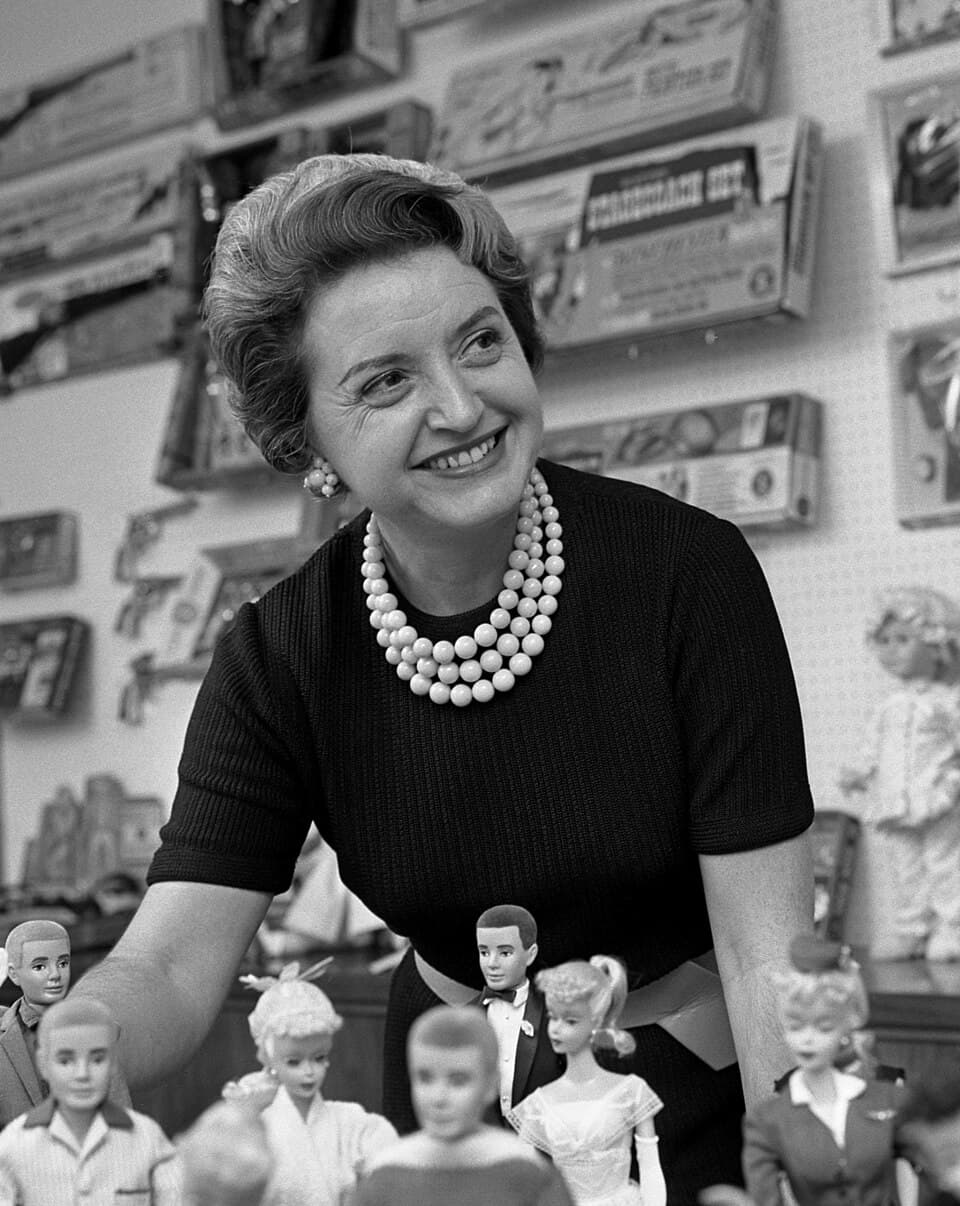
American · Arts · Medicine · Law · Politics
Ruth Handler
November 4, 1916 – April 27, 2002
Early life and background
Ruth Marianna Mosko Handler was born on November 4, 1916, in Denver, Colorado, to Jewish immigrant parents. She was the youngest of ten children in a large family, and biographical accounts emphasize that she grew up in a modest household where practicality, resilience, and improvisation were part of daily life. Those early conditions would later echo in her business style: direct, inventive, and attentive to ordinary people’s needs.
Handler moved to California as a young woman and married her high school sweetheart, Elliot Handler, in 1938. The marriage became both a personal and professional partnership. Ruth and Elliot shared an interest in design and manufacturing, and the couple eventually built a business together that would become Mattel. Her early years did not point toward a conventional path into corporate leadership, but they gave her a perspective that would prove crucial in recognizing untapped markets and consumer desires.
Although she is remembered primarily for Barbie, her life began in a period when women’s opportunities in business, invention, and manufacturing were sharply limited. Handler’s subsequent career therefore belongs to the history of women who entered male-dominated industries and changed them from within. Her background, Jewish identity, and family responsibilities all formed part of the social world that shaped her ambitions.
Career beginnings and the creation of Mattel
In the years before Mattel became a toy giant, Ruth and Elliot Handler worked in the giftware and toy business in Los Angeles. Accessible accounts describe the couple as building a small enterprise that moved from domestic manufacture into commercial production. In 1945, Ruth Handler co-founded Mattel with Elliot Handler and Harold “Matt” Matson, and she became the company’s first president. That role gave her unusual authority for a woman in postwar American business and made her a key decision-maker in a fast-growing company.
Handler’s importance at Mattel went far beyond title. She was deeply involved in product development, branding, and sales strategy. This was especially significant because the postwar toy industry was expanding alongside a new consumer culture aimed at children and families. Handler understood that toys could be marketed not only as objects of play but as cultural tools that helped shape imagination. That insight would later prove decisive with Barbie.
Mattel’s early growth also reflected the collaborative nature of the Handlers’ marriage. The company was built through experimentation, design iteration, and a willingness to take commercial risks. As the business expanded, Handler increasingly emerged as the public face of Mattel’s vision, even as legal and corporate structures of the era often obscured women’s contributions. Her leadership at Mattel from 1945 to 1975 placed her among the most consequential female executives in midcentury American industry.
Barbie and the reinvention of the fashion doll
Handler’s best-known achievement came in 1959 with the creation of Barbie. The doll debuted publicly at the American International Toy Fair in New York City on March 9, 1959. Inspired by the observation that her daughter Barbara and other girls played with paper dolls imagining adult futures, Handler envisioned a three-dimensional fashion doll that would allow children to project aspirations, identities, and social roles.
Barbie was revolutionary because it departed from the baby dolls that dominated the market. Instead of encouraging children to rehearse motherhood, the doll offered a glamorous adult figure with a changing wardrobe, occupations, and a seemingly limitless range of identities. That concept was controversial to some observers, but it proved enormously successful. Barbie quickly became one of the most popular toys in America and later a global icon.
Handler’s role in Barbie’s creation was central to the doll’s historical meaning. Barbie was not merely a product; it was a new way of thinking about gender, consumption, and girlhood. Over time, the doll became a site of debate about body image, feminism, race, and consumer culture. Yet its enduring cultural power reflects Handler’s original insight that play could be aspirational. The launch also demonstrated her ability to translate observation into a mass-market product with international reach.
Barbie’s success generated an entire universe of related merchandise, characters, and stories. Mattel introduced Ken, named after Handler’s son, and later built out a broad franchise. The brand’s growth was inseparable from Handler’s commercial instincts. She recognized that the doll could serve as a platform for continual reinvention, a concept that would become standard in modern licensing and character merchandising.
Patents, innovation, and business strategy
Handler’s connection to Barbie was not only creative but also legal and technical. On July 24, 1959, she filed a U.S. patent application for a doll construction that allowed the doll to stand upright in a realistic, balanced position. The patent was later granted on November 21, 1961 as U.S. Patent 3,009,284. These dates mark a crucial aspect of Barbie’s history: the product’s design was protected as intellectual property, helping secure Mattel’s control over an increasingly valuable brand.
In the competitive toy business, patents mattered because they supported commercial exclusivity and helped deter copycats. Handler’s willingness to engage the patent system shows that she understood the relationship between invention, branding, and legal protection. The patent also demonstrates the degree to which Barbie’s success depended on more than a single idea; it required a product that could be manufactured reliably, displayed attractively, and defended legally.
Later, on October 11, 1966, a patent for a doll with an angularly adjustable limb was granted, reflecting the broader engineering work surrounding Mattel’s doll lines during the Barbie era. Although that patent’s inventor was Jack Ryan, it belonged to the same ecosystem of innovation that Handler helped drive. Her career shows how women in business could influence product ecosystems even when not every technical contribution appeared in their own name.
Departure from Mattel and later life
Handler’s career at Mattel was not without conflict. In the early 1970s, she faced serious health challenges and corporate difficulties, including a battle with breast cancer. In 1970, after undergoing a mastectomy, she turned her attention to developing more realistic breast prostheses. That shift eventually led her to found Nearly Me, a company dedicated to manufacturing prosthetic breasts for cancer survivors.
This second act was historically significant for several reasons. First, it reveals a continuity in Handler’s life: she repeatedly identified unmet needs and built products to address them. Second, it placed her in the history of women’s health, where prosthetic and reconstructive options were often inadequate or stigmatized. By creating a more realistic prosthetic, Handler helped make post-mastectomy recovery less isolating for many women.
Handler was forced out of Mattel in 1975 after a period of legal and financial trouble. Her departure marked the end of her direct role in the company she had helped build, but it did not end her public significance. Barbie continued to expand into a global franchise, while Handler’s later medical work gave her a legacy beyond toy manufacturing. That dual legacy—commercial icon and health innovator—makes her unusual among twentieth-century entrepreneurs.
Personal life
Ruth Handler’s personal life was closely intertwined with her work. Her marriage to Elliot Handler was both affectionate and entrepreneurial, and together they raised children including Barbara and Kenneth, names that became part of Barbie and Ken’s cultural story. The family setting mattered not only as biography but also as inspiration: Handler’s observation of her daughter Barbara’s play is often cited as part of the thinking that led to Barbie’s creation.
Her experience as a wife and mother also shaped her sensibility about women’s lives and identities. That perspective helped her see a market for a doll that did not simply imitate infancy but opened imaginative space for adult roles. In later life, her battle with cancer and her concern for prosthetic options further reflected the personal dimensions of her public work. Handler’s career cannot be separated from the family experiences that inspired and sustained it.
Awards, recognition, and historical legacy
Handler received wide recognition in retrospective accounts, especially after Barbie became a global pop-culture phenomenon. She is frequently described as the inventor of Barbie and as a major figure in American toy history. Institutional and journalistic sources have also highlighted her second career in breast prosthetics, which broadened public understanding of her accomplishments.
Her legacy is unusually complex. Barbie made her famous, but it also ensured that her name would remain part of ongoing debates about femininity, consumerism, and representation. At the same time, her work on Nearly Me illustrates a commitment to practical solutions for women’s health. Few inventors have shaped both play culture and post-cancer recovery in such visible ways.
Handler died on April 27, 2002, in Los Angeles, California, at age 85. By then, Barbie had become one of the most recognized and contested toys in the world. Ruth Handler’s historical importance lies not only in what she invented, but in how she moved across domains—business, design, law, and medicine—to address unmet needs and create products with lasting cultural force. Her life remains a landmark in women’s history because it shows how female entrepreneurship could alter both commerce and culture on a global scale.
Dated achievements
8 indexed.
- Nov041916Politics
Birth of Ruth Handler
Born in Denver, Colorado, Ruth Handler would become the inventor of Barbie and a pioneering toy industry executive.
View details Ruth Handler - Wikipedia - Jan011945Arts
Co-founding of Mattel
Ruth Handler co-founded Mattel and became its first president, helping build a major toy company.