← All women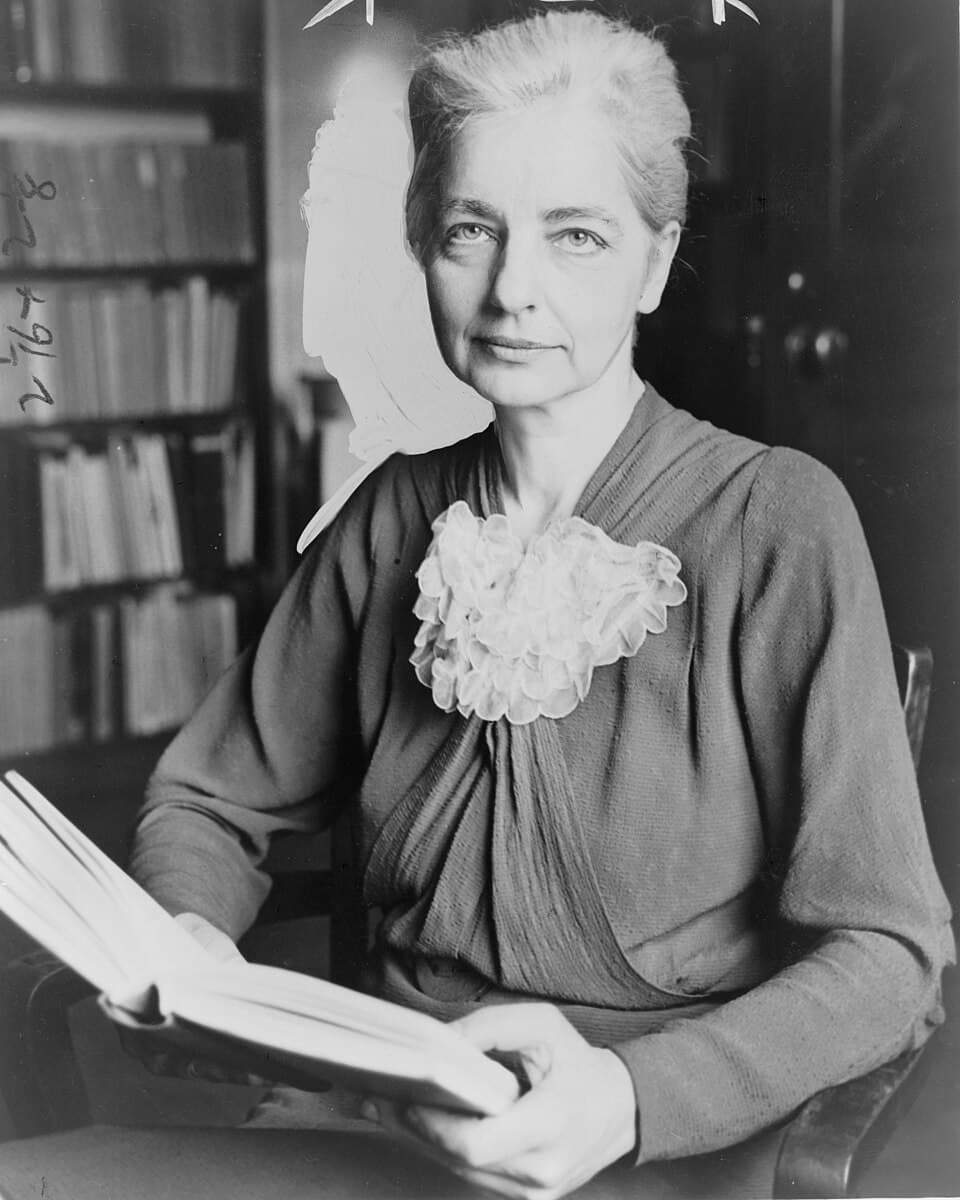
American · Science · Literature · Activism
Ruth Benedict
June 5, 1887 – September 17, 1948
Early Life and Family Background
Ruth Fulton Benedict was born Ruth Fulton on June 5, 1887, in New York City, the elder of two daughters born to Frederick S. Fulton, a homeopathic physician, and Bertrice (Shattuck) Fulton, a schoolteacher. Her father died of complications following an experimental surgery when Ruth was not yet two years old, and his death cast a long shadow over her childhood. Her mother, devastated by grief, remained emotionally distant, and Ruth later wrote candidly of the pall of mourning that pervaded her early years, describing a household haunted by what she called her mother's "cult of grief."
The family moved frequently in the years following her father's death, as Bertrice Fulton took teaching and library positions in Missouri, Ohio, Minnesota, and finally Buffalo, New York, where Ruth attended St. Margaret's School on scholarship. As a young child, Ruth also suffered a bout of measles that left her partially deaf, a disability that isolated her socially and academically, though it never prevented her from excelling as a student. Her deafness, combined with a lifelong stammer, may have contributed to her introspective temperament and to the profound sense of being an outsider that later informed her anthropological interest in how societies define normalcy and deviance.
Ruth attended Vassar College on a scholarship, graduating in 1909 with a degree in English literature. At Vassar, she was exposed to progressive feminist ideas and excelled academically, and it was here that she developed her interest in literature and writing, aspirations that would only later merge with anthropology.
Early Adulthood and Marriage
After graduating from Vassar, Fulton spent a year traveling in Europe before returning to the United States, where she worked briefly as a social worker in Buffalo and then taught at girls' schools in California. In 1914, she married Stanley Rossiter Benedict, a biochemist, and the couple settled in Bedford Hills, New York. The marriage, however, proved unsatisfying to Ruth, who found domestic life stifling and yearned for intellectual purpose. She began writing (unpublished) biographical essays on early feminist figures such as Mary Wollstonecraft, Olive Schreiner, and Margaret Fuller, exploring themes of women's intellectual frustration and thwarted ambition that mirrored her own experience. The Benedicts separated in the 1920s and eventually divorced, though Ruth retained the surname "Benedict" for the rest of her career.
Entry into Anthropology
Seeking greater intellectual engagement, Ruth Benedict enrolled at the New School for Social Research in New York City in 1919, where she studied under Elsie Clews Parsons. She soon transferred to Columbia University to study anthropology under the towering figure of Franz Boas, the "father of American anthropology." Benedict earned her Ph.D. in 1923 with a dissertation titled The Concept of the Guardian Spirit in North America, and Boas quickly recognized her exceptional talent, inviting her to stay on at Columbia as his assistant.
It was at Columbia, in 1922, that Benedict met a young undergraduate named Margaret Mead, beginning a relationship that would become one of the most significant intellectual and personal partnerships in the history of anthropology. Benedict became Mead's mentor, close friend, and—for a period—romantic partner, and the two maintained a lifelong correspondence and intellectual collaboration. Benedict encouraged Mead's fieldwork in Samoa, which resulted in Mead's landmark book Coming of Age in Samoa (1928).
Fieldwork and the Development of the Culture-and-Personality School
Throughout the 1920s, Benedict conducted ethnographic fieldwork among various Native American groups, including the Serrano, the Zuni, the Cochiti, and the Pima peoples of the American Southwest. Her fieldwork among the Pueblo peoples, particularly the Zuni, was foundational to her most influential theoretical contributions. She became a key figure in what came to be known as the culture-and-personality school of anthropology, which examined how cultural patterns shape individual psychology and behavior, and vice versa.
In 1931, Benedict was appointed assistant professor at Columbia University, though—reflecting the institutional sexism of the era—she would not be promoted to full professor until 1948, near the very end of her life, despite being effectively the head of the department in all but title for many years (a role that was formally held by male colleagues with less seniority and scholarly output).
Patterns of Culture (1934)
Benedict's most famous and influential work, Patterns of Culture, was published in 1934. In it, she argued that each culture develops its own coherent and integrated "configuration" or personality, comparing the Zuni, the Dobu of Melanesia, and the Kwakiutl of the Pacific Northwest to illustrate radically different cultural patterns of normalcy, aggression, and social organization. The book popularized the concept of cultural relativism—the idea that behaviors and values must be understood within their own cultural context rather than judged against a supposedly universal standard—and became one of the most widely read anthropological texts of the twentieth century, translated into numerous languages and used in university curricula for decades. It sold over a million copies and profoundly shaped mid-century American attitudes toward cultural difference, tolerance, and moral relativism.
Combating Racism and Wartime Contributions
Benedict was a vocal and early opponent of scientific racism and Nazi ideology. In 1940, she published Race: Science and Politics, a book that used anthropological evidence to systematically debunk theories of racial superiority, written explicitly to counter the racist propaganda emanating from Nazi Germany and to challenge racial prejudice within the United States itself.
During World War II, Benedict worked for the U.S. Office of War Information, applying anthropological methods to understand and analyze the cultures of America's wartime adversaries, since direct fieldwork in Japan and Germany was impossible during the conflict. This work culminated in her second most celebrated book, The Chrysanthemum and the Sword: Patterns of Japanese Culture, published in 1946. Drawing on interviews with Japanese Americans, Japanese films, literature, and other secondary sources, Benedict analyzed Japanese social structure, concepts of honor and shame, and cultural psychology. Though later critiqued by some scholars for methodological limitations (given she never visited Japan), the book had an enormous influence on postwar American policy toward Japan and remains a landmark, if controversial, work of "anthropology at a distance."
Awards, Honors, and Institutional Recognition
Despite facing persistent gender discrimination that delayed her formal academic advancement, Benedict received significant recognition later in her career. She served as president of the American Ethnological Society (1927) and vice-president of the American Anthropological Association (1936), and in 1948, shortly before her death, she was elected president of the American Anthropological Association—one of the first women to hold this position. She also received support from major foundations, including grants that funded her comparative research on national cultures during and after World War II, notably the Columbia University Research in Contemporary Cultures project. She was awarded an honorary degree and was widely regarded, alongside Mead, as one of the most publicly influential anthropologists of her generation.
Personal Life
Benedict's personal life was marked by both isolation and profound intellectual partnership. Her marriage to Stanley Benedict ended in separation and eventual divorce, and she never remarried. Her most significant emotional and intellectual bonds were with women, including Margaret Mead and, in later years, the psychologist Natalie Raymond and others within Benedict's circle of intimate friends and colleagues. Benedict's private writings, particularly her poetry (much of which she published under the pseudonym "Anne Singleton" to protect her academic reputation, since poetry was viewed as incompatible with serious scholarship at the time) reveal a deeply introspective and often melancholic inner life, concerned with themes of isolation, mortality, and the search for meaning—themes that also permeate her anthropological writing.
Later Life and Death
In 1948, Benedict was finally promoted to a full professorship at Columbia University, a long-overdue recognition of her decades of scholarly leadership and contribution to the department, which she had unofficially guided since Boas's retirement. That same year, she traveled to Europe to participate in a UNESCO seminar on childhood education. Shortly after her return to the United States, she suffered a coronary thrombosis and died on September 17, 1948, in New York City, at the age of 61.
Legacy
Ruth Benedict's influence on anthropology, and on American intellectual life more broadly, was profound and lasting. She helped establish cultural relativism as a central tenet of modern anthropology, challenging ethnocentric assumptions and racist pseudoscience during an era when such ideas were tragically ascendant in world politics. Her mentorship of Margaret Mead helped shape the career of one of the most publicly recognized anthropologists of the twentieth century, and her own writing—accessible, humane, and intellectually rigorous—brought anthropological thinking to a broad popular audience.
Benedict is remembered today not only for her scholarly contributions but as a trailblazer for women in academia, who navigated and ultimately overcame significant institutional barriers to achieve recognition in a field then dominated by men. Columbia University and Vassar College, her alma mater, continue to honor her legacy, and her major works remain standard texts in anthropology courses worldwide, cementing her place as one of the most significant American social scientists of the twentieth century.
Dated achievements
2 indexed.
- Jun051887Science
Birth of Ruth Fulton in New York City
Ruth Fulton (later Benedict) was born in New York City on June 5, 1887, later becoming one of the most influential American anthropologists of the 20th century.
View details Ruth Benedict - Wikipedia - Sep171948Science
Death of Ruth Benedict in New York City
Ruth Benedict died on September 17, 1948, in New York City from a coronary thrombosis, shortly after being elected president of the American Anthropological Association.