← All women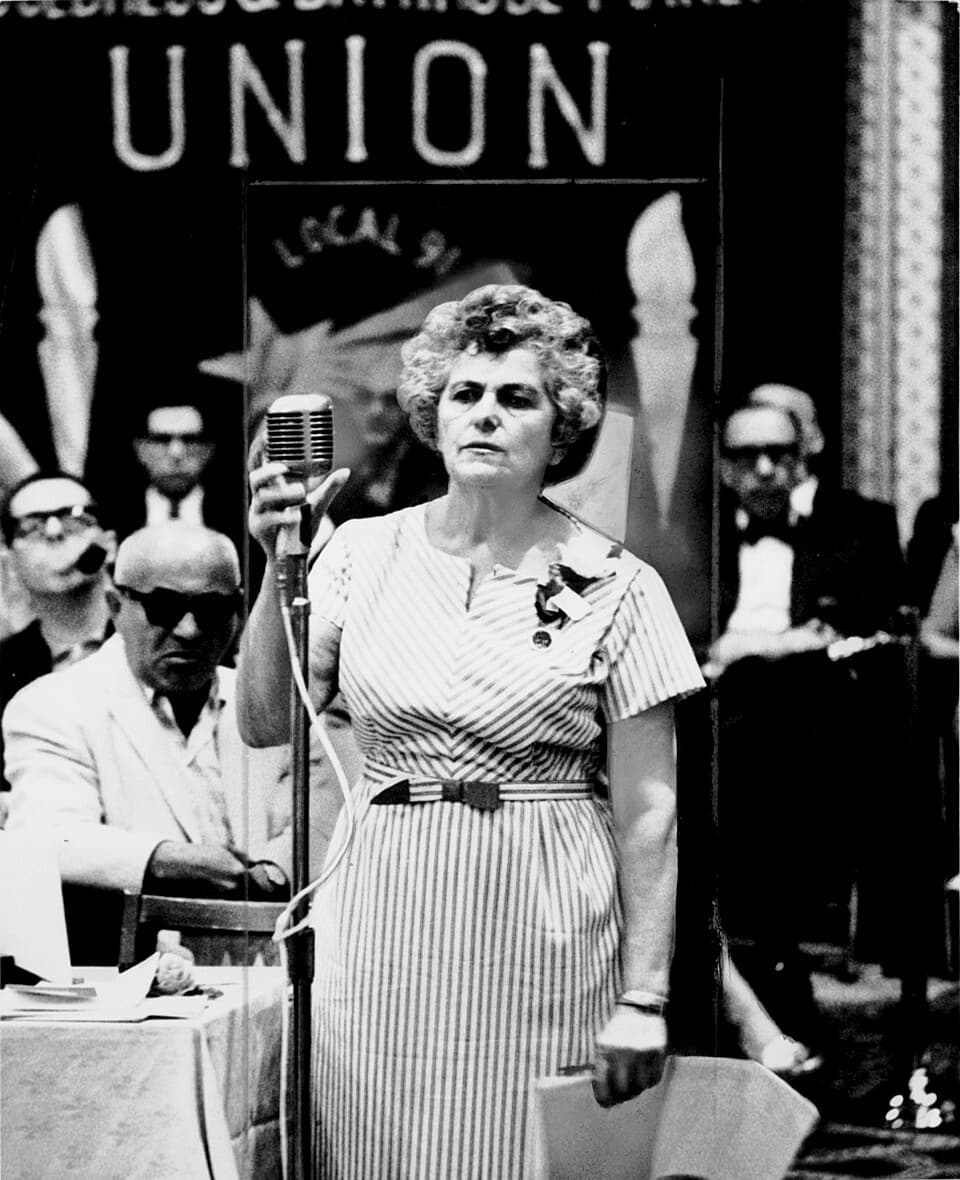
Ukrainian, American · Activism · Politics · Literature
Rose Pesotta
November 20, 1896 – December 8, 1965
Early Life and Background
Rose Pesotta was born Rakhel Peisoty on November 20, 1896, in Derazhnia, a small shtetl in the Podolia region of the Russian Empire (now Ukraine). She was one of several children born to Isaac and Masya Peisoty, a middle-class Jewish family; her father operated a grain and feed business that provided the family a modest but comfortable living by shtetl standards.
As a Jewish girl in Tsarist Russia, Rose was barred from the better local schools and instead received an informal, largely self-directed education. She was an avid reader from a young age, consuming Russian literature and radical political pamphlets that circulated, often clandestinely, among young Jewish intellectuals living under the restrictions of the Pale of Settlement. The pervasive antisemitism of the era—including the ever-present threat of pogroms—combined with her exposure to anarchist, socialist, and revolutionary ideas following the 1905 Russian Revolution, shaped her early political consciousness. She became particularly drawn to anarchist thought, which emphasized voluntary cooperation, mutual aid, and resistance to hierarchical authority—principles that would remain central to her worldview throughout her life.
Chafing against both the political repression of the Tsarist regime and the traditional constraints placed on women's roles within her community, Rose emigrated alone to the United States in 1913 at the age of sixteen. She settled with relatives in New York City, quickly anglicizing her name to Rose Pesotta and entering the workforce as so many immigrant women did: in the garment industry.
Entry into the Garment Industry and Early Activism
Pesotta found work as a seamstress in New York's garment sweatshops, where she experienced firsthand the grueling conditions, long hours, low pay, and unsafe workplaces that characterized the industry in the early twentieth century—conditions made horrifically visible to the American public by the Triangle Shirtwaist Factory fire of 1911, which had claimed 146 lives, mostly young immigrant women, just two years before her arrival.
She joined the International Ladies' Garment Workers' Union (ILGWU) in 1913, becoming an active rank-and-file member of Local 25, the same waistmakers' local that had spearheaded the historic 1909 "Uprising of the 20,000" strike. Pesotta quickly distinguished herself as an articulate and passionate advocate for workers' rights, participating in strikes and educational activities sponsored by the union. She attended the Ferrer Modern School, an anarchist-inspired educational institution in New York, further immersing herself in radical political circles and befriending prominent anarchists of the era, including Emma Goldman and Alexander Berkman, with whom she maintained lasting friendships and correspondence.
Recognizing her talents, the ILGWU sponsored Pesotta's education, and she attended Bryn Mawr College's Summer School for Women Workers in Industry as well as Brookwood Labor College, an institution dedicated to training labor organizers and activists. These experiences honed her organizing skills and deepened her commitment to industrial unionism and workplace democracy.
Rise as a National Organizer
By the late 1920s and into the 1930s, Pesotta had become one of the ILGWU's most effective and sought-after organizers, dispatched to lead campaigns across the United States and beyond. Her organizing philosophy emphasized grassroots mobilization, education, and empowering rank-and-file workers—particularly women—to take ownership of their unions rather than simply following top-down directives.
Among her most notable campaigns:
- She played a central role in organizing garment workers in Los Angeles in the early 1930s, a notoriously open-shop, anti-union city, where she helped build ILGWU membership among a diverse, multiethnic workforce including many Mexican-American and Mexican immigrant women.
- She led major organizing drives in Seattle, Montreal, Puerto Rico, and Boston, adapting her tactics to different cultural, linguistic, and economic contexts.
- In 1936, she was loaned by the ILGWU to assist the Committee for Industrial Organization (CIO) in organizing rubber workers in Akron, Ohio, contributing to the historic sit-down strikes and organizing victories that helped establish the United Rubber Workers union.
In 1934, in recognition of her extraordinary organizing record, Pesotta was elected vice president of the ILGWU's General Executive Board—an extraordinary achievement given that the union, though composed overwhelmingly of women workers, was led almost entirely by men. She would be re-elected to this position for several consecutive terms through 1942, one of only a small handful of women ever to hold such senior office in the union's leadership. She was frequently the sole woman on the Board and used her position to advocate consistently for greater representation of women within union leadership structures, often expressing frustration that the union's female-dominated membership was so poorly reflected in its governance.
Ideological Commitments and Tensions Within the Labor Movement
Throughout her career, Pesotta remained committed to anarchist and syndicalist principles, favoring decentralized, democratic organizing over bureaucratic control. This often put her at odds with the more centralized, sometimes autocratic leadership style of ILGWU president David Dubinsky and other union officials. She grew increasingly disillusioned with what she saw as the union bureaucracy's resistance to genuine rank-and-file empowerment and its marginalization of women leaders despite the overwhelmingly female membership base.
In 1942, frustrated by these internal tensions and the limited opportunities for women within the union hierarchy, Pesotta resigned from her vice presidency, though she continued working as an ILGWU organizer in a less prominent capacity for several more years. Her resignation letter and subsequent writings articulated a pointed critique of gender inequity within organized labor that remains a significant historical document for understanding the internal contradictions of the American labor movement in the mid-twentieth century.
Writing Career and Memoirs
Following her departure from formal union leadership, Pesotta turned increasingly to writing as a means of documenting her experiences and preserving the history of labor organizing from a worker's and organizer's perspective. She published two significant memoirs:
- Bread Upon the Waters (1944), which chronicled her organizing campaigns across the country, offering vivid firsthand accounts of strikes, negotiations, and the daily struggles of garment workers.
- Days of Our Lives (1958), a further memoir reflecting on her life, her anarchist convictions, and her decades in the labor movement.
These works remain invaluable primary sources for labor historians, offering a rare woman's perspective on the internal workings of American trade unionism during its most dynamic period of growth, and providing detailed accounts of the immigrant, multiethnic workforce that powered the garment industry.
Personal Life
Pesotta was married briefly early in her life to Frank López, a fellow anarchist, though the marriage did not last. She never had children, dedicating her life almost entirely to union organizing and, later, writing. She maintained close, lifelong friendships with leading figures of the anarchist movement, including Emma Goldman and Alexander Berkman, corresponding with them and drawing philosophical sustenance from their shared commitment to anarchist ideals even as she worked within the more mainstream, hierarchical structure of the ILGWU.
Later Life and Death
In her later years, Pesotta continued to write and remained connected to labor and social causes, though she gradually stepped back from active organizing. She battled cancer in her final years and died on December 8, 1965, in Miami, Florida, at the age of 69. Her death was noted with a formal obituary in The New York Times, acknowledging her decades of pioneering labor organizing.
Legacy
Rose Pesotta's legacy endures as one of the most significant women labor leaders in American history. She broke barriers as a woman rising to national union leadership in an era when few women held such positions, despite the fact that women constituted the vast majority of garment workers. Her tireless, boots-on-the-ground organizing helped bring union representation, improved wages, and safer working conditions to tens of thousands of immigrant and minority women workers across North America.
Her memoirs remain widely cited by labor historians as essential primary sources illuminating both the achievements and the internal gender politics of the American labor movement. Her papers are held at the New York Public Library and other archival institutions, continuing to inform scholarship on labor history, immigrant history, Jewish American history, and the history of women in the workplace. Pesotta is remembered today as a trailblazing figure whose life embodied the intersection of anarchist idealism, immigrant experience, and the fight for workers' dignity.
Dated achievements
2 indexed.
- Nov201896Activism
Born in Derazhnia, Podolia, Russian Empire
Rose Pesotta was born Rakhel Peisoty on November 20, 1896, in the Ukrainian shtetl of Derazhnia, then part of the Russian Empire.
View details Rose Pesotta - Wikipedia - Dec081965Activism
Died in Miami, Florida
Rose Pesotta, pioneering labor organizer for the ILGWU, died on December 8, 1965, in Miami, Florida, at age 69.