← All women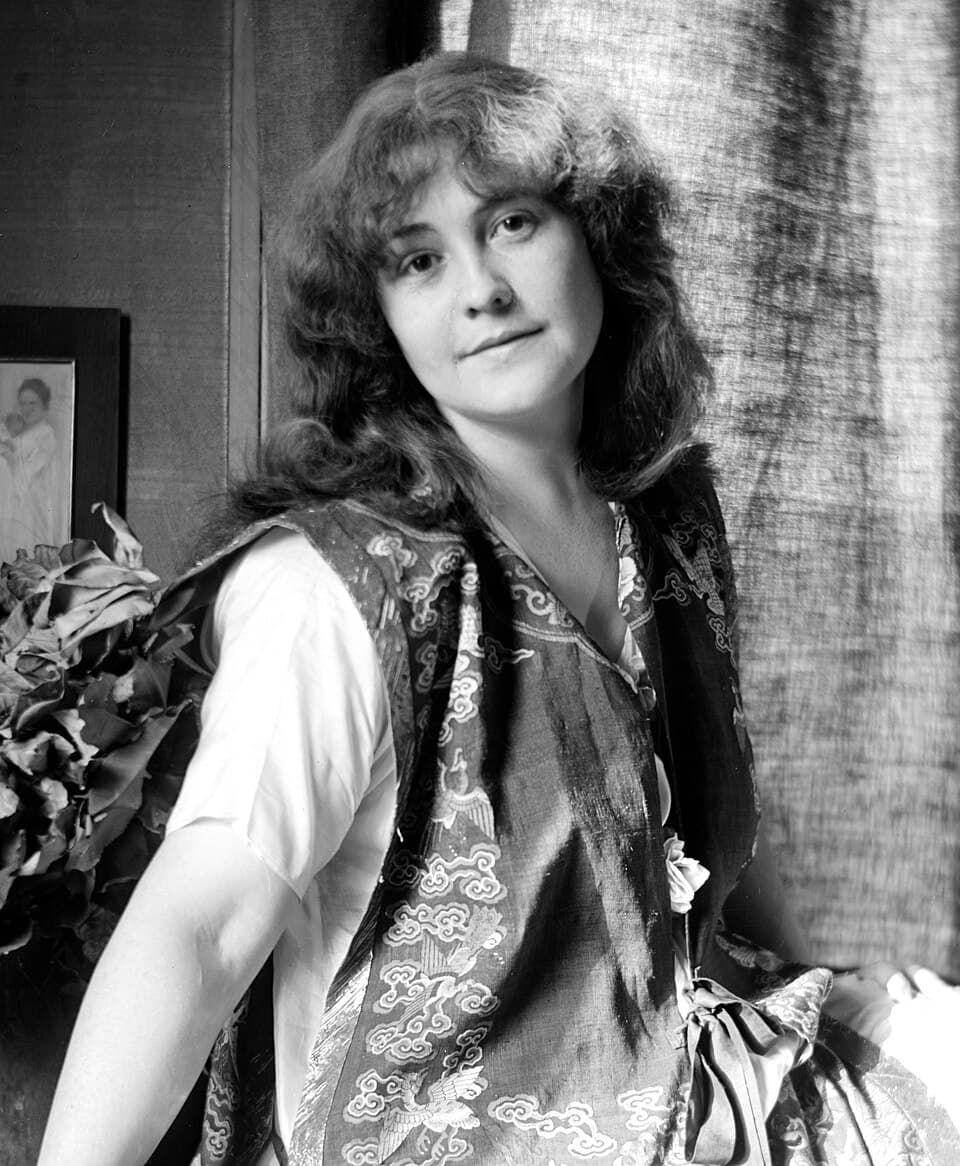
American · Arts · Activism
Rose O'Neill
June 25, 1874 – April 6, 1944
Early Life and Background
Rose Cecil O’Neill was born on June 25, 1874, in Wilkes-Barre, Pennsylvania, to William Patrick “Pat” O’Neill and Alice Asenath Smith O’Neill.[1][3] She was the second of seven children in an Irish American, Catholic family that valued books, music, and art despite limited financial means.[1][3] Her father, a bookseller, editor, and sometime actor, and her mother, an aspiring teacher and musician, encouraged creative expression from an early age.[1] When Rose was a child, the family relocated west, first to Omaha and then to rural Nebraska, seeking better economic prospects.[1][3]
Growing up in small towns and on the Great Plains, O’Neill had no access to formal art training.[1][4] She taught herself to draw by copying illustrations from magazines and books and by sketching the people, animals, and landscapes around her.[1][2] The contrast between her modest surroundings and the richly illustrated periodicals she devoured helped shape her understanding of art as a pathway out of poverty. By her early teens, she was determined to become a professional illustrator, a highly ambitious goal for a girl in the 1880s.
In 1893, her father moved the family to the Missouri Ozarks, where they eventually settled at a property that became known as Bonniebrook near present-day Branson, Missouri.[1][3] This wooded homestead would serve as O’Neill’s emotional anchor throughout her life. Although she spent significant periods in New York, Europe, and other cities, she repeatedly returned to Bonniebrook to work, rest, and support her extended family. The rural setting later appeared in her art and writing, infusing her fanciful imagery with a sense of nature and fantasy rooted in childhood.
Career Beginnings and Development
O’Neill’s professional career began unusually early. As a teenager in Nebraska, she submitted drawings to youth and humor publications and won a prize in a national drawing competition, which brought her work to the attention of editors.[1][2] By age 14 she was selling illustrations.[16][2] At around 18 she traveled alone to New York City to pursue work in the magazine industry, carrying a portfolio and letters of introduction.[1][2][16] At a time when women rarely lived independently in big cities, her move underscored both her ambition and her family’s reliance on her potential earnings.
Once in New York, she quickly began placing illustrations in popular magazines, including Truth, Harper’s, Collier’s, and other periodicals.[1][2][3] Her drawings often combined delicate line work with humorous or sentimental scenes, appealing to editors seeking images for the rapidly expanding mass-circulation market of the 1890s. O’Neill’s capacity to meet deadlines and deliver inventive imagery made her a valuable freelancer.
A key early milestone came on September 19, 1896, when her illustrations and comic strip appeared in True Magazine, a supplement of the humor weekly Puck.[10] The New-York Historical Society and other historians note that this publication made her the first female cartoonist to publish a comic strip in America.[10][2] In an era when editorial offices and comics pages were dominated by men, O’Neill’s achievement marked a significant breakthrough. It also established her connection with Puck, then one of the most influential humor magazines in the United States.
In 1897 she joined Puck as the first woman cartoonist on its all-male staff, drawing hundreds of cartoons and illustrations over several years.[14] Her work for the magazine ranged from political and social satire to depictions of modern women, often bending expectations about female respectability and humor. This period consolidated her professional reputation and provided a steady income to support her parents and siblings at Bonniebrook.
Creation of the Kewpies and Commercial Success
In the first decade of the twentieth century, O’Neill reached the pinnacle of her popular fame with the creation of the Kewpies. She reportedly began sketching the chubby, winged, elf-like figures around 1908, naming them after “Cupid.”[14] The characters combined elements of cupids, babies, and sprites, designed to deliver light moral messages through playful mischief. O’Neill described them as a “benevolent propaganda” for kindness, cheerfulness, and generosity.[1][4]
The Kewpies made their widely recognized magazine debut in the December 1909 Christmas issue of Ladies’ Home Journal, where they appeared in a series of illustrations accompanied by rhymed verses.[1][7] This exposure in one of the most popular women’s magazines of the era brought O’Neill’s characters into millions of homes. Readers responded enthusiastically, and the Kewpies soon became a recurring feature in other magazines and in a succession of books and postcards.[1][3]
Recognizing their commercial potential, O’Neill and her business partners moved to translate the Kewpies into three-dimensional form. By 1912, Kewpie dolls—initially made of bisque in Germany—were being manufactured and sold in large quantities.[1][6][17] These dolls were among the earliest mass-marketed character toys based on a newspaper or magazine figure, anticipating later merchandising empires built around comic and cartoon properties.
In 1913, O’Neill obtained a U.S. patent for her Kewpie doll design, securing legal protection for the distinctive form of the dolls and helping her control licensing.[1][7] Secondary sources agree on the year of the patent but do not consistently specify the exact grant date. With the backing of this protection, she licensed Kewpie imagery for a wide range of products, from figurines and household items to advertising campaigns. For a time, the Kewpies were described as the most widely known cartoon characters in the world until the rise of Mickey Mouse.[1][3][6][17]
The commercial success of the Kewpies made O’Neill extraordinarily wealthy compared with most women artists of her generation. She became, by several accounts, the best-known and highest-paid female commercial illustrator in the United States, and at one point perhaps the highest-paid female illustrator in the world.[1][5][6][17] She invested in properties in New York, Connecticut, and the Missouri Ozarks, supported her extended family, and patronized other artists and writers.
Writings, Fine Art, and Broader Creative Work
Although the Kewpies dominated her popular image, O’Neill saw herself as a multifaceted artist and writer. She produced illustrations for numerous books by other authors and wrote and illustrated her own volumes. Among her works were children’s books, collections of Kewpie stories and verses, and more ambitious projects.
O’Neill wrote several novels and a volume of poetry, including The Loves of Edwy, Gourmet’s Daughter, and collections that explored romantic, mystical, and philosophical themes.[3][5] These works were less commercially successful than her illustration but reveal her aspiration to be recognized as a serious literary figure. She also continued to develop a more personal strain of visual art that she called her “sweet monsters”: elongated, fantastical female figures and symbolic scenes influenced by Symbolism and Art Nouveau.[2][3]
Her fine art drawings and sculptures, which she exhibited intermittently in New York and Europe, explored themes of female desire, transformation, and spiritual longing.[2] While these did not achieve the mass popularity of the Kewpies, they have attracted increasing scholarly attention for their complex portrayal of women and for the way they subvert conventional beauty standards.
Throughout her career, O’Neill moved between commercial assignments and personal projects. She traveled frequently to Paris and other European art centers, where she studied and socialized with artists, writers, and intellectuals.[2][3] At her homes in New York and at Bonniebrook she hosted salons that brought together figures such as James Montgomery Flagg, Edwin Arlington Robinson, Khalil Gibran, and Booth Tarkington.[2] These gatherings underscored her position as a central node in early twentieth-century artistic networks.
Activism and Women’s Suffrage
O’Neill’s wealth and prominence allowed her to become an important supporter of the women’s suffrage movement. By the mid-1910s she was actively involved with suffrage organizations, lending both her voice and her art to the cause.[4][7][13] When she joined the movement around 1915, she began using her Kewpie characters in posters, postcards, and promotional materials advocating for women’s right to vote.[14]
These suffrage images often depicted Kewpies carrying banners, marching, or encouraging women to register and vote, combining charming humor with political messaging. By placing her beloved characters in a suffrage context, O’Neill helped normalize the movement for mainstream consumers and linked it to familial and domestic concerns. Her work appeared in national campaigns led by organizations such as the National American Woman Suffrage Association.[4][7]
Beyond illustration, O’Neill spoke at suffrage events and hosted gatherings at her homes to raise funds and awareness.[4][13] As a financially independent woman who had built a career in a male-dominated field, she served as a living example of the expanded roles suffragists envisioned. Her advocacy underlined the connection between economic autonomy, creative rights, and political enfranchisement for women.
O’Neill also used her platform to challenge conventional ideas about women’s sexuality, independence, and dress. She favored flowing, unconventional garments and encouraged younger women artists to pursue careers and personal freedoms similar to her own. These choices reinforced her reputation as a bohemian and a feminist iconoclast.[4][16]
Awards, Honors, and Professional Recognition
During her lifetime, O’Neill enjoyed enormous popular recognition, even if formal awards for commercial artists were less common than in later decades. Her status as a leading illustrator was reflected in the high fees she commanded and in the prominence of the magazines that featured her work.[1][2][3] She was widely profiled in the press as the creator of the Kewpies and as an exemplar of female professional success.
In the late twentieth and early twenty-first centuries, institutions began to formally recognize O’Neill’s contributions to American art and women’s history. The Society of Illustrators and other professional organizations have highlighted her as a pioneering woman in their historical materials.[19] Museums and historical societies, including the State Historical Society of Missouri and the New-York Historical Society, have mounted exhibitions and educational programs about her life and work.[1][10]
In 2019, she was inducted into the National Women’s Hall of Fame in Seneca Falls, New York, recognized as an illustrator, businesswoman, writer, philanthropist, and suffragist—reportedly the only illustrator honored there to date.[13][14] This posthumous honor reflects an evolving appreciation of commercial art, comics, and character design as fields in which women like O’Neill made historically significant contributions.
Personal Life and Relationships
O’Neill’s personal life was as unconventional as her career. She married twice and divorced twice, both times in an era when divorce carried significant stigma for women.[2][3] Her first marriage, to the writer and editor Gray Latham, ended amid financial difficulties and personal incompatibility.[3][5] Her second marriage, to the American novelist and playwright Harry Leon Wilson, also ended in divorce, though the two remained connected through shared literary and artistic circles.[3][5]
She had no children, a fact that likely gave her greater freedom to travel and work but also meant that much of her financial support flowed to parents, siblings, and nieces and nephews. O’Neill was known for her generosity, often providing housing, education, or direct financial assistance to family members and younger artists.[1][2]
At Bonniebrook and in her New York residences she cultivated a bohemian lifestyle. Visitors recalled rooms filled with art, books, costumes, and exotic objects, and long evenings of conversation, music, and storytelling.[2][16] O’Neill herself favored theatrical dress, flowing hair, and an open manner, rejecting Victorian constraints. She engaged in close friendships with both men and women, and some scholars have suggested that elements of her personal life and artwork hint at nontraditional notions of gender and sexuality, though direct documentation is sparse and must be interpreted cautiously.
Despite periods of great wealth, O’Neill’s lavish spending, generosity, and uneven business management left her vulnerable to financial reversals. She experienced bouts of depression and ill health, particularly as her popular fame waned and new artistic styles eclipsed her romantic, illustrative aesthetic.[1][3]
Later Life, Financial Decline, and Death
The 1920s and 1930s brought significant changes in O’Neill’s fortunes. As tastes shifted and competition increased, demand for Kewpie merchandise declined, especially after World War I and during the Great Depression.[1][3] Investments and real-estate ventures did not always pay off, and her continuing generosity placed further strain on her resources. She sold or lost several properties and increasingly retreated to Bonniebrook in the Missouri Ozarks.
At Bonniebrook, O’Neill continued to draw, sculpt, and write, even as she coped with financial insecurity and health issues.[1] She produced fewer commercial illustrations but remained engaged with local artistic communities, mentoring young artists and participating in exhibitions when possible. In the 1930s, a fire destroyed the original Bonniebrook home, a severe blow both emotionally and materially, although some artworks survived and were later preserved by admirers and family.[1]
On April 6, 1944, O’Neill died in Springfield, Missouri, at the age of 69.[1][3] She was buried near Bonniebrook, the place that had anchored her life between periods of intense urban activity and travel. At the time of her death her financial situation was modest, a stark contrast to the wealth she had amassed during the height of Kewpie popularity.
In the years immediately following her death, O’Neill’s name receded from public view even as Kewpie dolls and related imagery remained in circulation. Collectors preserved many of her works, and family members and local historians in Missouri kept her story alive, laying the groundwork for later rediscovery.
Legacy and Historical Impact
Rose O’Neill’s legacy spans multiple domains: comics history, commercial illustration, character merchandising, women’s rights, and feminist art history. She is widely credited as the first published female cartoonist in the United States, based on her 1896 comic strip in True Magazine and her subsequent work for Puck and other periodicals.[2][3][10] This status makes her a foundational figure for later generations of women cartoonists who entered newspaper strips, comic books, and graphic novels.
Through the Kewpies, O’Neill pioneered the idea of building a large-scale merchandising empire around a drawn character. The dolls and related products prefigure later phenomena such as Mickey Mouse, Hello Kitty, and other global character brands. The Library of Congress has emphasized that she was the first to build such an empire from her work, leveraging both patent protection and licensing agreements to retain control over her creation.[4][7]
As an illustrator, O’Neill helped shape the visual culture of early twentieth-century magazines. Her ability to blend sentimentality, humor, and elegance made her a favorite with readers and editors, and her success proved that women could command top rates and headline major publications.[1][2][5] In doing so, she expanded the space available to women in commercial art and showed that female artists could be both creatively and financially powerful.
Her suffrage imagery represents a key intersection of popular culture and political activism. By putting Kewpies to work in the service of women’s voting rights, she offered a friendly, accessible face to a movement that opponents often caricatured as unfeminine or radical. Contemporary scholars see this as an important example of how mass culture and visual humor contributed to political change.[4][7][14]
O’Neill’s more experimental drawings and sculptures—her “sweet monsters” and symbolic female figures—have been re-evaluated by art historians as significant precursors to later feminist art. These works push against idealized Victorian femininity, depicting women as powerful, visionary, and sometimes unsettling presences.[2][3] They complicate the image of O’Neill as merely the creator of cute dolls, revealing a deeper engagement with questions of desire, power, and spiritual longing.
Institutions such as the State Historical Society of Missouri, the Library of Congress, the New-York Historical Society, and the National Women’s Hall of Fame now highlight O’Neill’s story in exhibitions, educational materials, and digital collections, cementing her position in the canon of American women’s history.[1][4][7][10][13] The restored Bonniebrook home and museum in Missouri serve as a physical testament to her life and an archive of her work, attracting scholars, collectors, and admirers.
Today, Rose O’Neill is remembered not only as the “Queen of Kewpies” but also as a trailblazing artist, inventor, entrepreneur, and activist who challenged the gender norms of her time. Her career demonstrates how a woman with talent, imagination, and tenacity could use mass media and intellectual property to create both cultural icons and new possibilities for women’s independence.
Dated achievements
5 indexed.
- Jun251874Arts
Birth of Rose Cecil O’Neill
Rose Cecil O’Neill was born in Wilkes-Barre, Pennsylvania.
View details Historic Missourians - Rose O'Neill - Sep191896Arts
First female cartoonist to publish comic strip
First female cartoonist to publish a comic strip in America.
View details