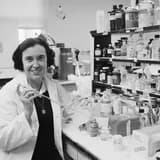
Yalow won the 1977 Nobel Prize in Physiology or Medicine, becoming the second woman and first American-born woman to receive the prize in that category.
On 10 October 1977, Rosalyn Yalow was awarded the Nobel Prize in Physiology or Medicine for the development of radioimmunoassays of peptide hormones. She shared the prize with Roger Guillemin and Andrew V. Schally. Yalow’s award made her the second woman ever to receive the medicine Nobel and the first American-born woman to do so.
The historical significance of the prize was immense. Yalow’s work with Solomon Berson had shown that radioactive tracers could be used to measure extraordinarily small concentrations of substances in blood and other body fluids. That innovation revolutionized endocrinology, diabetes research, and many other fields of medicine. It also carried symbolic force in an era when women scientists were still underrepresented in elite recognition. Yalow’s Nobel affirmed not only a transformative method but also the legitimacy of women’s leadership at the highest level of science. Her later status as the only female veteran-affiliated Nobel laureate further adds to the singular place she holds in American scientific history.