← All women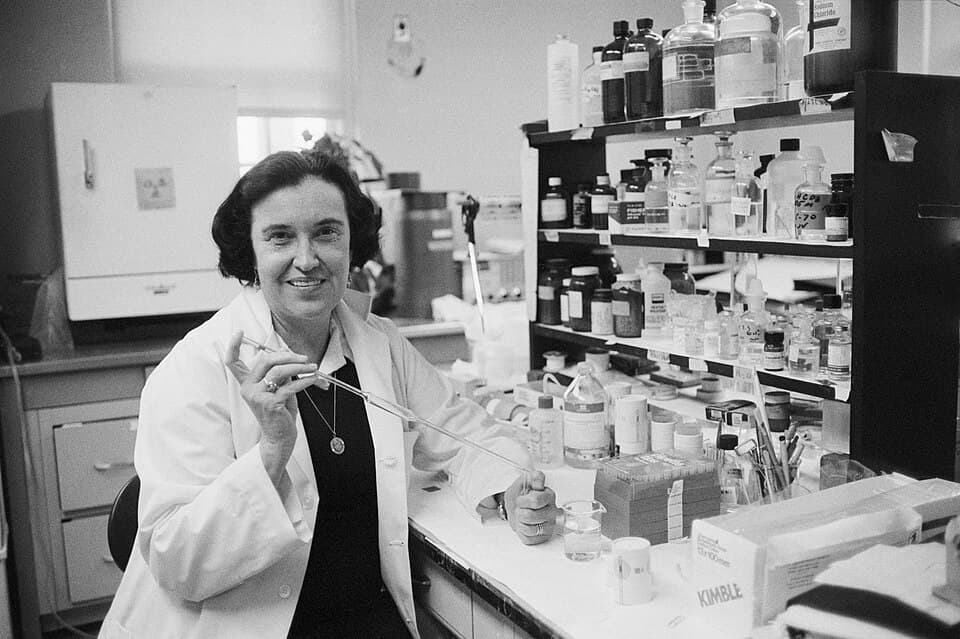
American · Science · Medicine
Rosalyn Yalow
July 19, 1921 – May 30, 2011
Early life and education
Rosalyn Sussman Yalow was born in New York City on July 19, 1921, and grew up in the Bronx in a Jewish family. Her father, Simon Sussman, worked as a paper and twine jobber, and her mother, Clara Sussman, was a piece sewer. Biographical sources emphasize that her parents had limited formal education, a background that made Yalow’s eventual scientific rise especially remarkable. She later reflected the independence and ambition that had to be cultivated in a time when many doors in science were still closed to women.
Yalow attended public schools in New York and then entered Hunter College, where she earned her bachelor’s degree in 1941. Hunter was an important pathway for talented women in science, especially those who faced discrimination at more selective institutions. Her intellectual ability and determination led her to the University of Illinois at Urbana–Champaign, where she entered graduate study in physics in 1941. According to institutional and biographical sources, she became the first woman in more than two decades to be admitted to the university’s engineering program, a sign of the era’s restricted access to advanced technical education for women.
At Illinois, Yalow studied nuclear physics and worked as a teaching assistant. She earned her master’s degree in 1942 and completed her doctorate in 1945. She was only the second woman in the university’s history to receive a PhD in physics. This was not simply a personal triumph; it represented a breach in the gender barriers that had long kept women from the most prestigious scientific training. The rigorous discipline she acquired in physics would become central to her later career in medical research.
Marriage and early career
On June 6, 1943, Yalow married Aaron Yalow. Their marriage occurred while she was still building her academic career, and later biographical accounts note two children, Benjamin and Elanna. Like many women scientists of her generation, Yalow had to balance professional ambition with family life at a time when women were often expected to leave science after marriage or motherhood. That she continued in research and later achieved international prominence reflects both unusual persistence and exceptional competence.
After completing her doctorate, Yalow faced a job market and research environment in which women physicists were frequently overlooked for prestigious positions. She took on teaching and research work before moving into the field that would define her career: medical physics. Her scientific identity was shaped in a period when the practical applications of physics to medicine were expanding, especially through the use of radioisotopes after World War II. Yalow’s training positioned her to bridge two domains that were rarely connected in the minds of many traditional scientists: nuclear physics and clinical medicine.
Work at the Veterans Administration Hospital
Yalow’s most important professional home became the Bronx Veterans Administration Hospital, where she worked with physician-scientist Solomon A. Berson. Their collaboration began in an era when major biomedical discoveries could emerge from modest settings, and their early laboratory space was famously limited. Biographical accounts describe them working in cramped quarters, even in a former janitor’s closet, yet producing research that would transform medicine. The limited resources they faced did not prevent them from asking large and original questions about how hormones circulate in the body.
In the late 1950s, Yalow and Berson developed radioimmunoassay (RIA), a technique that uses radioactive tracers and antibodies to detect tiny quantities of biological substances. Their 1959 work applying the method to insulin measurement was particularly consequential. Before RIA, many hormone levels could not be measured accurately enough to support modern endocrine research. Yalow and Berson’s method made it possible to quantify minute concentrations in blood and other body fluids, opening new pathways for diagnosis and treatment. The technique proved invaluable in diabetes research and later in studies of thyroid disease, fertility, and many other conditions.
The importance of radioimmunoassay extended beyond a single disease area. It changed how medicine understood biochemical communication in the body. By allowing researchers to detect substances at extremely low levels, it helped build the laboratory foundations of contemporary endocrinology and clinical testing. Yalow’s contribution was especially notable because she was applying physics to a domain that had previously relied on far less sensitive techniques. Her success also challenged assumptions about what kinds of work women physicists could do and how far a scientist could advance outside the conventional academic elite.
Recognition and honors
Yalow’s scientific contributions were increasingly recognized in the 1970s. On September 22, 1976, she received the Albert Lasker Award for Basic Medical Research, becoming the first woman to win that distinction. The award acknowledged the importance of radioimmunoassay in modern biomedical science and helped cement her reputation as a leading figure in medical research.
The highest recognition came on October 10, 1977, when Yalow received the Nobel Prize in Physiology or Medicine alongside Roger Guillemin and Andrew V. Schally. The Nobel Prize awarded her work on radioimmunoassays of peptide hormones. This made her the second woman to receive the medicine Nobel, after Gerty Cori, and the first American-born woman in that category. The award was a landmark in the history of women in science because it publicly honored a woman who had built a foundational tool of modern medicine through persistence, ingenuity, and technical skill.
Yalow also became the first woman to serve as president of the Endocrine Society in 1977, the same year as her Nobel Prize. That leadership role underscored her influence not only as a researcher but also as a figure in the professionalization of endocrinology. Over the course of her career she received many additional honors, election to learned societies, and widespread recognition in scientific and women’s-history circles. Her name became closely associated with the idea that women could lead major scientific innovation even in institutions that had long excluded them.
Personal life
Yalow’s marriage to Aaron Yalow was an enduring part of her life story. Historical sources note two children, Benjamin and Elanna. Her family life developed alongside a demanding professional career, reflecting the realities faced by many women scientists who had to sustain both domestic responsibilities and high-level research in an era with few institutional supports for working mothers. Although she is most often remembered for her scientific breakthroughs, her ability to maintain a family life while advancing in a male-dominated field is itself part of her historical significance.
Yalow was also known for encouraging girls and young women to enter science after her Nobel Prize, recognizing the importance of visible role models. Her life therefore had a dual dimension: she was both a creator of essential biomedical methods and an emblem of possibility for future generations. That symbolic role grew out of the barriers she had overcome herself, including underrepresentation in physics and the scarcity of women in senior scientific positions.
Later life and death
After decades of work at the Bronx Veterans Administration Hospital, Yalow retired from the Veterans Administration in 1991. Even after retirement, her reputation remained central to accounts of twentieth-century medical innovation. The method she had helped create continued to underpin laboratory testing and research across a wide range of fields. Her career showed how a technique born in one modest hospital laboratory could reshape global biomedical science.
Rosalyn Yalow died in New York City on May 30, 2011. She was 89 years old. Tributes at the time of her death emphasized that radioimmunoassay had revolutionized medicine by making precise measurements of hormones and other biologically relevant substances possible. They also highlighted her position in women’s history as a pathbreaking scientist who helped force a wider public recognition of women’s capacity for original discovery at the highest level.
Legacy
Yalow’s legacy lies in both scientific method and historical precedent. In medicine, radioimmunoassay transformed the study of hormones and helped establish modern laboratory endocrinology. In women’s history, her career offered a powerful counterexample to the assumption that major scientific breakthroughs belonged chiefly to men. She advanced from a working-class Bronx upbringing to the Nobel Prize through institutional barriers that were still formidable for women in the mid-twentieth century.
Her story remains especially important because it combines technical innovation, persistence in the face of gender discrimination, and a record of firsts that opened symbolic and practical space for later women scientists. Rosalyn Yalow is remembered not only as a Nobel laureate but as a scientist whose work changed what medicine could measure, and whose life demonstrated that intellectual excellence could emerge from places and people long overlooked by the scientific establishment.
Dated achievements
6 indexed.
- Jul191921Science
Birth of Rosalyn Sussman Yalow
Birth of Rosalyn Sussman Yalow in New York City, the future physicist who would transform hormone measurement and become a Nobel laureate.
View details Britannica biography of Rosalyn Yalow - Jun061943Politics
Marriage to Aaron Yalow
Rosalyn Sussman married Aaron Yalow, a personal milestone that coincided with the wartime years of her early scientific career.