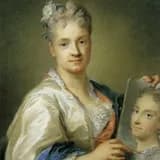
Carriera became one of very few women admitted to the prestigious French Royal Academy of Painting and Sculpture in Paris.
On October 26, 1720, following her sensationally successful stay in Paris, Rosalba Carriera was formally received (agréée and reçue) as a member of the Académie Royale de Peinture et de Sculpture, the most prestigious art institution in France and one of the most influential in all of Europe. Her presentation piece was a pastel allegory, Nymph of Apollo's Retinue, later titled variously in different accounts.
This honor was extraordinarily rare for a woman in the eighteenth century; the Academy limited female membership severely, and Carriera's admission placed her among an elite handful of women artists ever recognized by the institution. Her acceptance was propelled by the sensation she caused during her 1720-1721 sojourn in Paris, where she was celebrated by the highest levels of French society, painted portraits of the young King Louis XV, and befriended the wealthy financier and collector Pierre Crozat, who hosted her during her stay.
Her admission to the Academy validated pastel as a serious and legitimate artistic medium, elevating it from a tool for quick sketches and preparatory studies to a medium capable of producing finished masterworks worthy of royal and aristocratic patronage. It also cemented her reputation as an international celebrity artist, paving the way for greater acceptance of women in professional artistic institutions across Europe, and influencing later pastel virtuosos such as Maurice Quentin de La Tour and Jean-Baptiste Perronneau.