← All women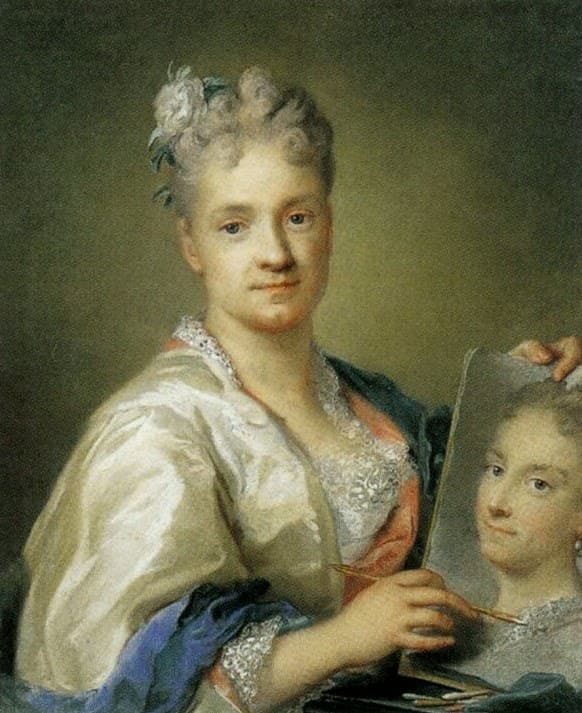
Italian, Venetian · Arts
Rosalba Carriera
October 7, 1675 – April 15, 1757
Early Life and Background
Rosalba Carriera was born in Venice on October 7, 1675, into a family of modest social standing. Her father, Andrea Carriera, worked as a minor government functionary, while her mother, Alba Foresti, was a skilled lacemaker whose craft placed the family within Venice's vibrant tradition of decorative arts. Rosalba was the eldest of three daughters; her younger sisters, Giovanna and Angela, would later become integral to her artistic enterprise, serving as studio assistants and collaborators throughout her career.
Venice in the late seventeenth century was a city in cultural and economic transition. Though its political and commercial power had waned since its medieval and Renaissance heyday, the city remained a magnet for wealthy travelers undertaking the Grand Tour, a rite of passage for young European aristocrats that combined education with leisure and consumption of art and souvenirs. Rosalba's earliest training came through her mother's lace-making workshop, where she learned to design intricate patterns. As the lace trade began to decline due to shifting fashions favoring different textiles, young Rosalba redirected her talents toward painting, initially producing miniature designs for snuffbox lids, a popular souvenir item sold to tourists passing through Venice.
Formal records of Carriera's artistic training are scarce, which has led historians to describe her largely as self-taught, though she likely received some informal guidance from Venetian painters of the period, possibly including Giuseppe Diamantini and Antonio Balestra. She also is thought to have studied works by other artists and engravings to develop her technique, an unconventional path for a woman in an era when formal academies and guild apprenticeships were typically closed to females.
Career Beginnings and the Rise of Pastel
Carriera's transition from miniature snuffbox painting to portrait miniatures on ivory marked her first significant artistic breakthrough. She developed a highly refined technique for painting directly on ivory, which imparted a luminous, translucent quality to her portraits that quickly attracted attention. Her miniatures gained popularity among the international visitors to Venice, and her reputation began to spread through networks of collectors, dealers, and travelers.
It was, however, her adoption and mastery of the pastel medium that would define her legacy and transform European art. Pastels, made from pigment sticks bound with gum, had existed for centuries but were generally regarded as a medium suited only to preparatory sketches or quick studies, not to finished, exhibition-worthy works. Carriera pioneered techniques of blending, layering, and building up pastel colors that achieved an unprecedented subtlety and luminosity, rivaling the sophistication of oil painting while retaining the immediacy and softness unique to pastel. She developed sophisticated methods for capturing the texture of skin, fabric, and hair, imbuing her sitters with a lifelike vibrancy that appealed enormously to the aristocratic clientele of her day.
By the first decade of the eighteenth century, Carriera had established a thriving studio in Venice, assisted by her sisters, particularly Giovanna, who became a talented pastelist in her own right, and Angela, who married the painter Giovanni Antonio Pellegrini, further linking the family to prominent artistic circles. Rosalba never married, choosing instead to dedicate herself fully to her craft and to managing a busy international clientele.
Major Works and International Acclaim
Carriera's reputation soared as she attracted patrons from across Europe. Grand Tourists, diplomats, and nobility sought portraits from her hand as prized souvenirs of their Venetian sojourns, and her fame soon extended well beyond Italy. Her sitters included members of the highest echelons of European society, and she produced portraits noted for their psychological insight as well as their technical brilliance.
A pivotal moment in her career came with her travels beyond Venice. In 1720, she journeyed to Paris at the invitation of the wealthy financier and art collector Pierre Crozat, who had long admired her work and served as her host and patron during her stay. Her time in Paris, lasting roughly a year, was a sensation. She was welcomed into the highest circles of French society and art, painting a celebrated portrait of the young King Louis XV, then a child monarch, as well as portraits of numerous aristocrats and members of the intellectual elite, including Antoine Watteau, with whom she developed a warm friendship; she is known to have painted his portrait as well.
Her success in Paris culminated in her election to the Académie Royale de Peinture et de Sculpture on October 26, 1720, an extraordinary honor rarely extended to women. This recognition was a watershed moment not only for Carriera personally but for the status of pastel as an artistic medium and for the broader question of women's participation in formal artistic institutions.
Following her triumphant Paris sojourn, Carriera's fame continued to grow. She traveled to Modena in 1723 at the invitation of the ducal court, and undertook a significant journey to Vienna in 1730, where she was received by Emperor Charles VI and produced numerous portraits of the imperial court, including the Empress and other members of the Habsburg family. Her international clientele over the decades included figures from England, Germany, Poland, Denmark, and beyond, making her arguably the most sought-after portraitist in Europe during the 1720s and 1730s.
Artistic Style and Technical Innovation
Carriera's style is characterized by its delicate handling of color, soft modeling of flesh tones, and an ability to capture both likeness and a sense of refined elegance associated with the Rococo aesthetic then ascendant in European art. Her portraits often depicted sitters in idealized, allegorical guises, such as depicting women as personifications of the Seasons or as classical or mythological figures, a fashionable convention that allowed her to display both technical virtuosity and imaginative flair.
Her technical contributions to the pastel medium were substantial. She experimented with new methods of fixing and preserving pastel works, and her handling of the medium influenced a generation of subsequent pastelists, including the French masters Maurice Quentin de La Tour and Jean-Baptiste Perronneau, both of whom built upon the foundations she established. Her influence extended to oil painters as well, who admired her subtle color harmonies and sensitive characterizations.
Personal Life
Carriera never married and had no children, a common choice among some professional female artists of her era who found that marriage and domestic obligations could impede a demanding artistic career. She lived for much of her adult life with her mother and sisters, and the Carriera household functioned as a close-knit family enterprise centered on artistic production. Her sister Giovanna, also a pastelist, worked alongside her for years until Giovanna's death in 1738, a loss that deeply affected Rosalba. Her sister Angela, who had married painter Giovanni Antonio Pellegrini, predeceased Rosalba as well, contributing to a series of personal losses in her later years.
Later Life, Decline, and Death
Carriera's later years were marked by profound personal and physical hardship. Beginning around 1730, she began to experience deteriorating eyesight, an affliction of particular cruelty for an artist whose entire craft depended on precise visual discrimination of color and light. She sought treatment for what was likely cataracts, undergoing surgery in 1746 that ultimately failed to restore her vision. By the early 1750s, she had become almost entirely blind, effectively ending her ability to paint.
Compounding her physical decline, Carriera suffered from documented periods of mental distress and melancholia in her final years, exacerbated by the deaths of her close family members and the isolation imposed by her blindness. Visitors and correspondents, including the French collector and connoisseur Pierre-Jean Mariette, documented her sorrowful condition during this period.
Rosalba Carriera died in Venice on April 15, 1757, at the age of 81. She was buried in her native city, the city whose light and artistic traditions had shaped her extraordinary career.
Legacy and Historical Impact
Rosalba Carriera's legacy endures as one of the most significant transformations in eighteenth-century European art. She is widely credited with elevating pastel from a medium of quick studies and preparatory sketches to one capable of producing fully realized, exhibition-quality masterworks that could stand alongside oil paintings in prestige and technical accomplishment. Her influence radiated across the continent, shaping the work of major pastelists in France, and inspiring the broader Rococo aesthetic's embrace of soft, luminous color and intimate psychological portraiture.
As a woman who achieved international fame and institutional recognition in a field overwhelmingly dominated by men, Carriera stands as a pioneering figure in the history of women artists. Her election to the French Royal Academy was a rare acknowledgment of female artistic genius in an era when women were systematically excluded from most professional and academic artistic structures. Today, her works are held in major museum collections worldwide, including the Gemäldegalerie Alte Meister in Dresden, the Metropolitan Museum of Art, the Uffizi Gallery, and the Ca' Rezzonico museum in Venice, ensuring her continued recognition as a defining master of eighteenth-century portraiture.
Dated achievements
3 indexed.
- Oct071675Arts
Birth of Rosalba Carriera in Venice
Rosalba Carriera was born in Venice on October 7, 1675, to a modest family of a lace-maker and a civil servant.
View details Rosalba Carriera - Wikipedia - Oct261720Arts
Elected to the Académie Royale de Peinture et de Sculpture in Paris
Carriera became one of very few women admitted to the prestigious French Royal Academy of Painting and Sculpture in Paris.