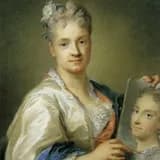
Rosalba Carriera died in Venice on April 15, 1757, nearly blind and largely forgotten after decades as Europe's most celebrated pastel portraitist.
Rosalba Carriera died in her native Venice on April 15, 1757, at the age of 81. Her final years were marked by tragedy and hardship: she had begun losing her eyesight in the early 1730s, a devastating affliction for an artist whose entire career depended on precise visual perception and delicate handling of color. She underwent unsuccessful cataract surgery in 1746, which failed to restore her sight, and by the 1750s she was almost completely blind, a cruel irony for one of the most visually gifted artists of her generation.
Her later years were also clouded by mental decline, possibly linked to the deaths of her sisters Giovanna and Angela, who had long been her closest companions and studio assistants, and general melancholia recorded by contemporaries who visited her in her final years, including the French collector Pierre-Jean Mariette.
Despite this sorrowful decline, Carriera's legacy as the preeminent pastel portraitist of the eighteenth century was already firmly established across Europe. She had trained and influenced a generation of pastel artists, and her technical innovations, including her use of blended, luminous colors and her elevation of the pastel medium to rival oil painting in prestige, permanently transformed European portraiture. She was buried in Venice, and her death marked the end of an era for the Rococo pastel tradition she had done so much to define, though her influence persisted through artists she inspired throughout the eighteenth century.