← All women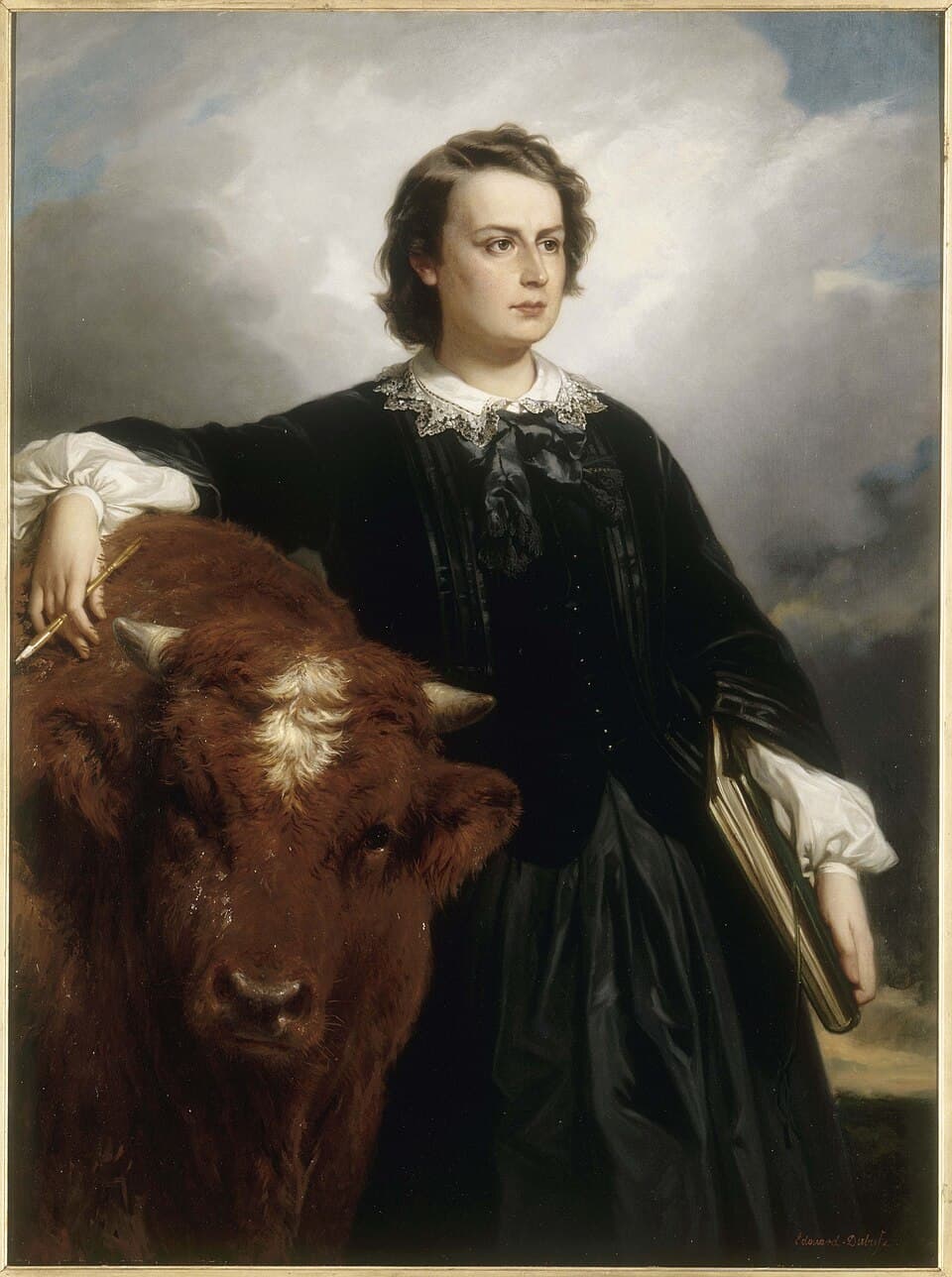
French · Arts
Rosa Bonheur
March 16, 1822 – May 25, 1899
Early Life and Background
Rosa Bonheur, born Marie-Rosalie Bonheur on 16 March 1822 in Bordeaux, France, emerged as one of the most celebrated animal painters of the 19th century.[2][3] She was the eldest daughter in a family of artists; her father, Raimond (Raymond) Bonheur, was a landscape painter and drawing teacher, while her siblings Auguste, Isidore, and Juliette also pursued artistic careers.[5][17] The family moved to Paris around 1829, seeking better prospects and immersion in the capital’s cultural life.[1][12] Her father’s association with Saint-Simonian social and feminist ideas encouraged a belief in education and professional opportunities for women.[5][16]
Bonheur’s formal schooling was limited and reportedly difficult; she struggled with conventional academic subjects and was eventually withdrawn from school.[2] Instead, she trained under her father, copying drawings, studying prints, and practicing from nature. She was encouraged to draw animals from an early age, visiting markets, streets, and the countryside.[1][11] These experiences nurtured a deep fascination with living creatures and developed her exceptional observational skills.
Growing up in a period when women’s access to professional training was restricted, Bonheur’s artistic formation was largely informal. She was excluded from the École des Beaux-Arts, which did not admit women, and had to compensate by intensive self-directed study.[2][11] Her father’s progressive views and the artistic atmosphere at home were crucial in enabling her to pursue an ambition that few women of her generation could realize: a full-time career as an artist.
Career Beginnings and Development
Bonheur’s professional career began remarkably early. In 1841, at the age of nineteen, she exhibited for the first time at the Paris Salon, submitting two animal paintings.[20][11][1] The Salon, organized by the Académie des Beaux-Arts, was the most important official exhibition in France. Acceptance into its juried show was a significant achievement in itself and marked Bonheur as a serious artist within the mainstream institution rather than an amateur working on the margins.
Bonheur quickly established herself as an "animalier"—an artist specializing in animal subjects—but on a scale and with a seriousness uncommon for women.[8] She returned to the Salon repeatedly during the 1840s and early 1850s. Her reputation grew steadily, thanks to her combination of meticulous naturalism and ambitious compositions.[1][18] In 1845, she was awarded a third-class medal in the "Paysage et Animaux" (Landscape and Animals) category, her first official decoration from the Salon.[20][1] This recognition indicated that critics and juries considered her work technically accomplished and emotionally compelling.
Three years later, at the Salon of 1848, Bonheur received a first-class (gold) medal for her painting Bœufs et Taureaux, race du Cantal (Oxen and Bulls, Cantal Breed).[20][1][16] The prize represented the highest level of Salon distinction and confirmed her status among the leading artists of her generation. The work’s powerful depiction of rural cattle reflected her method: she spent extensive time studying animals in fields, markets, and stables, sketching them from life and sometimes dissecting carcasses to understand anatomy.[1][18]
The revolutionary year of 1848 saw the rise of the Second Republic, which briefly adopted more egalitarian rhetoric. Within this political context, Bonheur’s success as a woman artist carried symbolic weight. It showed that, at least in the realm of art, talent and persistence could sometimes override entrenched gender bias.
Major Works and Accomplishments
One of Bonheur’s most important early achievements was the state commission for Ploughing in the Nivernais (Labourage). Commissioned by the government of the Second Republic, the painting was exhibited at the Salon of 1849.[1][5][20] It depicts teams of oxen ploughing the fields in the Nivernais region, rendered with striking realism and lyrical attention to the rhythms of rural labor. The work elevated contemporary agricultural scenes to the status of serious, nearly "historical" painting, challenging the hierarchy that placed grand historical or mythological subjects above scenes of everyday life.
This commission was a landmark: large, prestigious government commissions were rarely entrusted to women. Bonheur’s success signaled that the state recognized her mastery and allowed a woman to represent themes central to national identity.[1][5] The painting remains a key work in the collection of the Musée d’Orsay in Paris, underscoring its enduring importance.[2]
Bonheur’s international fame was sealed by her monumental canvas The Horse Fair (Le marché aux chevaux). She exhibited the original version at the Salon of 1853, and the work was completed around 1855.[2][11] The painting depicts the horse market held on the Boulevard de l’Hôpital in Paris, featuring powerful horses and dealers amidst dynamic movement. The composition stretches across a large horizontal canvas, combining panoramic vision with precise anatomical detail.
The Horse Fair was widely acclaimed at the Salon, praised for its energy, realism, and technical sophistication.[11] It later toured England, where it attracted great attention and was admired by Queen Victoria.[1][11] Bonheur also painted a smaller version, now in the National Gallery in London, to facilitate the production of engravings and prints for sale, demonstrating her adeptness at managing the commercial aspects of her success.[15]
The painting eventually entered the collection of the Metropolitan Museum of Art in New York, where it remains one of the institution’s iconic 19th‑century works.[2][18] Its presence in major museums across countries illustrates the breadth of Bonheur’s impact.
Throughout her career, Bonheur produced numerous other animal paintings and sculptures, depicting cattle, horses, lions, deer, and farm scenes. She carefully studied her subjects, often maintaining a personal menagerie of animals at her residence and visiting slaughterhouses and stables to deepen her knowledge.[1][11][18] Her commitment to direct observation aligned with realist tendencies in mid-century art but retained a deeply sympathetic view of animals, which some later writers have associated with modern concerns about animal welfare.
Awards, Honours, and Official Recognition
Bonheur’s sustained achievements were recognized through a series of prominent honours. As noted, she earned Salon medals in 1845 and 1848.[20][1] Her breakthrough status as a nationally celebrated artist led to a remarkable moment in 1865, when she was awarded the Cross of the Légion d’honneur, France’s highest civilian order of merit.
In June 1865, Empress Eugéniefirst female artist and generally regarded as the first woman to receive the Légion d’honneur.[11][8] The honour acknowledged both her artistic excellence and her role as a symbol of the possibilities open to women.
Later, in 1894, Bonheur was promoted to Officier de la Légion d’honneur, becoming the first woman to attain this higher rank.[11][9][20] This promotion reflected decades of consistent achievement and influence. At a time when few women received such recognition, her advancement demonstrated that the French state was willing to reward sustained contributions by women in cultural fields.
Beyond the Légion d’honneur, Bonheur enjoyed extensive international recognition. Her works were collected by wealthy patrons in France, Britain, and the United States, and she was one of the richest and most commercially successful women artists of her era.[18] She corresponded with collectors and admirers across Europe and North America, and her exhibitions often attracted large audiences. Cultural institutions including the National Gallery in London, the Musée d’Orsay in Paris, and the Metropolitan Museum of Art in New York acquired her works, further consolidating her reputation.[2][11][15]
Personal Life and Relationships
Bonheur’s personal life was unconventional for a 19th‑century woman. She never married and instead formed long-term relationships with women, which have attracted growing attention from scholars and LGBTQ+ historians.[6][18] Her first major companion was Nathalie Micas, with whom she lived for many years. After Micas’s death, Bonheur developed a close partnership with the American painter Anna Elizabeth Klumpke, who later authored a biography of Bonheur and managed aspects of her estate.[2]
Bonheur openly defied gender norms in her daily life. She wore men’s trousers and jackets, cut her hair short, smoked in public, and rode horses.[4][18][19] Because French law required women to obtain special permission to wear male clothing, she secured a police permit that allowed her to dress practically for visiting stables, markets, and slaughterhouses to study animals.[2][19] Her appearance and habits drew commentary from contemporaries, some of whom criticized her as "masculine"; others admired her independence.
She lived and worked for many years at the Château de By near Fontainebleau, where she maintained a studio and kept a small menagerie of animals.[2][11] The rural estate provided space and seclusion, allowing her to focus on large-scale works while living according to her own rules. Contemporary accounts describe an environment filled with animals—dogs, horses, deer—reflecting her lifelong fascination and affection for nonhuman creatures.[1]
Later interpretations have highlighted Bonheur’s relationships with women and her gender-nonconforming presentation as aspects of a queer history of art. Some modern writers frame her as a proto-lesbian or gender-nonconforming figure, though terminology and identities were different in her time.[6][18] Regardless of labels, the evidence indicates that she forged a life centered on personal choice and professional dedication rather than conformity to expected female roles.
Artistic Style, Working Methods, and Ideas
Bonheur’s artistic style was rooted in naturalism and realism. She focused on capturing the physical presence and movement of animals with scientific accuracy, while often infusing scenes with emotional resonance and a sense of dignity.[2][10] Her paintings feature carefully modeled forms, richly textured coats, and nuanced light effects that convey the mass and vitality of horses, cattle, and other animals.
Her working methods were rigorous. She produced numerous preparatory sketches, studying animals from multiple angles and in varied environments before committing compositions to canvas.[1][11][18] She frequented markets, farms, and the horse fair at the Boulevard de l’Hôpital, drawing on-site to record gestures and groupings.[2] In pursuit of anatomical understanding, she visited slaughterhouses and performed dissections, seeking precise knowledge of muscle and bone structures.[1][18] This empirical approach reflects both her personal curiosity and the broader 19th‑century interest in scientific observation.
Despite her unconventional life, Bonheur’s art often aligned with dominant aesthetic tastes of the period. She favored clear narrative compositions, detailed finish, and themes that appealed to bourgeois patrons—rural labor, noble animals, and picturesque countryside.[1][4] This combination of technical rigor and accessible subject matter contributed to her commercial success.
Bonheur herself expressed strong views about art and vocation. According to later accounts, she regarded art as a "tyrant" that demanded complete devotion.[19] She prioritized her work above social expectations, turning down marriage and many social engagements to preserve time and focus for painting. Her stance resonated with the Romantic ideal of the artist as a dedicated, sometimes solitary figure, but her gender made this choice particularly striking.
Legacy and Historical Impact
During her lifetime, Bonheur was often described as the most famous female painter of the 19th century.[2][13] Her fame rested not only on the popularity of works like The Horse Fair but also on the narrative of her life—a woman who had achieved extraordinary success in a male-dominated field while living with substantial independence. She became a role model for aspiring women artists, demonstrating that they could aim for large-scale, technically challenging work and seek official recognition.[1]
Bonheur’s influence extended beyond the art world. Her receipt of the Légion d’honneur in 1865 and promotion to Officier in 1894 broke gender barriers in France’s highest civil honour system and helped broaden public understanding of women’s contributions to national culture.[11][9] These milestones are frequently cited in histories of women’s rights and recognition.
In the decades after her death, shifts in artistic taste reduced her visibility. The rise of Impressionism and modernist movements led some critics to view her detailed realism as conservative or outdated.[2] However, her works remained in major museum collections, and periodic exhibitions and biographies ensured that she was never completely forgotten.
Recent scholarship and public initiatives have revived interest in Bonheur, particularly in relation to women’s and LGBTQ+ history. Studies emphasize her defiance of gender norms, her same-sex relationships, and her self-determined lifestyle.[6][18] Museums and cultural institutions highlight her as a pioneering woman artist who achieved unprecedented commercial success and honoured status at a time when most women were confined to private spheres.
Her legacy also reaches into contemporary digital culture. On 16 March 2022, the bicentenary of her birth, Google featured a dedicated Google Doodle celebrating her life and work, bringing her story to a global audience and prompting renewed media coverage.[7] This modern commemoration underscores her continuing relevance as a figure of artistic excellence and gender-norm defiance.
Later Life and Death
In her later years, Bonheur continued to live and work at the Château de By near Fontainebleau, surrounded by animals and nature.[2][11] She maintained her artistic productivity, painting and sculpting even as new movements emerged around her. Her relationship with Anna Klumpke deepened, and Klumpke became both a companion and chronicler of her life.
Bonheur’s health eventually declined, and she died on 25 May 1899 at By, near present-day Thomery, France.[2][3][9] Sources indicate that she died of complications following pneumonia.[16] She was 77 years old. Her death marked the end of an era in French animal painting and removed from the scene a figure who had been central to discussions about women in art for half a century.
After her death, Klumpke and others worked to preserve her studio and legacy. Many of her works were acquired by museums or remained in private collections. Her home at By has been recognized as an important site for understanding 19th‑century artistic life.
Today, Bonheur’s life is studied not only for her artistic achievements but also for what she reveals about women’s strategies for navigating restrictive social systems. She used talent, discipline, and a carefully managed public image to secure space for herself within institutions that were not designed for women. Her biography continues to serve as a touchstone in discussions about gender, art, and recognition.
Dated achievements
10 indexed.
- Mar161822Arts
Birth of Rosa Bonheur
Marie-Rosalie "Rosa" Bonheur was born on March 16, 1822, in Bordeaux, France.
View details Wikipedia - Mar011841Arts
First exhibition at the Paris Salon
At age 19, Bonheur exhibited her works for the first time at the Paris Salon in 1841.
View details