← All women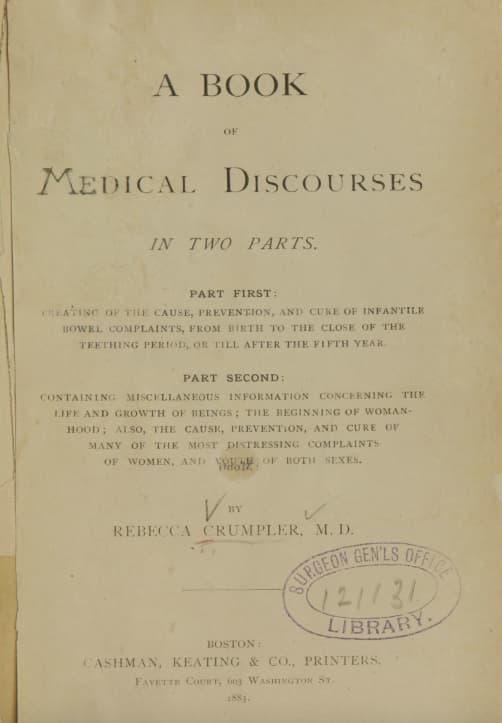
American · Medicine
Rebecca Lee Crumpler
February 8, 1831 – March 9, 1895
Early Life and Background
Rebecca Davis Lee Crumpler (born Rebecca Davis) was an American physician, nurse, and medical author, best known as the first African American woman to earn a medical degree in the United States.[1][2][11] She was born on February 8, 1831, in Christiana, Delaware, to Matilda Webber and Absolum Davis.[2][10][11] Several biographical accounts note that she grew up in Pennsylvania, where she lived with an aunt who provided informal health care to neighbors, caring for the sick and vulnerable in the community.[6][9][11] This environment of lay caregiving exposed Rebecca to basic nursing and health practices and strongly influenced her desire to pursue a career in medicine.[1][6][10]
Little is known about her early formal education, but sources indicate that she attended a prominent private school, the West Newton English and Classical School in Massachusetts, as a "special student," suggesting that she received advanced instruction beyond the limited schooling typically available to Black girls in the mid‑nineteenth century.[6] Her move from Delaware and Pennsylvania to Massachusetts occurred against a backdrop of intense regional inequalities: while slavery was abolished in the North, racism and segregation still sharply constrained educational and professional opportunities for African Americans. Crumpler’s ability to secure private schooling reflects both her own determination and the support of networks willing to invest in her talent.
Biographical sources agree that in 1852 she moved to Charlestown, Massachusetts, where she lived with her caregiving aunt and began working as a nurse.[6][9][10] At this time, nursing was not yet a formally credentialed profession, and many women—especially Black women—provided care as untrained or informally trained nurses. Crumpler’s years as a nurse in Charlestown and other parts of Massachusetts throughout the 1850s gave her extensive practical experience in caring for the sick before she entered medical school.[1][4][9][10]
Career Beginnings and Medical Education
By the late 1850s, Crumpler’s reputation as a capable nurse had grown. Documentation from multiple sources indicates that she spent approximately eight years nursing in Massachusetts communities, including Boston.[1][9][10] In 1860, she applied to the New England Female Medical College in Boston, the first institution in the world established specifically to train women physicians.[1][6][10] According to CompHealth and American National Biography, she was the first Black woman known to apply to a medical school in the United States, underscoring the audacity of her decision.[6]
The New England Female Medical College offered a program leading to the degree of "Doctress of Medicine." At the time, women were largely barred from coeducational medical schools, and Black students faced near‑total exclusion from professional training. Crumpler’s acceptance into the college required surmounting both gender and racial barriers. She studied anatomy, physiology, clinical practice, and the prevailing medical theories of the mid‑nineteenth century, likely under considerable scrutiny from faculty and peers unaccustomed to a Black woman trainee.[1][10]
In 1864, Crumpler completed her program and graduated with the Doctress of Medicine degree.[1][2] This achievement made her the first African American woman in the United States to earn an M.D. degree and the only African American woman ever to graduate from the New England Female Medical College.[1][2][4] The college itself would later merge with Boston University School of Medicine in 1873, without graduating any other Black women.[1][4] For many years, historical accounts misattributed the distinction of the first Black woman physician to Rebecca Cole; the National Library of Medicine explicitly notes that this honor was "formerly credited to Rebecca Cole" and now correctly identifies Crumpler as the pioneer.[1]
Post–Civil War Practice and Work with the Freedmen’s Bureau
After her graduation, Crumpler initially practiced medicine in Boston, where she built on her nursing experience to serve local communities.[1][10] With the end of the American Civil War in 1865, she moved to Richmond, Virginia, joining the massive effort to care for newly freed African Americans in the Reconstruction South.[1][4][8][11] In Richmond she worked with the Freedmen’s Bureau and other charitable organizations, providing medical care to formerly enslaved people, women, and children who were frequently denied treatment by white physicians.[1][4][8][10][11]
Conditions in postwar Richmond were harsh. Freedpeople faced poverty, disease outbreaks, and hostile white resistance. Crumpler’s work often involved treating patients who lived in crowded, unsanitary environments, addressing illnesses such as smallpox, cholera, and other infectious diseases that disproportionately affected the poor.[8][10] She faced not only the medical challenges of limited resources but also overt racism and sexism; some white physicians refused to recognize her credentials, and many white patients declined to be treated by a Black woman doctor.[1][11] Nonetheless, she persisted, documenting these challenges and her clinical experiences in journal notes that she would later use in her major written work.
Her Richmond practice exemplified a form of community‑based health care that prioritized populations excluded from mainstream institutions. By working through the Freedmen’s Bureau, she contributed to a government‑led experiment in social medicine, helping people transition from slavery to citizenship and asserting that Black communities deserved competent, professional medical care. This phase of her career cemented her reputation as a physician deeply committed to racial justice and public health.
Return to Boston and Urban Medical Practice
By the late 1860s, Crumpler returned to Massachusetts, and sources place her back in Boston by about 1869.[1][8][10] There she established a practice in the city’s North Slope of Beacon Hill, an area with a significant Black and working‑class population.[1][8] She focused her work on women and children, continuing the emphasis on maternal and child health that had characterized her earlier nursing and medical efforts.
Contemporary accounts and later historical reconstructions describe Crumpler’s Boston practice as busy and demanding. She treated a wide range of conditions, from pregnancy‑related complications to childhood infectious diseases, and often cared for people who could not afford private physicians.[1][8][10] Her approach emphasized preventive measures—hygiene, nutrition, vaccination, and early treatment—as much as curative interventions, a perspective that anticipated the later development of formal public health and community medicine.[8][12]
Despite her qualifications, she continued to face professional isolation. Many mainstream institutions did not recognize Black women physicians on equal terms, and she appears not to have held hospital appointments typical of white male doctors.[1] Instead, her medical authority was grounded in neighborhood practice, word‑of‑mouth reputation, and her ability to deliver effective, compassionate care. She is reported to have retired from active medical practice by around 1880, after more than two decades devoted to nursing and medicine.[10]
Major Work: A Book of Medical Discourses in Two Parts
Crumpler’s most enduring professional contribution is her 1883 publication, A Book of Medical Discourses in Two Parts. Drawing on years of journal notes and clinical experience, she wrote the book primarily for women, especially mothers, offering practical advice on caring for infants and children and on managing women’s health concerns.[1][8][10] Scientific American notes that she compiled nearly two decades of notes into this volume, which she published after treating hundreds, probably thousands, of patients.[8]
The book is structured in two parts. The first addresses infant and child health, covering topics such as breastfeeding, teething, common diseases, and preventive measures in early childhood. The second part focuses more on women’s health, including reproductive issues, pregnancy, and general care.[1][8][10] Throughout, Crumpler emphasizes preventive care: proper nutrition, cleanliness, timely medical consultation, and understanding symptoms before they escalate. Her tone is didactic but accessible, designed for lay readers rather than professional physicians.
Institutional sources including the National Library of Medicine, Medical News Today, and Adventist Health describe this volume as one of the first medical publications by an African American and likely the first academic medical textbook written by a Black physician in the United States.[1][6][9][10] Scientific American further highlights that it was also among the earliest medical texts by a woman in the U.S.[8][12] In the context of the 1880s, when scientific publishing was dominated by white male authors and Black women had virtually no presence in medical literature, Crumpler’s book represented a groundbreaking assertion of Black female expertise.
The impact of A Book of Medical Discourses extends beyond its immediate readership. Historians of public health note that her emphasis on community‑based and preventive strategies for women and children anticipated later developments in maternal and child health programs and health education.[8][12] The book also serves as a rare written record of a nineteenth‑century Black woman physician’s voice, providing insight into her clinical priorities and the health challenges faced by poor families in Boston and the postwar South.
Awards, Honors, and Later Recognition
During Crumpler’s lifetime, formal professional honors were limited, reflecting the exclusion of Black women from mainstream medical institutions. There is no evidence that she held prestigious posts or received awards from major medical societies in the nineteenth century. Instead, her recognition came informally, through the trust of patients and communities she served.
Posthumously, her reputation has grown substantially. The U.S. National Library of Medicine includes her in its "Changing the Face of Medicine" exhibition, recognizing her as the first African American woman to earn an M.D. and highlighting her book as one of the earliest medical texts by an African American.[1] PBS NewsHour, Scientific American, and numerous health organizations have published profiles celebrating her as a pioneer of women’s and Black health care.[8][11]
In the early twenty‑first century, researchers and institutions corrected the longstanding historical error that attributed the "first Black woman physician" title to Rebecca Cole, restoring Crumpler’s primacy.[1][2] Medical News Today, EBSCO, and other educational platforms now consistently identify her as the first African American woman to graduate from a U.S. medical school.[2][10] In 2020, Boston University reported that a gravestone was finally placed at her previously unmarked burial site more than 130 years after her death, symbolically acknowledging her contributions and giving her a permanent memorial.[10]
Crumpler’s story has also become an important feature of Black History Month commemorations, with hospitals, universities, and health organizations sharing her biography as an example of resilience and barrier‑breaking achievement.[6][9][11] While these honors came after her lifetime, they underscore her enduring significance in medical, African American, and women’s history.
Personal Life
Information about Crumpler’s personal life is limited, but available records indicate that she married at least once and possibly twice. Wikipedia and other sources identify her as Rebecca Davis Lee CrumplerArthur Crumpler.[2][4] The Spanish‑language Wikipedia notes that she married Arthur Crumpler, a veteran who served with the Union Army during the Civil War.[4] Details about the dates of these marriages, their duration, and any children are sparse in surviving documentation.
Her household arrangements likely intersected with her professional work. Living in Boston’s Beacon Hill area, she would have shared domestic responsibilities with her spouse while running a demanding practice focused on women and children.[1][8] Some sources suggest that her husband supported her career, but specific evidence is limited. The scarcity of personal papers—letters, diaries, or family records—complicates efforts to reconstruct her private life.
What is clear is that her identity as a married woman, and later as "Dr. Crumpler," challenged prevailing gender norms. Nineteenth‑century ideals of domestic femininity generally excluded professional work, especially in fields like medicine. By combining marital life with a medical career and authorship, Crumpler embodied an alternative model of Black womanhood that integrated family, community service, and professional achievement.
Legacy and Historical Impact
Rebecca Lee Crumpler’s legacy is multifaceted, encompassing pioneering achievements in medical education, clinical practice, and medical writing. First and foremost, she is recognized as the first African American woman to earn an M.D. degree in the United States, a status affirmed by the National Library of Medicine and multiple modern reference works.[1][2][10] This barrier‑breaking accomplishment opened conceptual space for Black women’s participation in medicine, even though structural discrimination continued to limit opportunities for decades.
Her work in Richmond with the Freedmen’s Bureau illustrates the role of physicians in Reconstruction‑era social justice. By treating formerly enslaved people, she helped address the health consequences of slavery and poverty, asserting that Black communities deserved competent medical care.[1][4][8][11] This contribution situates her within the broader history of African American professionals who used their skills to support emancipation and civil rights.
In Boston, her focus on poor women and children and on preventive health measures aligns her legacy with emerging concepts of public health and community medicine. Scientific American describes her as a "women’s health pioneer" whose emphasis on maternal education and disease prevention anticipated later developments in public health practice.[8] Her book, A Book of Medical Discourses, extended this impact by providing accessible medical guidance to a wider audience, making her one of the earliest Black physician authors.[1][8][10][12]
Her historical impact also includes the process of recovery and recognition. For much of the twentieth century, she was largely absent from mainstream medical histories, and her achievements were overshadowed by misattributions and the dominance of white male narratives.[1][2] The renewed scholarly and institutional attention to her story reflects broader efforts to acknowledge the contributions of Black women and other marginalized groups. In this sense, her legacy is not only what she did but also how later generations have come to value and reinterpret her work.
Today, Crumpler serves as an important role model for Black women entering medicine. Educational resources, museum exhibits, and Black History Month profiles frequently cite her perseverance and commitment to underserved communities.[1][6][9][11] Her life demonstrates that, even in the face of systemic discrimination, it was possible for a Black woman in the nineteenth century to attain professional credentials, practice medicine, and author a substantial medical text.
Later Life and Death
In her later years, Crumpler appears to have reduced her clinical workload, with sources suggesting that she retired from active practice by around 1880.[10] Having spent decades nursing and practicing medicine, she had already completed her major written work by publishing A Book of Medical Discourses in 1883.[1][8][10] She continued to live in the Boston area, specifically in Hyde Park, which was then a separate town but later annexed by Boston.
On March 9, 1895, Rebecca Davis Lee Crumpler died in Hyde Park, Massachusetts, at about age 64.[2][6][10][11] EBSCO notes that the cause of death was fibroid tumors.[10] Her passing marked the end of a quiet yet trailblazing career. Despite her historic achievements, her grave remained unmarked for many decades, reflecting the broader marginalization of Black women’s contributions in public memory.[10]
In the years following her death, medical and historical scholarship gradually rediscovered her work. As historians corrected the record to acknowledge her as the first African American woman physician, her grave became a site of symbolic importance. In 2020, a headstone was finally placed to honor her life and achievements, more than a century after her death, as reported by Boston University.[10] This act of commemoration underscores both how long she went unrecognized and how firmly her legacy has now taken root.
Rebecca Lee Crumpler’s life, spanning from 1831 to 1895, illustrates the intersecting histories of race, gender, and health in the United States. Her journey from a caregiving household in Pennsylvania to the halls of the New England Female Medical College, the clinics of Richmond’s Freedmen’s Bureau, the streets of Boston’s Beacon Hill, and the pages of an early medical text embodies a profound commitment to healing those with little access to care. Today, her name stands among the key figures who changed the face of American medicine.
Dated achievements
4 indexed.
- Feb081831Medicine
Birth of Rebecca Davis (Rebecca Lee Crumpler)
Rebecca Davis (later Rebecca Lee Crumpler) was born in Delaware.
View details Honoring Dr. Rebecca Lee Crumpler - Jan011864Medicine
First African American woman to earn an M.D. degree in the U.S.
Rebecca Lee Crumpler became the first African American woman to earn an M.D. degree.