← All women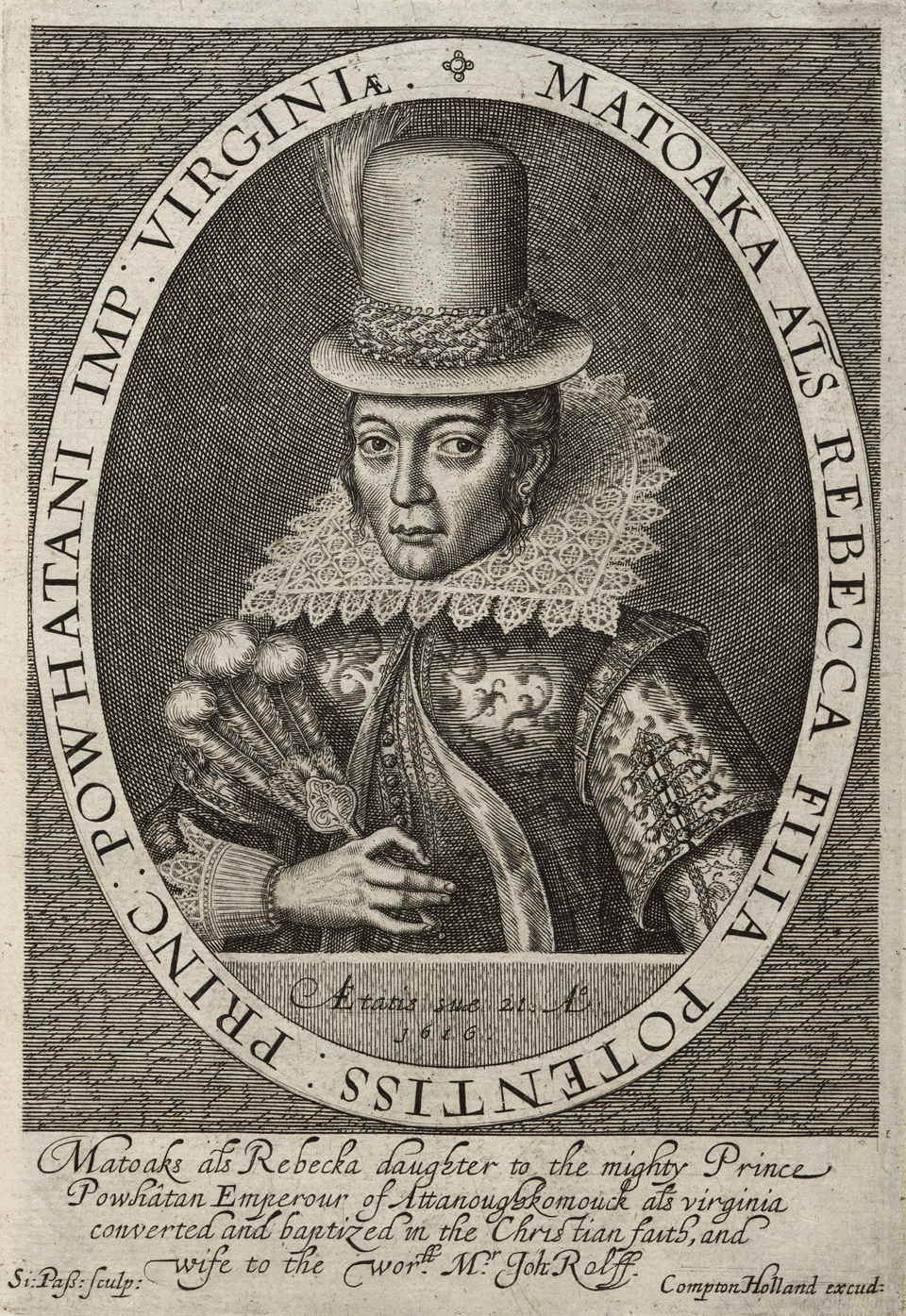
Powhatan · Exploration · Activism
Pocahontas
1596 – March 21, 1617
Early life and background
Pocahontas, who was also known by the names Matoaka and Amonute, was born around 1595 or 1596 near present-day Jamestown, Virginia, into the Powhatan world of Tsenacommacah, the powerful network of Algonquian-speaking peoples led by her father, Wahunsenacawh (commonly known as Chief Powhatan). Her exact birth date is not recorded, and the surviving evidence only permits an approximate year. As the daughter of the paramount chief, she grew up at the center of Indigenous political life in the Chesapeake, where kinship, diplomacy, trade, and ritual were inseparable from daily governance.
Very little is known with certainty about her childhood in the form modern biography often expects. English colonists later described her as playful and energetic, and the name Pocahontas itself was a nickname meaning something like “playful” or “mischievous.” Because most surviving records were written by English men, her early life must be reconstructed indirectly, from colonial reports and Indigenous context. What is clear is that she was not a “princess” in the European sense, but a young woman from a ruling family whose relationships mattered politically. In the early seventeenth-century Chesapeake, elite Indigenous women often played visible roles in exchange, alliance, and ceremonial life, even though later European accounts tended to flatten that complexity into romantic stereotype.
The period in which Pocahontas came of age was shaped by increasing pressure from English expansion. The Jamestown colony, founded in 1607, entered Powhatan territory with limited resources and an uncertain future. The resulting contact created both danger and opportunity. Pocahontas would later become one of the most famous figures associated with these early encounters, but her importance should be understood in the context of Indigenous sovereignty, not simply colonial legend. Her life unfolded at a moment when Native communities were trying to manage foreign intrusion while preserving autonomy, a challenge that would define much of her historical significance.
Early contact with Jamestown
Pocahontas first appears in English narratives in connection with the earliest years of Jamestown. In December 1607, she is said to have met Captain John Smith, one of the colony’s leaders. A year later, she reportedly brought food to the colonists during a devastating famine, helping to sustain the settlement when its stores and harvests had failed. Smith later described her as an “instrument” that preserved the colony from “death, famine, and utter confusion.” These accounts became central to her fame, though historians continue to debate the exact nature and reliability of the famous rescue story attached to Smith’s later recollections.
Regardless of the details of the Smith episode, Pocahontas’s role in the colony’s survival was real in the broader sense that she participated in the exchanges that linked Jamestown and the Powhatan world. Food, information, and access to trade routes were critical in a region where the English were dependent on Indigenous knowledge. English colonists were deeply vulnerable in the first years of settlement, and Powhatan leaders had strong reasons to watch, bargain with, or manipulate the newcomers. Pocahontas became one of the few Indigenous women whose name entered the colonial archive because of her movement through these politically charged spaces.
Her early contact with the settlers has often been romanticized, but the underlying historical reality was tense and unstable. English expansion threatened Powhatan control of land and resources, while the colony’s survival depended on uneasy cooperation. Pocahontas’s activities in this period reveal both her visibility and the limits imposed on her. She was young, but not politically irrelevant; rather, she stood at the center of a frontier relationship that would shape the future of English Virginia.
Captivity, conversion, and marriage
During the conflicts of the First Anglo–Powhatan War, Pocahontas stopped visiting Jamestown and was eventually taken prisoner by the English. She was held as a hostage and used in negotiations with her father, a reminder that her later prominence emerged from coercive colonial circumstances as much as from voluntary diplomacy. While in captivity at Henricus, she learned English customs and, around 1613–1614, converted to Christianity and was baptized as Rebecca. English leaders emphasized her baptism as evidence of missionary success, while modern historians note how carefully such claims served colonial interests.
Her captivity culminated in marriage to John Rolfe, an English tobacco planter, on April 5, 1614. The marriage was politically consequential and has often been described as the first recorded interracial marriage in colonial North American history. It was also celebrated by the English as a sign of peace. The union helped usher in a period of relative calm between the Powhatan peoples and the colonists, a period later remembered as the “Peace of Pocahontas.” Yet this peace was limited and temporary, and it did not erase the underlying structures of conquest and dispossession.
The marriage produced one son, Thomas Rolfe, and it placed Pocahontas into a new role as wife, mother, and diplomatic emblem. In the English imagination, she was increasingly transformed into a symbol of successful assimilation and colonial possibility. In reality, her life remained constrained by the expectations of English authorities, who valued her not only as a person but as proof that Indigenous people could be incorporated into English society. Her marriage thus stands as both a personal relationship and a political instrument, significant for what it meant to colonial officials and for the way it has been remembered ever since.
Journey to England
In 1616, Pocahontas accompanied John Rolfe and their young son on a Virginia Company-sponsored trip to England. They departed Virginia on June 3, 1616, and arrived in England on June 21, 1616. The purpose of the voyage was promotional: Virginia Company leaders wanted to show investors that the colony was stable, profitable, and spiritually transformative. Pocahontas was therefore presented as a living example of the colony’s civilizing mission.
In London, she was received in elite circles and used in company propaganda. On July 10, 1616, she was presented to Virginia Company investors as a symbol of alliance and conversion. Later that year, she appeared in public settings that highlighted her role as a Christianized Indigenous woman aligned with English interests. Her appearance at court culminated in her presentation before King James I and Queen Anne at Whitehall Palace on January 5, 1617. Such appearances were extraordinary for a Native American woman in early modern Europe, but they were also tightly managed and framed by colonial aims.
The English response to Pocahontas reflected curiosity, admiration, and imperial self-interest. She was treated as a novelty, but also as a diplomatic symbol. Her presence helped sustain the idea that colonization could produce not only profits but conversion and cultural reconciliation. At the same time, the way she was displayed reveals the severe limits of her agency in the English public sphere. She was expected to perform a role written for her by others, and her identity was filtered through racial and religious assumptions that made her legible to English audiences. Even so, her London sojourn made her one of the earliest Indigenous women to become a public figure in transatlantic politics.
Death and burial
As Pocahontas prepared to return to Virginia in March 1617, she fell gravely ill and was taken ashore at Gravesend on March 12, 1617. She died there on March 21, 1617, at about age twenty-one or twenty-two. The exact cause of death is uncertain, though later accounts have suggested pneumonia, tuberculosis, or another sudden illness. Her burial also took place on March 21, 1617, at St George’s Church in Gravesend, where parish tradition records her interment, though the exact location of her grave is now unknown.
Pocahontas died far from the homeland where her life had begun and from the colony that had made her famous. Her death ended a life already heavily mythologized in England and America. Because she had been used to symbolize peace, conversion, and colonial success, her passing quickly became part of the larger story colonists told about themselves. Yet modern scholarship has made clear that this story was never simple. It was shaped by coercion, diplomacy, propaganda, and later racial fantasy. The death record is one of the few fixed points in a biography that is otherwise difficult to separate from legend.
Legacy and historical impact
Pocahontas’s legacy is among the most enduring and contested in early American history. For centuries, she has been portrayed as the friendly Indigenous woman who helped save Jamestown, the Christian convert who embraced English ways, or the princess who bridged two civilizations. These images were deeply influential in literature, art, tourism, and film. Yet historians and Indigenous scholars have also emphasized how those portrayals often erase the coercive conditions under which her story was produced. She became a symbol of reconciliation in narratives that frequently justified colonial domination.
Her importance lies in several overlapping fields of history. She is central to the history of early Virginia, to the history of Native-colonial relations, and to the history of how Indigenous women were represented in Anglo-American culture. She was among the first Native women in English America to become a public diplomatic figure, and perhaps the most famous Indigenous woman in colonial memory. Her life illustrates the power imbalance of the seventeenth-century Atlantic world: a Native woman could be celebrated publicly while being politically constrained, turned into an emblem while being deprived of control over the emblematic meaning.
Modern commemorations have increasingly tried to recover the historical Pocahontas behind the legend. Museums and scholars now emphasize that she was a Powhatan woman acting within Indigenous political structures, not simply a romantic figure in a colonial tale. That shift has not erased her mythic status, but it has made her legacy more complex and more truthful. Pocahontas remains a foundational figure in American historical memory precisely because her life exposes the entanglement of diplomacy, violence, gender, race, and empire in the earliest period of English colonization.
Dated achievements
11 indexed.
- Dec011607Exploration
First recorded meeting with John Smith
Pocahontas first met English captain John Smith in December 1607.
View details Pocahontas: Her Life and Legend - Jan151608Exploration
Provisioning Jamestown colonists during famine
Pocahontas repeatedly brought food to Jamestown colonists in early 1608.