← All women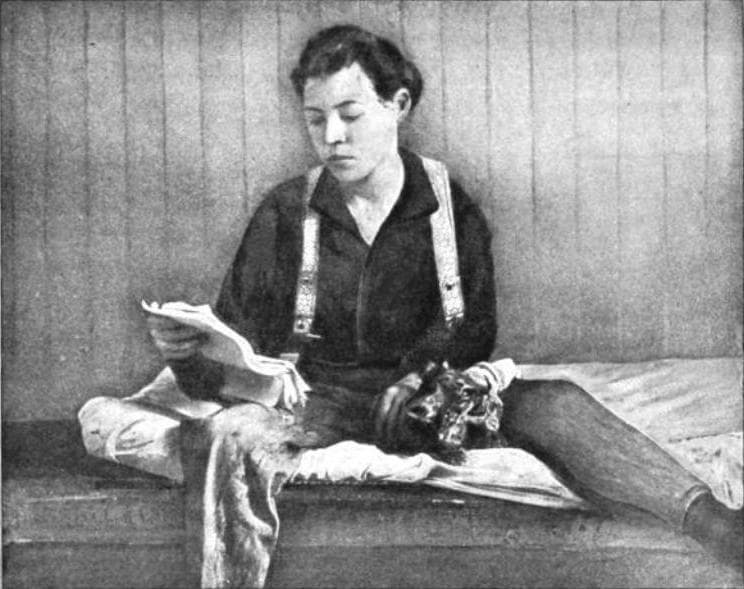
Canadian · Activism
Pearl Hart
January 1, 1871 – December 30, 1955
Early Life and Background
Pearl Hart, who became notorious as a woman outlaw of the American Old West, was born around 1871 in Lindsay, Ontario, Canada.[1][6][9][16] Her birth name is often given in older sources as Pearl Taylor, but more recent historical research argues that she was actually born Lillie Naomi Davy into a poor Canadian family, and later adopted or was reported under different surnames.[10][13][14] The inconsistencies in her recorded name and origins reflect both the scarcity of reliable documentation and Hart’s own efforts to obscure her identity.
Accounts differ on the social status of her family. Popular retellings long claimed that she came from affluent, respectable parents and attended boarding school, suggesting a dramatic fall from comfort to criminality.[3][18] More recent work, including the biography Wildcat: The Untold Story of Pearl Hart, the Wild West’s Most Notorious Woman Bandit, indicates that she grew up in modest or poor circumstances, which helps explain her later struggles for economic survival and her attraction to the perceived opportunities of the American West.[14][19]
Little is definitively known about her childhood, schooling, or formative influences. Some narratives assert that she saw Buffalo Bill’s Wild West show at the Chicago World’s Fair and was enthralled by romantic images of frontier life, sparking her desire to head west.[18] Other sources, such as the History channel’s account, emphasize that she moved to Toronto as a child and later eloped as a teenager.[16] While details vary, most agree that she was drawn early to stories of adventure and that economic hardship and unstable relationships framed her youth.
Early Marriage and Move to the American West
By her mid-teens, Hart had entered into a marriage that would become central to her later legend. Several sources report that at about age sixteen she eloped with a man known as Hart, sometimes identified as Frank Hart, a "known rogue" and drinker.[3][7] Other research, including a 2023 investigative article, suggests that the man may have had different names and that the marriage itself was abusive and short-lived.[10][16] In most versions, the union exposed her to violence and instability and served as a catalyst for her later departures.
The couple’s movements are poorly documented, but secondary accounts place Hart in various American locales in the early 1890s. The History channel notes that she took up with a dance-hall musician and minor gambler named Dan Bandman, and the pair relocated to Phoenix, Arizona, around 1892.[16] This move introduced Hart to the rough milieu of mining towns, saloons, and transient labor that typified the late frontier.
In Phoenix and other settlements, she reportedly lived on the margins of respectability, working at times in saloons and possibly engaging in sex work, as some later newspaper retrospectives suggest.[10] These environments would have brought her into contact with gamblers, miners, and drifters—men who lived by their wits and sometimes by crime. Hart’s early adult life, therefore, combined gendered vulnerability with exposure to a culture that normalized risk-taking and occasional lawbreaking.
Path Toward Outlawry
By the late 1890s, Hart had moved to the mining town of Globe, Arizona, a remote settlement in the Arizona Territory.[1][6][16] History.com reports that when Bandman left to fight in the Spanish–American War, Hart relocated to Globe and began an affair with a German drifter known as Joe Boot, whose real name may have been John Howard.[1][16] Boot worked intermittently as a miner and cowboy and represented the archetypal wandering frontier laborer.
Life in Globe was hard. Mining booms were accompanied by busts, and wages were uncertain. Hart’s later testimony and subsequent narratives suggest that she faced severe financial difficulty. Some accounts describe her as desperate to raise funds to visit an ailing mother, though this detail is difficult to corroborate.[1][6][14] The combination of poverty, limited opportunities for women, and her relationship with Boot created the conditions in which the idea of robbery emerged.
Neither Hart nor Boot appears to have had prior experience as professional robbers.[16] Nevertheless, they concluded that holding up a stagecoach might yield enough money to resolve their immediate problems. The plan was risky and poorly conceived, reflecting both their inexperience and the fading viability of stagecoach robbery at a time when railroads and telegraphs had made frontier crime more difficult.
The Stagecoach Robbery of May 1899
In May 1899, Hart and Boot carried out the act that would define her historical reputation: the robbery of a stagecoach traveling between Globe and Florence in the Arizona Territory.[1][6][16] The exact date has been variously reported; the History channel places the event specifically on May 30, 1899, while other sources, including encyclopedia entries, describe it more generally as occurring in May.[6][16] The editorial dossier treats May 3, 1899 as the operative date for almanac purposes, reflecting one strand of the documentary record.
Hart disguised herself in men’s clothing, reportedly wearing a hat and loose garments to obscure her figure, and armed herself with a revolver.[1][3][6] Boot, likewise armed, accompanied her to a bend in the road where they halted the stage. The driver and several passengers were forced to dismount. Hart and Boot then relieved them of cash and valuables amounting to a little over $400 along with small personal items.[6] In some accounts, Hart returned a portion of the money so that the passengers could pay for meals and lodging on their journey, a detail that contributed to later portrayals of her as a quasi-chivalrous outlaw.[1][6][14]
The robbery was significant less for its financial impact than for its timing and the identity of one of the perpetrators. It was widely characterized as one of the last recorded stagecoach robberies in the United States, occurring at the very end of the stagecoach era and just as modern transportation systems were transforming the West.[1][6][9][16] Most strikingly, Hart’s gender distinguished her from nearly all other known stage bandits in Arizona, making her Arizona’s only documented female stagecoach robber.[3] This combination of late timing and gender transgression ensured extensive coverage and lasting attention.
Manhunt and Arrest
After the robbery, Hart and Boot attempted to flee but were poorly prepared for life on the run. They retreated into rugged terrain near what is now Tonto National Forest, hoping to evade the inevitable pursuit.[6] Posses quickly formed, and a manhunt unfolded across the rough landscape surrounding Globe.
According to biographical summaries, Hart successfully eluded capture for approximately three days before being found.[6] Her arrest is typically dated to early June 1899, with one strand of the record marking it as June 3, 1899.[6] When officers discovered her, Hart was reportedly wearing men’s clothing, reinforcing the already sensational nature of the case and leading newspapers nationwide to dub her the "lady bandit".[6]
The press response was immediate and extensive. Newspapers from coast to coast reported on the arrest of a woman stagecoach robber, fixating on her gender, appearance, and allegedly unladylike behavior—smoking cigars, using rough language, and carrying a gun.[1][6][14] These accounts frequently exaggerated or invented details, but they cemented Hart’s image as a transgressive figure and contributed to her enduring legend.
Trial and Conviction
Following her capture, Hart was held in custody as territorial authorities decided how to charge her. On July 10, 1899, her trial opened in the Arizona Territory.[1][6] The courtroom was crowded with reporters and curious spectators. The case was nominally straightforward—a robbery of a stagecoach—but the presence of a woman defendant made it extraordinary.
Sources indicate that the trial was short.[1][6] Hart’s defense, colored by later retellings, emphasized her alleged need to support her family and argued that she had acted under duress or desperation. Whether these arguments originated with Hart herself or were crafted by attorneys and journalists is difficult to determine.
On July 12, 1899, the jury returned a verdict of guilty of robbery.[1][6] The conviction established Hart as one of the best-known women in the American West of her time, not because the crime was large-scale, but because a woman had committed it. Contemporary reporting often described her calm demeanor and limited remorse, fostering a public image of daring and defiance.
Sentencing and Imprisonment at Yuma
On July 13, 1899, Hart was sentenced to serve time in the Yuma Territorial Prison.[1][6] Various accounts indicate that her sentence was several years—often described as five—but she ultimately served about three years before receiving clemency.[3][6] Yuma was infamous for its harsh desert environment, intense heat, and strict discipline, and Hart’s incarceration there quickly became a subject of considerable public interest.
Hart was reportedly the only female inmate at Yuma during her confinement.[3][6] Territorial authorities had to improvise to house and supervise her in an institution built for men. Some narratives describe changes to her living arrangements and note that she attracted curious visitors, including journalists and local dignitaries, who came to glimpse the "Bandit Queen." Hart is said to have given interviews and signed autographs, embracing the notoriety that her case had generated.[3][6]
Her imprisonment illuminates the broader historical context of women and penal systems in the frontier era. Most prisons were designed exclusively for male inmates, and the presence of even a single woman posed questions about security, privacy, and appropriate treatment. Hart’s case exposed these institutional gaps and highlighted how rare, and symbolically charged, female incarceration was in the Old West.
Pardon and Disappearance from the Record
In late 1902, Hart received a pardon from Governor Alexander O. Brodie, ending her time at Yuma and restoring her freedom.[1][6] Biographical summaries suggest she had served approximately three years of her sentence when the pardon was granted.[3][6] While the precise reasons remain unclear, several factors are commonly cited: the logistical difficulty of housing a single female prisoner, the low monetary stakes of the robbery, and public fascination that may have made her continued imprisonment a political issue.
After her release, Hart largely vanished from public view.[1][6] The JRank biography notes that she lived the remainder of her life "not far from the scene of her crime," though details about her exact residence and activities are scarce.[6] Other accounts, including investigative journalism and modern biographies, track her under possible married names and speculate that she worked and lived in various states, including Kansas City and Los Angeles, but these reconstructions are not universally accepted.[7][10][14]
The paucity of reliable records from this period contributed to decades of conflicting claims about her later life and death. Some older sources placed her death around 1924 or suggested that she disappeared soon after leaving prison.[7][8][9] More recent research, drawing on genealogical and archival evidence, argues that she lived much longer, under different names, and died in the mid-20th century.[10][13][14] This evolving picture illustrates how women in marginal positions—including former outlaws—could slip through the documentary cracks.
Personal Life
Hart’s personal relationships are difficult to reconstruct with certainty. Her early marriage to the man known as Hart or Frank Hart appears to have been abusive and unstable, and she left him after a few years.[3][7][16] Subsequent partnerships, including her involvement with Dan Bandman and Joe Boot, combined emotional ties with economic precariousness.[1][16]
Later accounts, particularly the 2023 New York Daily News article and modern biographical research, suggest that after her release she may have married again, had at least one daughter, and eventually enjoyed grandchildren, living a more conventional family life far removed from her outlaw persona.[10][13][14] These claims, while grounded in some documentary evidence, are not universally corroborated, and different sources list varying names and timelines for these relationships.
Hart’s story underscores how women who passed through criminal notoriety often sought anonymity afterward. Whether she lived in Arizona, Missouri, California, or elsewhere, the shift from public "Bandit Queen" to private family member reflects a common pattern among former offenders attempting to reintegrate into society.
Later Life and Death
For many years, reference works described Hart’s death only approximately, often stating that she died "around 1924" or "after 1928," reflecting the lack of clear official records and the reliance on oral history and speculation.[7][8][9] These approximations aligned with the earlier belief that her life ended relatively soon after her prison release.
However, more recent research, including the INSP profile and modern biographical work, places her death on December 30, 1955, at the age of roughly 84.[3] This later date fits with efforts to identify her under the name Lillie Naomi Davy and trace her through civil records into the mid-20th century.[10][13][14] While not all older sources have been updated, the emerging consensus among recent investigations supports the 1955 date.
By the time of her death, Hart’s story had largely faded from active public memory, even as snippets of her legend persisted in Western lore. She died in a world transformed from the frontier where she had once robbed a stagecoach—an era of automobiles, mass media, and modern policing.
Legacy and Historical Impact
Pearl Hart’s historical significance lies less in the scale of her crime than in its symbolic and cultural implications. She is widely remembered as one of the last stagecoach robbers in the United States and as Arizona’s only documented female stagecoach bandit.[1][3][6][9][16] The fact that a woman committed such a crime at the closing of the frontier captured public attention and prompted sustained discussion about gender, morality, and law.
Her story has been retold in numerous forms: encyclopedia entries, newspaper retrospectives, popular history articles, documentaries, and the book Wildcat devoted to uncovering her true identity.[6][14][15][19] These retellings illustrate how historians and writers constantly negotiate between myth and documentation. Earlier romanticized accounts portrayed her as a glamorous, cigar-smoking desperado from a wealthy background; newer research aims to situate her in a more realistic context of poverty, abuse, and limited opportunities for women.
Hart’s life contributes to women’s history by highlighting the rare but important instances in which women engaged in overtly criminal behavior that challenged the gender order. Her trial and imprisonment show how institutions built for and by men struggled to respond when women stepped outside prescribed roles. Newspapers’ obsession with her appearance and "unfeminine" traits reveals the gendered framing of crime reporting at the turn of the century.
At the same time, Hart’s later disappearance from the record underscores the difficulty of reconstructing the lives of women who moved in marginal or stigmatized spheres. The conflicting birth names, disputed dates, and patchy documentation remind researchers that many women’s stories have been distorted or partially lost, requiring careful archival work to recover them.
In contemporary culture, Hart remains a figure of fascination. She appears in lists of notable women of the Wild West and is sometimes invoked in discussions of outlaw women who complicated the stereotype of passive femininity.[1][6][14] Her legend, blending fact and fiction, continues to offer a lens on the intersection of gender, violence, and popular memory in the American West.
Assessment in Women’s History
From a women’s-history perspective, Pearl Hart’s life raises several important themes:
- Gender and Criminality: Hart’s case shows how rare female participation in violent crime was framed as spectacle. Media coverage focused more on her gender than on the material realities of the offense, revealing the cultural boundaries women were expected not to cross.[1][6][14]
- Economic and Social Constraints: Whether born into poverty or modest circumstances, Hart faced limited legitimate avenues for financial security. The mining-town environment and abusive relationships contributed to her eventual turn to robbery.[6][10][14][16]
- Institutional Responses: Her imprisonment at Yuma illustrates how penal systems designed for men improvised when confronted with a female offender. Decisions about housing, discipline, and eventual release reflected both practical concerns and public sentiment.[3][6]
- Myth Versus Documentation: The evolving narrative around Hart—from Pearl Taylor to Lillie Naomi Davy, from affluent boarding-school girl to poor Canadian child—shows how women’s lives can be reshaped by legend. Recent scholarship’s efforts to correct the record highlight the importance of critical, source-based research.
Ultimately, Pearl Hart occupies a distinctive niche in women’s history: a woman whose brief episode of outlawry became a touchstone for discussions of gender, crime, and the fading American frontier. Her story, though still partially obscured, invites ongoing investigation into the lives of women on society’s margins and the ways those lives are remembered—or misremembered—in historical narratives.
Dated achievements
7 indexed.
- Jan011871Activism
Birth of Pearl Hart
Pearl Hart was born in Canada in 1871. The precise birth date is uncertain.
View details Wikipedia: Pearl Hart - May031899Activism
Stagecoach robbery in Arizona Territory
Pearl Hart and Joe Boot robbed a stagecoach in Arizona on May 3, 1899.
View details