← All women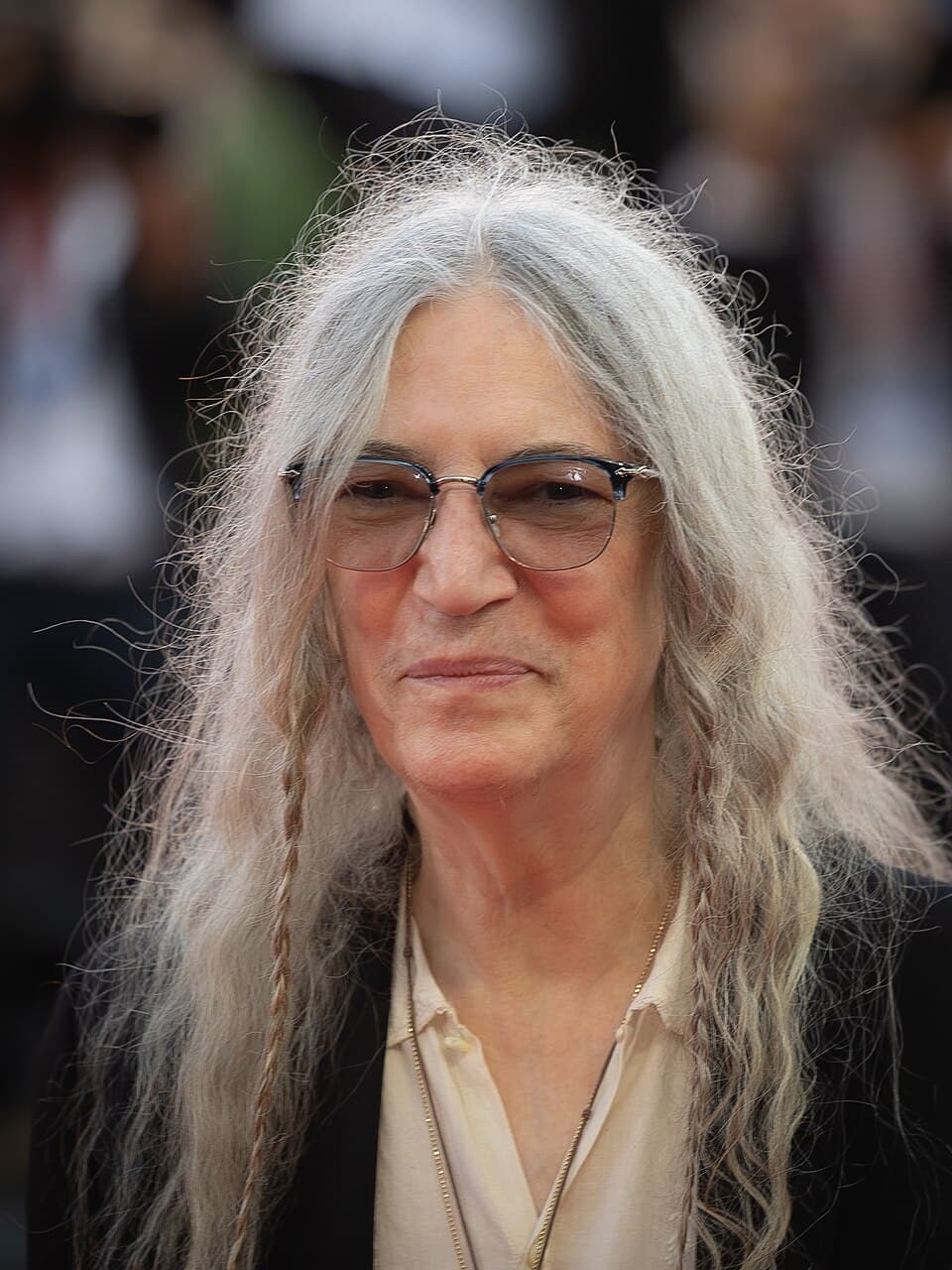
American · Arts · Literature
Patti Smith
December 30, 1946 – present
Early Life and Background
Patricia Lee "Patti" Smith was born on 30 December 1946 at Grant Hospital in Chicago, Illinois, United States.[1][2][9] She was the eldest of four children. Her father, Grant Smith, worked primarily as a factory machinist, while her mother, Beverly Smith, had been a jazz singer and waitress.[1][13][16] Shortly after Patti’s birth, the family moved to Germantown, a working‑class neighborhood near Philadelphia, and later settled in Deptford Township in southern New Jersey, where she spent most of her childhood.[1][13]
Smith grew up in a household that combined economic modesty with strong intellectual and spiritual currents. She was raised in part within the Jehovah’s Witness tradition and exposed early to biblical narratives and apocalyptic imagery, which would later inform her writing and iconography.[1][13] At the same time, her mother’s musical background and her own voracious reading led her toward art. She developed obsessions with poets and writers such as Arthur Rimbaud and William Blake, and with rock and roll performers including Bob Dylan and the Rolling Stones.[1][13][14]
Smith attended public schools in New Jersey and briefly enrolled at Glassboro State College (now Rowan University), but she left formal education early and worked factory and service jobs.[1][16] One formative experience was her employment on a factory assembly line, which she later depicted in the song "Piss Factory."[16] These early years shaped her awareness of class, labor, and the constraints placed on young women, themes that would recur throughout her artistic work.
Move to New York and Artistic Beginnings
In 1967, at age 20, Smith moved to New York City, initially intending to pursue visual art and teaching.[1][13][14] There she immersed herself in the cultural ferment of the East Village and the wider downtown arts community. She worked in bookstores, including Scribner’s, which connected her to literary circles, and became involved with experimental theater, notably the work of director Wilford Leach and the troupe at La MaMa Experimental Theatre Club.[1][13]
Smith developed a close relationship with photographer Robert Mapplethorpe, whom she met soon after arriving in New York. The two lived together intermittently, collaborated on art projects, and supported one another’s evolving practices; their relationship—romantic, artistic, and deeply emotional—would later be memorialized in her award‑winning memoir Just Kids.[1][13] They frequented sites such as the Chelsea Hotel and Max’s Kansas City, immersing themselves in the era’s bohemian milieu.
By the early 1970s, Smith began to focus increasingly on writing and performing poetry. In 1971, she started presenting her poems with electric guitar accompaniment at venues including St. Mark’s Church‑in‑the‑Bowery and the Poetry Project, often collaborating with guitarist Lenny Kaye.[13][14] These performances, blending spoken word and rock textures, were instrumental in forming her hybrid style and drew attention within New York’s literary and music scenes.
Smith’s first published volume, the poetry collection Seventh Heaven, appeared on 10 February 1973 through the Poetry Project at St. Mark’s Church.[13] The slim book established her as a serious poet within the avant‑garde and downtown literary communities and foreshadowed her later fusion of Beat‑influenced language with rock energies.
Formation of the Patti Smith Group and Punk Emergence
In 1974, Smith and Lenny Kaye formally assembled a band, the Patti Smith Group, bringing together musicians such as Richard Sohl, Ivan Kral, and Jay Dee Daugherty.[1][14] This ensemble developed a sound rooted in three‑chord garage rock, layered with improvisational spoken word, and informed by Smith’s poetic and political sensibilities.
On 1 July 1974, Smith released her debut single "Hey Joe" / "Piss Factory" on Mer Records.[1][14][16] Her version of "Hey Joe" reinterpreted a rock standard, while "Piss Factory" drew on her own factory experiences, expressing alienation and artistic defiance. The single is widely cited as an early, formative document of punk rock and expanded her audience beyond poetry circles.
Smith and her band became fixtures in New York’s burgeoning punk scene, performing at venues such as CBGB and attracting attention alongside contemporaries including Television, Talking Heads, and the Ramones.[1][14] In 1975, she signed with Arista Records, signaling a transition from underground performer to recording artist with an international platform.[1][16]
Horses and Breakthrough
Smith’s debut album, Horses, was released on 13 December 1975, produced by former Velvet Underground member John Cale and recorded at Electric Lady Studios.[1][14][16] The album opens with her incendiary reworking of Van Morrison’s "Gloria," beginning with the line "Jesus died for somebody’s sins but not mine," and includes pieces such as "Redondo Beach," "Birdland," and "Land."[1]
Horses synthesized Beat‑style free verse, rock instrumentation, and a confrontational performance ethos. Its stark cover photograph by Robert Mapplethorpe—Smith in a white shirt, with a black jacket slung over her shoulder—became one of the most iconic images in rock history.[1] Critics hailed the album as a landmark, and it rapidly came to be seen as central to the New York punk movement.
Although Horses did not achieve major commercial sales, its artistic impact was enormous. It influenced subsequent generations of rock and alternative musicians, particularly women and queer artists who saw in Smith a model of androgynous style, intellectual ambition, and refusal of conventional femininity.[1][7][9] Her fusion of poetry and rock earned her the epithet "Godmother of Punk" or "punk rock’s poet laureate."[3][7][9]
In 1977, Smith suffered serious injuries after falling from a stage during a concert in Tampa, Florida, breaking vertebrae and temporarily halting her touring and recording activities.[1] The accident forced a period of convalescence, influencing her subsequent work and deepening her reflections on vulnerability and physical limitation.
Easter, Wave, and Commercial Success
Smith’s third album, Easter, was released on 3 March 1978 and produced by Jimmy Iovine.[1] It combined religious and political imagery with rock hooks. The standout track "Because the Night," co‑written with Bruce Springsteen, became her most commercially successful single. Springsteen contributed the initial music and title, while Smith wrote new lyrics.[1]
In 1978, "Because the Night" reached number 13 on the Billboard Hot 100 and number 5 on the UK Singles Chart, giving Smith a major international hit.[1][9][14][16] The song’s success introduced her to a broader audience, demonstrating that an artist rooted in punk and poetry could achieve mainstream chart recognition while retaining artistic complexity.
Her fourth studio album, Wave, followed on 4 April 1979, produced by Todd Rundgren.[1] The record included "Dancing Barefoot" and the title track, which paid tribute to Pope John Paul I. Wave exhibited a slightly more polished sound while preserving Smith’s spiritual and poetic concerns. It would be the last album recorded with the original Patti Smith Group before a prolonged hiatus.
After Wave, Smith gradually withdrew from the music industry. She moved to Detroit and deepened her relationship with Fred "Sonic" Smith, former guitarist for MC5. The two married in 1980 and had two children, Jackson and Jesse.[1][16] During the 1980s, she largely dedicated herself to family life, making only occasional appearances and collaborations.
Dream of Life and Return to Recording
On 1 June 1988, Smith released Dream of Life, her first studio album since Wave.[1] Co‑produced with Fred "Sonic" Smith in Detroit, the album signaled her return to recording after nearly a decade and reflected both domestic contentment and political awakening. The song "People Have the Power" emerged as a key anthem, urging listeners to recognize their collective capacity to effect change.[1]
"People Have the Power" would later be widely used at political rallies, benefit concerts, and activist events, reinforcing Smith’s growing identity as an artist engaged with social issues. Despite this creative resurgence, Smith experienced profound personal losses in the ensuing years: her close friend Mapplethorpe died of AIDS in 1989, her brother Todd passed away, and Fred "Sonic" Smith died in 1994.[1][14][16]
These bereavements led to another period of withdrawal and grief. However, they also informed the intensely reflective and elegiac tone of her subsequent work, as she processed mortality, memory, and spiritual questions through music and writing.
Gone Again, Peace and Noise, and Late-1990s Resurgence
Patti Smith reemerged decisively with the release of Gone Again on 18 June 1996.[1] The album was shaped by the deaths of Mapplethorpe, Fred Smith, her brother, and other friends, and it explores themes of loss, resilience, and transcendence. Tracks such as "About a Boy," dedicated to Kurt Cobain, and "Farewell" exemplify its meditative tone.
Gone Again received strong critical praise and marked the beginning of a late‑career renaissance. It reintroduced Smith to the touring circuit and set the stage for subsequent releases that deepened her engagement with politics and spirituality.[1][14]
On 30 September 1997, Smith released Peace and Noise, a follow‑up album characterized by its urgency and political focus.[1] Songs like "1959" reference the Tibetan uprising and Chinese occupation, while others interrogate war, oppression, and faith. The record’s raw sound and incantatory lyrics recalled her 1970s punk energy, now filtered through mature reflection.
She continued releasing albums into the 2000s, including Gung Ho (2000), which addressed figures such as Ho Chi Minh and explored historical and revolutionary themes.[1][14] This period established Smith as a respected elder of alternative rock, whose work was as concerned with global politics and spiritual searching as with personal narrative.
Literary Career: Poetry, Just Kids, and M Train
Throughout her musical life, Smith has been a prolific writer of poetry and prose. She has published numerous volumes, including Witt, Babel, Coral Sea, and collections of essays and photographs.[1][4][13] Her literary reputation rose significantly in the late 2000s.
In 2010, Smith published the memoir Just Kids, which chronicles her relationship with Robert Mapplethorpe and their shared struggle to become artists in New York.[1] The book details their time at the Chelsea Hotel, encounters with cultural figures, and Mapplethorpe’s illness and death, providing a vivid portrait of bohemian life from a young woman’s perspective.
On 17 November 2010, Just Kids won the National Book Award for Nonfiction in the United States.[1] The award cemented Smith’s status as a major literary voice and brought her story to a wide readership beyond fans of her music. Critics praised its lyrical prose, emotional depth, and historical insight into New York’s artistic underground.
In 2015, she published another memoir, M Train, which moves between travelogue, meditation on loss, and reflections on daily ritual—coffee shops, television series, notebooks.[1][4] M Train further established Smith as a writer capable of transforming ordinary experience into philosophical exploration, underscoring her dual identity as musician and author.
Awards, Honors, and Recognition
Smith’s contributions have been recognized by numerous institutions worldwide. On 15 March 2005, the French Ministry of Culture appointed her a Commander of the Ordre des Arts et des Lettres, honoring her work in music, literature, and visual arts.[1][4] This distinction signaled France’s esteem for her as an artist who has reshaped rock and poetry.
On 12 March 2007, she was inducted into the Rock & Roll Hall of Fame in the Performer category.[1][14] The induction acknowledged her role in the New York punk movement, the influence of Horses and subsequent albums, and her status as one of rock’s most important women.
On 25 March 2009, the U.S. Library of Congress selected Horses for inclusion in the National Recording Registry as "culturally, historically, or aesthetically significant."[1] This recognition placed the album within the official canon of American recorded sound.
On 8 June 2011, Smith received the Polar Music Prize in Stockholm, sharing the honor with the Kronos Quartet.[1][2] The prize committee cited her for transforming the way an entire generation "looks, thinks and dreams," emphasizing her fusion of poetry and rock.
On 18 March 2013, she was awarded the Edward MacDowell Medal in the Arts, recognizing her interdisciplinary contribution to American culture.[1] In 2013 she also received honorary degrees and other commendations from institutions such as Columbia University, reflecting growing academic interest in her work.[14]
On 31 May 2022, the French government appointed her an Officer of the National Order of the Legion of Honour, one of the nation’s highest distinctions.[1][4] This followed her earlier arts‑and‑letters decoration and underscored her long‑standing connection to French culture.
On 19 June 2026, the Princess of Asturias Foundation announced Smith as the laureate of the 2026 Princess of Asturias Award for the Arts, honoring her as a pioneering figure who brought an intellectual point of view to punk and became one of the most influential artists in rock music.[0]
Personal Life
Smith’s personal relationships have deeply influenced her art. Her early bond with Robert Mapplethorpe was central to her development as a visual and literary artist, and their collaborative dynamic is a cornerstone of her biography.[1][13] Mapplethorpe shot many of her most famous photographs, including the Horses cover, and Smith has written extensively about their connection.
In the late 1970s, she entered a relationship with Fred "Sonic" Smith, a guitarist associated with the Detroit proto‑punk band MC5. They married in 1980 and settled in the Detroit area.[1][16] Together they had two children, Jackson and Jesse, and Smith largely stepped away from public musical activity to focus on her family. Fred’s encouragement and partnership were vital to her later return; he co‑produced Dream of Life and was closely involved in her artistic decisions until his death in 1994.[1][16]
Smith has maintained a complex relationship with religion. Raised as a Jehovah’s Witness, she later moved away from organized religion but continued to draw heavily on biblical and mystical imagery. Her work often blends reverence and critique, and she has spoken frequently about spiritual searching.[1][13] This dimension of her life came into public focus when she performed at the Vatican’s Christmas concert in Rome on 20 December 2014 at the invitation of Pope Francis, singing "Because the Night" in a setting that surprised some observers.[1]
Legacy and Historical Impact
Patti Smith is widely regarded as one of the most influential women in rock history.[1][4][5][9] Her 1970s work redefined the boundaries of rock performance by merging Beat‑inspired poetry, improvisational spoken word, and garage‑rock instrumentation. Her androgynous visual style, refusal to conform to gendered expectations, and insistence on intellectual ambition in popular music created new possibilities for female artists.
The epithet "Godmother of Punk" reflects the extent to which Smith’s work helped shape the ethos of punk: anti‑authoritarian, confrontational, and grounded in everyday experience, yet suffused with lyrical and symbolic complexity.[3][7][9] Albums such as Horses, Easter, and Wave influenced musicians across genres, including post‑punk, indie rock, and alternative singer‑songwriters.
Her later recordings—Gone Again, Peace and Noise, Gung Ho, and others—positioned her as an elder artist addressing global politics, human rights, and spiritual questions. Songs like "People Have the Power" and "1959" have been used in activist contexts and underscore her engagement with issues such as democracy and Tibetan independence.[1][14]
Smith’s literary output has further cemented her legacy. Just Kids and M Train are widely taught and discussed, contributing to feminist and queer histories of art and offering intimate accounts of creative life from a woman’s perspective.[1][13] Her poetry collections and prose works continue to attract scholarly attention, and she is frequently cited as a central figure in discussions of cross‑disciplinary practice.
Institutional recognitions—from the Rock & Roll Hall of Fame and National Recording Registry to the Polar Music Prize, French state orders, and the Princess of Asturias Award—attest to her importance across national and artistic boundaries.[1][2][4][0] She stands as a key figure in women’s cultural history, demonstrating that a woman can occupy a central place in rock while being simultaneously a poet, memoirist, visual artist, and activist.
Later Life and Continuing Work
Since the 2000s, Smith has continued to record, tour, write, and exhibit visual art. She released the album Trampin' (2004), which reflects her concerns with motherhood, faith, and social justice, and Banga (2012), inspired in part by literary sources such as Mikhail Bulgakov’s The Master and Margarita.[1][4][14] Her performances often blend music with readings and spoken reflections, reinforcing her identity as a poet‑performer.
Smith has been active in political and environmental causes, participating in campaigns and benefit concerts and using "People Have the Power" and other songs to galvanize audiences.[14] She remains a prominent voice in discussions about the role of artists in public life and has spoken about the responsibilities of cultural figures in times of crisis.
By the mid‑2020s, Smith is recognized as a living legend whose work spans more than five decades. She continues to influence musicians, writers, and visual artists, and her recordings and books are widely studied. Honors such as the Princess of Asturias Award for the Arts in 2026 highlight her ongoing relevance and the enduring power of her contributions.
As of the latest accounts, Patti Smith remains active, performing internationally, publishing essays and photography, and engaging with younger generations through concerts, readings, and digital media.[1][4][14] Her life and career exemplify an artist’s capacity for continual reinvention, grounded in a commitment to poetry, music, and the belief—expressed in "People Have the Power"—that individuals and communities can shape history.
Dated achievements
18 indexed.
- Dec301946Arts
Birth of Patti Smith
Patti Smith, born on December 30, 1946, in Chicago.
View details Britannica Biography of Patti Smith - Feb101973Literature
Publication of poetry collection 'Seventh Heaven'
First poetry collection *Seventh Heaven* published on February 10, 1973.
View details