← All women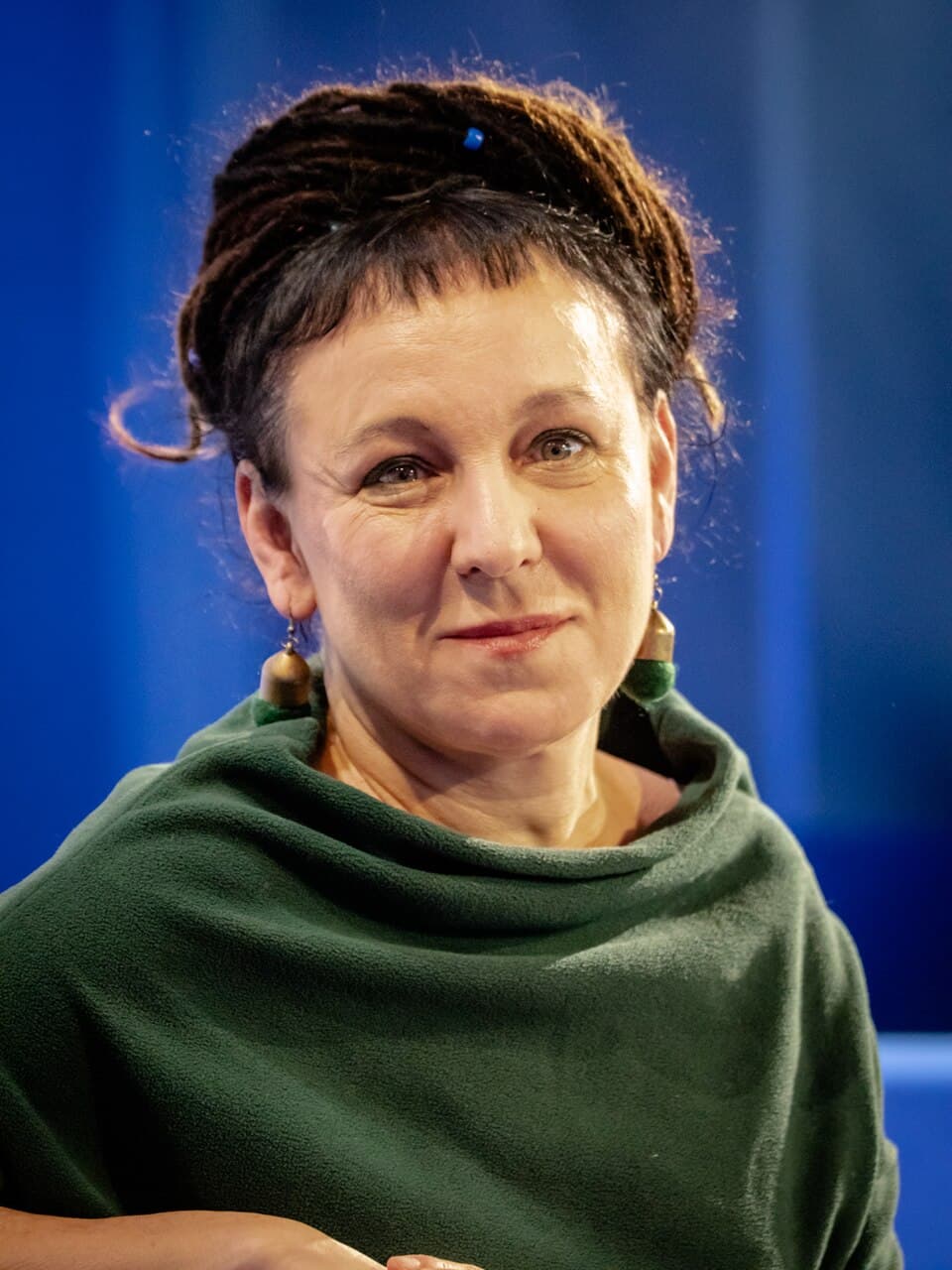
Polish · Literature
Olga Tokarczuk
January 29, 1962 – present
Early Life and Background
Olga Nawoja Tokarczuk was born on 29 January 1962 in Sulechów, a small town in western Poland, then part of the Polish People’s Republic.[2][3][11] She grew up in a family of teachers; her father, Józef Tokarczuk, was responsible for the school library, and her mother, Wanda Slabowska, also worked in education.[4][11] Surrounded by books and encouraged to read widely, Tokarczuk developed an early fascination with literature, mythology, and psychology.[4]
Her childhood unfolded under state socialism, in a rural and borderland region near Zielona Góra.[2][14] The combination of provincial life and ready access to a library shaped her sensibility: she became attentive to peripheral spaces, overlooked stories, and the complexities of identity in a country marked by shifting borders and historical traumas. These experiences later informed her fiction, which frequently explores borderlands, migration, and the lives of marginalized people.
After completing secondary school, Tokarczuk moved to Warsaw to study psychology at the University of Warsaw.[2][5][9] She was influenced by the work of Carl Gustav Jung, among others, and became interested in psychoanalysis, dreams, and archetypes.[2] Her psychological training gave her tools for probing inner lives and collective myths, elements that would become central to her literary practice.
Education and Early Career
Tokarczuk graduated in psychology from the University of Warsaw and initially worked as a clinical psychologist and psychotherapist.[2][5][7] She practiced in a mental health setting, encountering patients whose life stories and psychic struggles deepened her understanding of narrative, trauma, and identity. Over time, however, she found herself drawn more strongly to writing than to clinical work.
She began publishing literature in her late teens. Her first short story appeared in 1979 under the pseudonym Natasza Borodin in the Polish youth magazine Na przełaj.[10][13] Throughout the 1980s she wrote poetry and prose while continuing her psychological work. In 1989 she published a first collection of poems, marking her transition toward a professional literary career.[4]
After experiencing early literary success, Tokarczuk left full-time psychotherapy and moved to the Sudetes region in southwestern Poland.[7] She eventually settled in the village of Krajanów near Nowa Ruda, a borderland landscape that became both home and inspiration. The region’s layered histories of Polish, Czech, German, and other communities reinforced her interest in crossing boundaries and inhabiting multiple cultural perspectives.
Literary Debut and Career Development
Despite earlier publications, Tokarczuk’s literary debut is widely considered to be her 1993 novel Podróż ludzi Księgi (The Journey of the Book-People).[2][7] Set in the 17th century, it follows seekers of a mysterious book in a narrative that combines historical fiction, philosophical reflection, and elements of fantasy. The novel established her distinctive style: multi-voiced, historically conscious, and attentive to metaphysical questions.
In 1996 she published Prawiek i inne czasy (Primeval and Other Times), the book many critics consider her breakthrough.[2][4] The novel depicts the fictional village of Prawiek and its inhabitants across much of the 20th century, blending magic realism with Poland’s historical experiences of war, occupation, and political change.[2] Its polyphonic structure, mythic motifs, and attention to everyday life exemplify her interest in combining local, intimate details with broad temporal arcs.
Tokarczuk continued to develop her narrative approach in Dom dzienny, dom nocny (House of Day, House of Night), published in 1998.[2] The book is constructed as a mosaic of interlinked stories set in the borderlands near the Polish–Czech frontier, mixing realistic observation with dreamlike and mystical episodes. Its hybrid form—part novel, part story cycle—became a hallmark of her method, which often resists conventional genre boundaries.
Across the 1990s and early 2000s, Tokarczuk also issued collections of shorter prose, including Gra na wielu bębenkach (Playing Many Drums, 2001), and essays engaging with philosophy, ecology, and religion.[2][1] She steadily built a reputation as one of the most original voices of her generation in Polish literature.
Major Works
Tokarczuk’s oeuvre encompasses novels, collections of stories, essays, and screenplays. Several works are particularly central to her international standing.
- Primeval and Other Times (1996) presents the village of Prawiek as a microcosm of Poland. Through magic realist techniques, Tokarczuk connects the fate of ordinary people with spiritual forces and historical events, illustrating how myth and everyday life intertwine.[2][4]
- House of Day, House of Night (1998) uses a fragmented structure to portray life in the borderlands and explore themes of memory, identity, and faith. The text resists linear storytelling, echoing the layered histories of the region.[2][1]
- Bieguni (Flights, 2007) is a complex, non-linear work composed of short fragments, travel narratives, historical sketches, and philosophical reflections on movement and the human body.[2][3] It interrogates the modern obsession with travel and explores lives defined by mobility and dislocation.
- Prowadź swój pług przez kości umarłych (Drive Your Plow Over the Bones of the Dead, 2009) is a darkly humorous, genre-bending novel narrated by an eccentric older woman in a rural village.[2][6] Mixing crime fiction with ecological and ethical concerns, it critiques hunting culture, anthropocentrism, and patriarchal power. The novel was later adapted into the film Pokot, co-written by Tokarczuk and director Agnieszka Holland.[5]
- Księgi Jakubowe (The Books of Jacob, 2014; often dated 2015 in some contexts) is a monumental historical novel set in the 18th century, centered on the controversial religious leader Jacob Frank and the diverse communities of the Polish–Lithuanian Commonwealth.[2][1] Extending over more than 900 pages in Polish, it interweaves voices from various religious, ethnic, and gender positions, foregrounding women and marginalized groups in early modern history.
- Empuzjon (The Empusium, 2022) revisits motifs from Thomas Mann’s The Magic Mountain, situating them in a male health resort in the early 20th century to explore gender, illness, and misogyny.[2] The novel continues Tokarczuk’s interest in re-reading canonical narratives from feminist and ecological perspectives.
In addition to these works, Tokarczuk has published essay collections and shorter prose volumes that articulate her philosophical concerns, notably around ecology, animal ethics, migration, and the responsibilities of storytellers.[2][12] Her writing is often associated with magic realism, though critics note that it also incorporates elements of postmodernism, mythopoesis, and ethical realism.[2][3]
Awards, Honors, and Recognition
Tokarczuk has received numerous national and international honors, making her one of the most decorated Polish authors of her generation. Within Poland, she has been closely associated with the Nike Literary Award, the country’s most prestigious literary prize.
At the 1997 Nike ceremony she won the Nike Audience Award for Primeval and Other Times, signaling early popular acclaim.[1] In 1999 she again received the Nike Audience Award, this time for House of Day, House of Night, confirming a strong bond with readers.[1] In 2002, she earned a third audience prize for her short prose collection Playing Many Drums.[1]
A major milestone came in 2008, when she won the main Nike Literary Award for Flights, alongside the Nike Audience Award at the same ceremony.[1][6] In 2015 she repeated this rare double success, receiving both the Nike Literary Award and the audience prize for The Books of Jacob.[1][6] These distinctions consolidated her status as a leading figure in contemporary Polish literature, respected by critics and beloved by the reading public.
Internationally, Tokarczuk has received the Vilenica Prize (2013) for literature, recognizing her contribution to Central European writing, and the German-Polish Bridge Prize (Brückepreis) in 2015 for fostering cultural understanding.[6] In 2018 she was awarded the Jan Michalski Prize for Literature, a Swiss-based international award that honors works of world literature, and in 2019 she received the Prix Laure Bataillon for the French translation of Les Pérégrins (Flights).[6]
On 22 May 2018, Tokarczuk and Jennifer Croft won the Man Booker International Prize for the English translation of Flights, making Tokarczuk the first Polish writer to receive this award.[6][3] The recognition significantly expanded her readership in the English-speaking world and drew attention to the importance of translators in the global circulation of literature.
Her most prominent honor is the Nobel Prize in Literature for 2018. The Swedish Academy announced the award on 10 October 2019, citing her "narrative imagination that with encyclopedic passion represents the crossing of boundaries as a form of life."[8][14] The prize was awarded belatedly due to the Academy’s internal crisis in 2018, and she received the medal and diploma at the Nobel ceremony in Stockholm on 10 December 2019.[8][15] The prize placed her among a small group of women Nobel laureates in literature and made her one of the key literary voices of the early 21st century.
Themes, Style, and Influence
Tokarczuk’s writing is noted for its polyphonic structure, philosophical depth, and ethical concerns. She frequently employs non-linear narratives, multiple perspectives, and fragmentary forms, rejecting traditional plot-driven structures in favor of networks of stories.[2][3] Critics highlight her ability to move between centuries and locales, connecting seemingly disparate episodes through recurring motifs of travel, borders, and transformation.
Her work often explores the relationship between humans and non-human beings, including animals and landscapes, reflecting ecological and anti-anthropocentric commitments.[2][12] In novels like Drive Your Plow Over the Bones of the Dead, she critiques hunting culture and the instrumental use of animals, while in Flights she interrogates the modern obsession with mobility and the commodification of bodies.
Tokarczuk also revisits historical and religious narratives from feminist and minority perspectives. The Books of Jacob foregrounds women, Jews, and other marginalized figures in its retelling of 18th-century religious movements, while her essays often question national myths and patriarchal structures.[2][1] She has described herself as interested in "tender narrators"—voices that can tell stories with empathy, complexity, and attention to the vulnerable.
Her influence extends beyond Poland. Tokarczuk’s works have been translated into dozens of languages, including English, French, German, Spanish, and many others, making her one of the most widely read contemporary Polish authors.[6][12] Scholars of world literature frequently cite her as a key figure in the transnational turn of European fiction, connecting Central European concerns with global questions of migration, ecology, and ethics.
Activism and Public Intellectual Role
In addition to her literary career, Tokarczuk is a prominent activist and public intellectual. She speaks openly on issues including refugees’ rights, civil liberties, minority rights, and environmental protection.[2][12] She has supported same-sex partnerships and participated in equality marches, aligning herself with feminist and LGBTQ+ movements.[12]
In Poland, her outspokenness has sometimes provoked controversy, especially when she challenges national myths or criticizes right-wing politics. Nevertheless, she remains an influential voice in public debates about democracy, pluralism, and historical memory.[2] Her Nobel lecture and essays emphasize the ethical responsibilities of writers and the need for narratives that foster empathy across social and species boundaries.
Tokarczuk is also involved in institutional efforts to support literature and culture. She has collaborated with publishers, theaters, and film-makers, and her works have inspired stage and screen adaptations. After attaining international recognition, she used her visibility to advocate for better support for writers and translators and for inclusive cultural policies.
Olga Tokarczuk Foundation
Tokarczuk’s commitment to cultural and social causes led to the creation of the Olga Tokarczuk Foundation, based in Wrocław.[10][13] The foundation focuses on promoting literature, supporting artistic and educational initiatives, and fostering dialogue around ecological and social issues. It also works to preserve and disseminate Tokarczuk’s literary heritage.
Through the foundation, she helps fund residencies, readings, and projects that connect writers and readers across national and linguistic boundaries. This institutional work extends her impact beyond her own books, contributing to the infrastructure of contemporary Polish and European literary life.
Personal Life
Tokarczuk lives in Krajanów in the Sudetes region of southwestern Poland, near the town of Nowa Ruda.[7][2] Her choice to remain in a rural borderland setting, rather than moving to a major metropolitan center, reflects her long-standing interest in peripheral spaces and landscapes shaped by mixed histories.
She has maintained a degree of privacy regarding her intimate relationships and family life. Publicly available biographical sources focus primarily on her professional career, activism, and intellectual positions.[2][3] This relative privacy contrasts with her openness about political and ethical issues, suggesting a deliberate separation between personal and public spheres.
Legacy and Historical Impact
Olga Tokarczuk is widely regarded as one of the most important contemporary Polish writers and a major voice in world literature.[2][3] Her combination of formal innovation, ethical engagement, and historical depth has influenced younger authors in Poland and beyond, particularly women writers seeking to experiment with narrative form and address ecological and feminist themes.
As a Nobel laureate and the first Polish winner of the Man Booker International Prize, she has expanded global recognition of Polish and Central European literature.[6][8] Her success has highlighted the role of translators and the value of literary traditions outside the Anglophone mainstream, encouraging publishers to invest in translations of Eastern and Central European women writers.
Tokarczuk’s impact extends to intellectual debates about storytelling and ethics. Her concept of tender narration and her insistence on the importance of cross-boundary perspectives resonate with contemporary discussions about care, vulnerability, and planetary responsibility. In this sense, her work contributes to and shapes emerging paradigms in the humanities.
Within women’s history, Tokarczuk stands as a figure who has reconfigured expectations about what a woman writer from a peripheral region can achieve. She has authored vast historical epics, philosophically ambitious novels, and widely read experimental fiction, demonstrating that women can occupy central, authoritative roles in reimagining national and global narratives.
Later Life and Continuing Work
In the years following her Nobel recognition, Tokarczuk has continued to write and publish. The 2022 novel Empuzjon shows her ongoing engagement with canonical texts, gender politics, and illness.[2] She remains active in public debates and cultural initiatives, using her international platform to advocate for progressive social values and ecological awareness.
Tokarczuk’s career, from her early story in 1979 to her Nobel lecture and later novels, illustrates a sustained commitment to exploring the complexities of human and non-human life across time and space. As of the mid-2020s she continues to live and work in Poland, contributing new texts and interventions to literary and public spheres.[2]
Dated achievements
11 indexed.
- Jan291962Literature
Birth of Olga Tokarczuk
Olga Nawoja Tokarczuk was born in Sulechów, Poland.
View details Biography of Olga Tokarczuk - Oct051997Literature
Nike Audience Award for "Primeval and Other Times"
Olga Tokarczuk received the Nike Audience Award in 1997 for "Primeval and Other Times."
View details