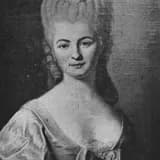
In June 1757, she began the calculations with Clairaut and Lalande that led to the celebrated prediction of Halley’s Comet’s return.
In June 1757, Nicole-Reine Lepaute joined Alexis Clairaut and Jérôme Lalande in calculations aimed at determining the return of Halley’s Comet. This work became one of the most famous astronomical collaborations of the Enlightenment and demanded immense numerical labor, since predicting the comet’s path required accounting for gravitational perturbations from the major planets.
Lepaute’s participation is historically significant because it shows that she was not merely assisting in a domestic or clerical capacity; she was part of a serious scientific computation project at the highest level. The calculation of cometary return was a major test of Newtonian celestial mechanics. For an eighteenth-century woman to contribute to such work was exceptional, especially in a field dominated by academies and male scholars. The project also required persistence and accuracy over long periods of calculation, qualities that made her one of the period’s leading scientific “computers.”
Her involvement in the Halley calculations helped establish her reputation among astronomers. It also illustrates a broader feature of Enlightenment science: large-scale numerical work could open limited but real opportunities for women whose mathematical talent might otherwise have been excluded from institutional recognition. Lepaute’s role therefore stands as both a scientific milestone and a reminder of the barriers women faced in receiving credit for foundational research.