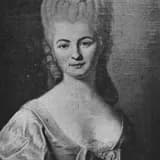
On 1 April 1764, Nicole-Reine Lepaute’s calculations accurately predicted the duration and extent of an annular solar eclipse visible across Europe.
On 1 April 1764, an annular solar eclipse swept across parts of Europe. In advance of this celestial event, Nicole-Reine Lepaute undertook the demanding calculations needed to predict its duration and the apparent size of the Sun’s obscuration as seen from different locations. At a time when astronomical tables were computed entirely by hand, this work required exceptional numerical stamina and mastery of celestial mechanics.
Working alongside professional astronomers such as Jérôme Lalande, Lepaute computed the motions of the Moon and Sun with sufficient precision to forecast when and where the eclipse would be annular rather than partial. Her tables allowed observers to prepare their instruments and verify theoretical models of orbital motion. In an era when navigation, timekeeping, and cartography depended on accurate ephemerides, such eclipse predictions were of practical as well as scientific importance.
For a woman in mid‑eighteenth‑century France, contributing publicly to eclipse prediction was itself significant. Scientific academies rarely admitted women, and their labour was often acknowledged, if at all, only in prefaces or correspondence. Yet contemporaries recognized the quality of Lepaute’s work, and her name became associated with reliable astronomical computation.
The 1764 eclipse therefore stands as a sentinel moment in her career: it showcased her ability to handle large‑scale, precision calculations and reinforced her reputation as one of the most skilled human "calculators" of the Enlightenment, paving the way for her later contributions to official ephemerides.