← All women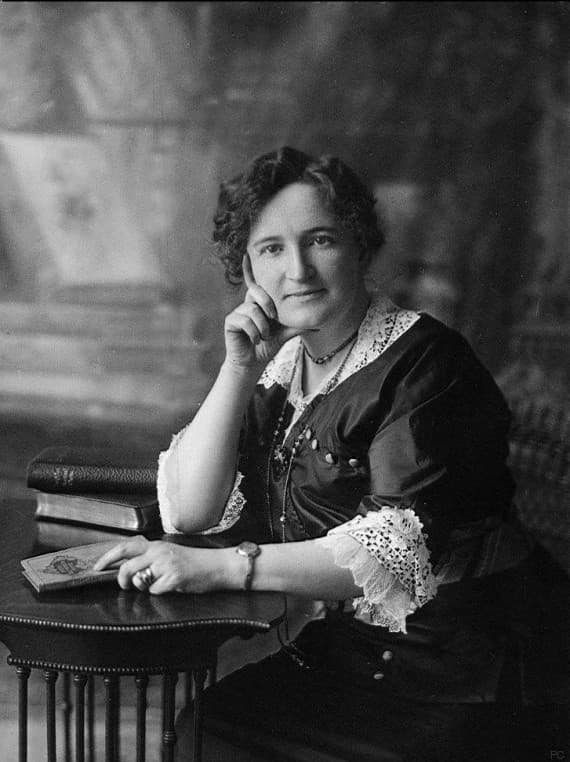
Canadian · Activism · Politics · Literature · Law
Nellie McClung
October 20, 1873 – September 1, 1951
Early Life and Background
Nellie Letitia McClung (née Mooney) was born on October 20, 1873, on a farm near Chatsworth, Ontario, the youngest of six children of John Mooney and Letitia Mooney, Irish and Scottish immigrants. In 1880, when Nellie was six years old, the family moved west to a homestead near Wawanesa in the Souris Valley of Manitoba, then a rugged and sparsely settled frontier region of the young Dominion of Canada.
Because formal schools were scarce on the frontier, Nellie did not begin her education until the age of ten. She proved to be a voracious learner, however, and by sixteen had earned a teaching certificate from the Winnipeg Normal School. She taught in rural Manitoba schools for several years, an experience that exposed her to the economic and social hardships faced by farm families, particularly women and children, and that planted early seeds of her lifelong commitment to social reform.
Marriage and Early Career
In 1896, Nellie married Robert Wesley McClung, a pharmacist, and the couple eventually settled in Manitou, Manitoba. They had five children together. Robert was supportive of Nellie's literary and political ambitions throughout their marriage, a relatively unusual dynamic for the period, and the family later moved to Winnipeg, then Edmonton, and finally Calgary and Victoria as Robert's career and Nellie's public life evolved.
Nellie's writing career began in earnest with her first novel, Sowing Seeds in Danny (1908), a bestselling and warmly received work of fiction that combined humor with social commentary on poverty, temperance, and women's roles. The novel's success gave her a public platform and financial independence, and she went on to publish numerous sequels and additional novels, including The Second Chance (1910) and Purple Springs (1921), often featuring strong, independent female protagonists who challenged social norms.
Suffrage Activism in Manitoba
McClung became deeply involved in the temperance movement through the Woman's Christian Temperance Union (WCTU), viewing alcohol abuse as intertwined with the broader denial of women's rights and protections. This activism naturally evolved into full-throated advocacy for women's suffrage. She joined and became a leading voice of the Political Equality League, founded in Winnipeg in 1912, which campaigned for the vote for Manitoba women.
Her most celebrated piece of political theater came on January 28, 1914 (a date sometimes cited in connection with her advocacy, distinct from the eventual legislative victory), when McClung and her colleagues staged a satirical "Mock Parliament" in Winnipeg. In this performance, women played the roles of legislators debating whether to grant men the right to vote, mimicking and mocking the dismissive arguments Premier Rodmond Roblin's government had used against women's suffrage. McClung, playing a mock premier, delivered a devastatingly witty parody that captured public attention and shifted the tone of the suffrage debate across the province.
Her efforts, combined with sustained petitioning, public lectures, and coalition-building among farm women's groups, labour organizations, and other reformers, contributed to a change in government. The Liberal government of Premier T.C. Norris, elected in 1915, moved quickly to enact suffrage legislation, and on January 28, 1916, Manitoba became the first province in Canada to grant women both the right to vote and the right to hold provincial office. This victory was rapidly followed by similar legislative changes in Saskatchewan and Alberta later that same year, establishing McClung as a national figure in the suffrage movement.
Political Career in Alberta
By 1914, the McClung family had relocated to Edmonton, Alberta, where Nellie continued her activism. In the 1921 Alberta provincial election, she successfully ran as a Liberal candidate and was elected as a Member of the Legislative Assembly (MLA) for Edmonton, serving until 1926. As a legislator, she championed a range of progressive causes, including public health measures, mothers' pensions, factory safety laws, and property rights for married women. Although a committed reformer, McClung's record — like many of her contemporaries in the era's eugenics-influenced reform movements — also included support for controversial policies such as sexual sterilization legislation, an aspect of her legacy that modern historians critically examine.
The Persons Case and the Famous Five
McClung's most enduring legal legacy came through her involvement in the "Persons Case." In 1927, she joined four other prominent Alberta women — Emily Murphy, Irene Parlby, Henrietta Muir Edwards, and Louise McKinney — collectively known as the Famous Five, in petitioning the Supreme Court of Canada to determine whether the word "persons" in Section 24 of the British North America Act (1867) included women, and therefore whether women could be appointed to the Senate of Canada.
In 1928, the Supreme Court ruled that women were not "qualified persons" eligible for Senate appointment under the existing constitutional framework. Undeterred, the Famous Five appealed to the Judicial Committee of the Privy Council in London, England, then the final court of appeal for Canada. On October 18, 1929, the Privy Council overturned the Canadian ruling, declaring that the exclusion of women from public office was "a relic of days more barbarous than ours" and affirming that women were indeed persons in the eyes of the law, eligible for full participation in public and political life, including Senate appointment.
This landmark decision remains one of the most significant moments in Canadian constitutional and women's legal history, establishing the principle of the "living tree" doctrine of constitutional interpretation, whereby the Canadian constitution should be read expansively to reflect evolving social values.
Later Career and Public Service
Following her time in the Alberta legislature, McClung and her family moved to Calgary and later to Victoria, British Columbia. She remained active in public life throughout the 1930s, serving as a member of the Board of Governors of the Canadian Broadcasting Corporation (CBC) from 1936 to 1942, one of the first women to hold such a national institutional role. In 1938, she was appointed one of two women delegates representing Canada at the League of Nations Assembly in Geneva, Switzerland, further cementing her role as a stateswoman of international standing.
She continued writing prolifically throughout her later years, producing memoirs and reflective works including Clearing in the West: My Own Story (1935) and its sequel The Stream Runs Fast: My Own Story (1945), which together provide a rich firsthand account of pioneer life, the suffrage movement, and her political career.
Personal Life
Nellie and Robert McClung were married for over five decades and raised five children together: Jack, Florence, Paul, Mark, and Horace. Robert's steady support for Nellie's public career was notable for the era, and the couple's partnership is often cited by historians as a model of mutual respect that enabled her extraordinary public accomplishments. Robert McClung passed away in 1958, several years after Nellie's own death.
Death and Legacy
Nellie McClung died on September 1, 1951, at her home, "Lantern Lane," in Victoria, British Columbia, at the age of 77. She was buried in Ross Bay Cemetery in Victoria.
Her legacy is vast and multifaceted. She is commemorated as one of the Famous Five on the Canadian ten-dollar bill and via a bronze statue on Parliament Hill in Ottawa (unveiled in 2000) and a companion statue in Calgary. She has been designated a Person of National Historic Significance by the Government of Canada, and her homes in Manitou, Manitoba, and Winnipeg have been preserved as heritage sites open to the public. Schools, streets, and awards across Canada bear her name, including the Nellie McClung Foundation, which continues to promote awareness of her life and work.
While celebrated as a pioneering feminist, author, and stateswoman, McClung's legacy is also examined critically by contemporary historians, particularly regarding her support for eugenics-based social policies common among progressive reformers of her era, including sterilization laws targeting marginalized groups. This complexity has made her a frequent subject of nuanced historical reassessment, reflecting broader conversations about the intersections of early feminism, class, and race in early twentieth-century Canada. Nonetheless, her foundational contributions to Canadian women's suffrage and legal personhood remain foundational chapters in the history of Canadian democracy and women's rights.
Dated achievements
4 indexed.
- Oct201873Activism
Born in Chatsworth, Ontario
Nellie Letitia Mooney was born on a farm near Chatsworth, Ontario, Canada.
View details Nellie McClung - Wikipedia - Jan281916Politics
Manitoba grants women the right to vote
McClung's activism helped Manitoba become the first Canadian province to grant women the vote, on January 28, 1916.