← All women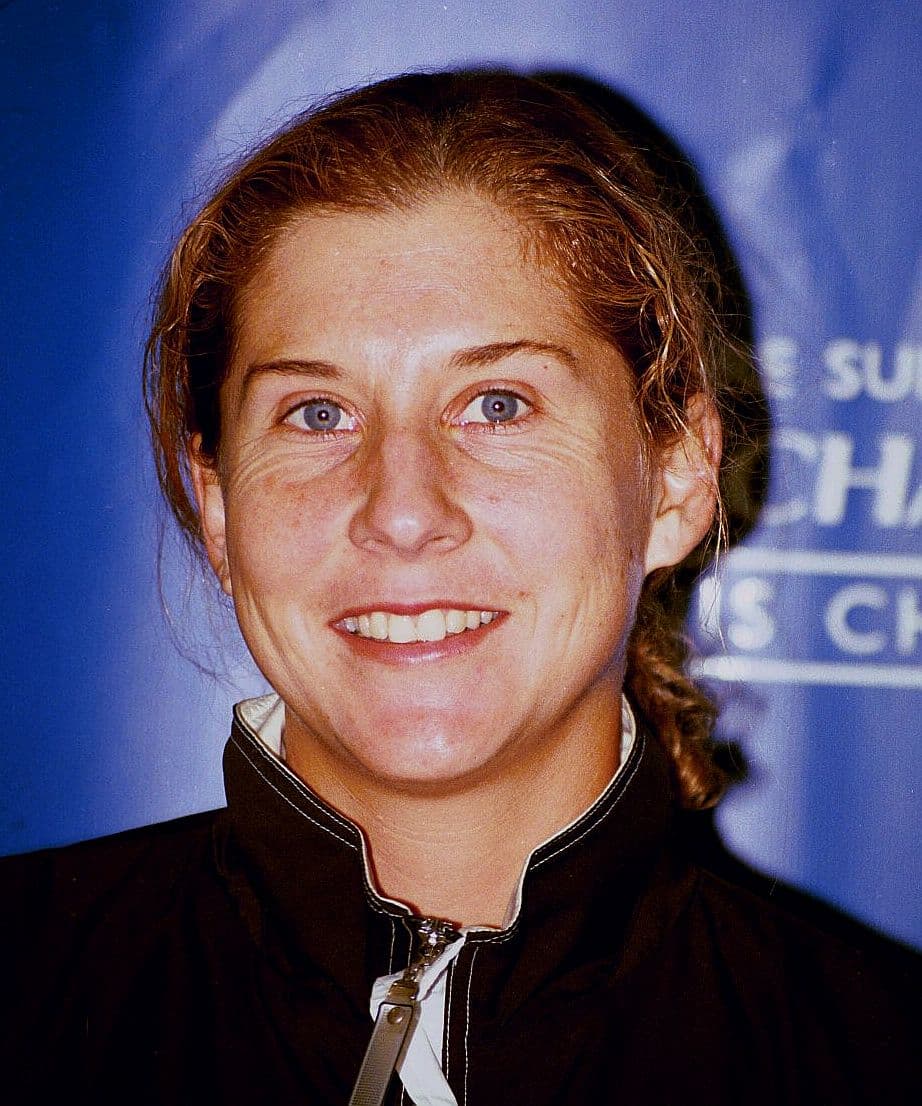
Serbian, Yugoslav, Hungarian, American · Sports
Monica Seles
December 2, 1973 – present
Early life and background
Monica Seles was born on 2 December 1973 in Novi Sad, then part of the Socialist Federal Republic of Yugoslavia, now in Serbia, into a Hungarian-speaking family of modest means. Her parents, Karolj (Karoly) Seles, a professional cartoonist and recreational tennis player, and Eszter (Esther) Seles, nurtured both her creativity and athletic talent from an early age.[1][2][10][12]
Growing up in the multiethnic Vojvodina region, Seles spoke Hungarian at home and later became fluent in Serbian and English. Her father introduced her to tennis when she was about five years old, turning practice into a game by drawing cartoon characters and targets on tennis balls and on the court to encourage her to hit with precision and joy. This playful yet focused approach fostered the early development of the distinctive two-handed strokes on both forehand and backhand that would later become her hallmark.[1][7][9]
By the age of nine, Seles emerged as one of the most promising young talents in Yugoslav and European junior tennis. At 11 she won the prestigious Orange Bowl junior tournament in Florida, a significant marker of global potential. Recognizing the need for structured elite training, her family made the difficult decision to leave Yugoslavia’s state-socialist sports system and relocate to the United States so she could train full-time.[3][9]
Around age 12–13, Seles moved with her brother to Florida to attend the Nick Bollettieri Tennis Academy in Bradenton, a center known for producing champions such as Andre Agassi and Jim Courier. Her parents followed as circumstances allowed. The move represented both an athletic opportunity and a major cultural shift, as Monica adapted to life in a new country while taking correspondence courses for her schooling and focusing intensively on tennis.[1][3][7][9]
Career beginnings and rapid rise
Seles’s early teenage years were marked by a rapid progression from junior standout to professional contender. She played her first professional tournament as an amateur in March 1988 at the Virginia Slims of Florida, competing on the women’s tour at just 14 years old.[9] In February 1989, at age 15, she officially turned professional and entered the WTA rankings at world No. 88, a remarkably high starting position.[9]
Her breakthrough on the tour was almost immediate. In April 1989 she captured her first professional title at a Virginia Slims event in Houston, defeating established players and signaling that she was ready to challenge the sport’s elite.[5] Over the remainder of the 1989 season she surged up the rankings and earned recognition such as TENNIS Magazine/Rolex Female Rookie of the Year, while the WTA later cited her as its 1990 Most Improved Player, reflecting the speed of her ascent.[5]
By 1990, Seles had become a fixture in the latter rounds of major events. Her game—built around double-handed strokes on both sides, aggressive returns, early ball-striking, and intense on-court focus—contrasted sharply with the more traditional one-handed styles that had dominated women’s tennis. Her trademark loud grunts during shots also drew attention and debate but underscored the physical effort she invested in every stroke.[1][2]
Breakthrough and domination (1990–1992)
The turning point in Seles’s career came at the 1990 French Open. On 9 June 1990, at age 16, she defeated world No. 1 Steffi Graf 7–6(6), 6–4 in the final to win her first Grand Slam singles title, becoming the youngest women’s singles champion in French Open history.[1][4][10] The victory ended Graf’s extended dominance and signaled the arrival of a new superstar.
Later that year, Seles underscored her credentials by winning the prestigious WTA Tour Championships at Madison Square Garden in New York on 18 November 1990, defeating Gabriela Sabatini in the final.[3] The year-end title, featuring the tour’s top performers, confirmed that her French Open success was part of a broader surge toward the top of the women’s game.
In 1991 Seles entered a period of extraordinary dominance. On 25 January 1991 she won the Australian Open singles title, her first in Melbourne, defeating Jana Novotná in three sets.[1] She then successfully defended her Roland Garros crown at the 1991 French Open, beating Arantxa Sánchez Vicario 6–3, 6–4 in the final on 8 June 1991.[1]
Seles’s rise to the very top of the rankings was formalized on 11 March 1991, when she became the world No. 1 in singles for the first time. At 17, she was the youngest player ever to achieve the WTA’s top ranking.[1][2] Later that year, on 7 September 1991, she captured her first US Open singles title by defeating Martina Navratilova 7–6(1), 6–4 in the final, showcasing her ability to triumph on the hard courts of New York.[1]
Her season concluded with a second straight year-end triumph; on 24 November 1991, she defended her WTA Tour Championships title with a victory over Navratilova at Madison Square Garden.[1] She finished 1991 ranked world No. 1 for the first time in the year-end standings, having won three majors and the Tour Championships in a single season.
The 1992 season further elevated Seles’s standing. On 25 January 1992 she defended her Australian Open title with a commanding straight-sets win over Mary Joe Fernández.[1] She then completed one of her most remarkable achievements on clay: on 6 June 1992 she defeated Steffi Graf in an epic 6–2, 3–6, 10–8 final to win her third consecutive French Open title. In doing so, she became the first woman since Hilde Sperling (1935–37) to win three straight Roland Garros titles and the only woman in the Open Era at that time to achieve this feat.[4][14]
On 12 September 1992, Seles successfully defended her US Open title with a straight-sets victory over Sánchez Vicario, giving her back-to-back championships in New York.[1] She capped the year by winning a third consecutive WTA Tour Championships crown on 22 November 1992, again defeating Navratilova in the final.[1] In 1992 she reached the final of all four major tournaments—Australian Open, French Open, Wimbledon, and US Open—joining a very small group of players who have done so in a single season.[3]
By the end of 1992, Seles had won eight Grand Slam singles titles and three year-end championships, and she had spent long stretches at No. 1. Many commentators regarded her as almost unbeatable at the majors, particularly on hard courts and clay.[1][2][3]
1993: Peak achievement and traumatic attack
Seles began 1993 by extending her dominance in Melbourne. On 30 January 1993, she defeated Steffi Graf in three sets to win her third consecutive Australian Open women’s singles title, becoming the only woman in the Open Era to hold three straight Australian Open and three straight French Open titles.[1][4] This victory represented the peak of her pre-attack career and further separated her from the rest of the field.
Just three months later, her trajectory was violently disrupted. On 30 April 1993, during a changeover in her quarterfinal match at the Citizen Cup in Hamburg, Germany, Seles was sitting on her courtside chair when a spectator, Günter Parche, rushed from the stands and stabbed her between the shoulder blades with a knife.[1] The attack, carried out by an obsessed fan of Graf, left her with a serious back wound and deep psychological trauma.
The incident shocked the global sports community and led to intense scrutiny of security arrangements at tennis tournaments. Although Seles’s physical injuries healed within weeks, the emotional impact—including anxiety, depression, and fear for her personal safety—was profound. She withdrew from competition, and legal proceedings in Germany later resulted in Parche avoiding prison, a verdict that Seles and many observers found deeply troubling.[1][2]
At the time of the attack, Seles was just 19 years old and had already collected eight major titles. Many analysts believe the assault irrevocably altered the course of women’s tennis history, interrupting what could have been one of the most statistically dominant careers in the sport.
Return to competition and later career
After more than two years away from the tour, Seles returned to professional tennis in August 1995. Her comeback quickly demonstrated that her skills and competitiveness remained world-class. In her first Grand Slam tournament after the hiatus, the 1995 Australian Open, she reached the final, losing to Mary Pierce on 27 January 1995, but earning widespread admiration for her resilience and determination.[1]
On 2 October 1994, during her period away from competition, Seles had become a naturalized United States citizen, reflecting both her long-term residency in the country and the political changes in her native Yugoslavia.[1] She would later represent the United States in Fed Cup competition and at the Olympic Games.
Seles’s most significant post-comeback triumph came at the 1996 Australian Open. On 27 January 1996, she defeated Anke Huber 6–4, 6–1 to win her fourth Australian Open and ninth Grand Slam singles title overall.[1][3] This victory was widely celebrated as a vindication of her efforts to rebuild her career after the trauma of 1993.
Throughout the late 1990s, Seles remained a top-tier player, regularly reaching the latter rounds of majors and winning additional tour titles. In 1996 she played a key role in leading the United States Fed Cup team to a world title, and she contributed to further Fed Cup victories for the U.S. in 1999 and 2000.[13] In 1999 she claimed the Bausch & Lomb Championships in Amelia Island, underlining her enduring threat on clay despite injuries and the rise of younger competitors.
At the 2000 Sydney Olympic Games, Seles earned an Olympic bronze medal in women’s singles for the United States. On 26 September 2000, she defeated Mirjana Lučić in the bronze-medal match, adding an Olympic honor to her résumé.[2][6]
Persistent foot injuries increasingly hampered her play in the early 2000s. On 25 February 2003, Seles contested what would become her final WTA Tour match at the Dubai Duty Free Women’s Open, losing in the first round to Ai Sugiyama.[1][3] After this event she effectively left the tour, although an official retirement announcement did not come until 2008.
Awards, honors, and recognition
Over the course of her career, Seles received numerous awards and honors recognizing both her on-court achievements and her broader impact on sports. The WTA named her Most Improved Player in 1990, reflecting her rapid ascent into the game’s elite.[5] Various media outlets, including TENNIS Magazine, lauded her as Rookie of the Year and a transformative figure in women’s tennis.
Her most formal and enduring honor came with her induction into the International Tennis Hall of Fame. On 11 July 2009, Seles was enshrined in Newport, Rhode Island, in recognition of her nine Grand Slam singles titles, three year-end championships, weeks at No. 1, and her influence on the style of modern women’s tennis.[4][1]
In addition to Hall of Fame recognition, Seles’s career statistics are frequently cited: she won 53 singles and several doubles titles on the WTA Tour (figures vary slightly by source), accumulated more than 20 million dollars in prize money, and compiled one of the highest winning percentages at Grand Slam events in the Open Era.[1][3][15] She also remains a celebrated figure in Olympic and Fed Cup histories for her contributions to the United States.
Playing style and influence
Seles is widely credited with helping usher in the era of power baselining in women’s tennis. Her unique two-handed strokes on both forehand and backhand sides allowed her to take the ball exceptionally early, redirect pace, and generate heavy topspin while maintaining control.[1][2]
Her return of serve was one of her greatest weapons; she frequently stepped inside the baseline to attack second serves, putting immediate pressure on opponents. Combined with her aggressive court positioning, this approach foreshadowed the styles later adopted by players such as Serena Williams, Maria Sharapova, and other heavy-hitting baseliners.
Seles’s intense vocalization during rallies—her loud grunts—sparked controversy and discussions about gamesmanship, but they also reflected the extraordinary physical exertion in her game. Despite criticism from some quarters, she rarely altered this aspect of her play, and over time, vocalization became more common, especially in the women’s game.[1][2]
Her on-court demeanor combined ferocity with vulnerability; she was fiercely competitive during points but often shy, soft-spoken, and introspective in interviews. This contrast contributed to her enduring appeal as a complex, relatable champion.
Personal life
Seles’s personal life has been shaped by migration, cultural adaptation, and coping with trauma. Having grown up in Yugoslavia, she spent much of her adolescence in Florida, navigating language barriers and distance from her extended family while pursuing a demanding training regimen. She later acquired U.S. citizenship in 1994 and, according to some sources, Hungarian citizenship in 2007, reflecting her ethnic roots and multinational identity.[1][15]
A central emotional thread in her life has been her relationship with her father, Karolj. He served as her first coach, moral anchor, and creative partner in her development as a player. His illness and death in the late 1990s deeply affected her and coincided with a challenging period in her career.[1][12]
In her post-playing years, Seles has spoken candidly about struggles with depression and eating disorders, particularly binge eating, that intensified after the stabbing and during injury layoffs. She has described food as a coping mechanism for emotional pain, and later wrote and spoke about her path to recovery, contributing to public conversations about mental health among elite athletes.[7]
Seles also built a life beyond tennis. She appeared on the U.S. television show Dancing with the Stars in 2008, introducing her to audiences outside sports. She later became engaged and then married Tom Golisano, an American billionaire businessman and philanthropist; sources note their relationship as a significant aspect of her later personal life, although Seles has generally guarded her privacy.[6][7]
Authorship and off-court activities
Following her competitive career, Seles became active as an author and motivational speaker. She wrote a memoir, often cited as Getting a Grip: On My Body, My Mind, My Self, in which she recounts her childhood in Yugoslavia, rise to tennis stardom, the trauma of the stabbing, her father’s illness, and her struggles with food and self-image. The book offers an unusually candid look at the psychological burdens behind elite performance and the challenges facing women in professional sport.
Seles has also authored a series of young adult novels centered on a fictional tennis academy, using her experience to craft accessible stories about ambition, friendship, and pressure in youth sport. Through these works and public speaking engagements, she has advocated for mental health awareness, balanced lives for young athletes, and opportunities for girls in sport.
Additionally, Seles has engaged in philanthropic initiatives, including charity exhibitions and fundraising events. She has supported causes related to children’s health, education, and cancer research, often motivated by her father’s illness and her own experiences with adversity.
Legacy and historical impact
Monica Seles’s legacy in women’s tennis rests on both her extraordinary achievements and the “what if” questions surrounding the trajectory interrupted by violence. By age 19 she had amassed eight Grand Slam singles titles and three consecutive year-end championships, numbers that compare with or exceed those of many all-time greats at similar ages.[1][3]
Her aggressive baseline game, double-handed strokes, and relentless pace helped redefine the sport’s tactical landscape. Many later stars—particularly those known for explosive groundstrokes and early ball-striking—can be seen as inheriting elements of the style she pioneered or popularized. Analysts frequently place her among the greatest players never to have had the chance to fully realize their potential prime, given the disruption of 1993.[2][3]
Beyond technique and titles, Seles’s story has had lasting cultural resonance. As a teenage immigrant from a politically unstable region, she became a global icon and symbol of opportunity. The stabbing and her subsequent recovery journey drew public attention to issues of player security, the psychological toll of trauma, and the pressures on young women in elite sport. Her willingness to discuss depression and eating disorders contributed to a broader conversation about athlete mental health that has gained prominence in the 21st century.
Her Hall of Fame induction on 11 July 2009 formally placed her among the sport’s legends, but her influence extends far beyond statistics or institutional honors. For many fans and historians, Seles stands as both a champion and a figure of resilience whose career encapsulates triumph, injustice, and recovery in equal measure.
Later life
After her de facto final WTA appearance in 2003 and her formal retirement announcement in 2008, Seles transitioned into a multifaceted life combining authorship, business endeavors, mentoring, and occasional media work. She has participated in tennis exhibitions, charity events, and legends’ matches, staying connected to the sport without returning to full competition.[3][7][15]
Living primarily in the United States, Seles has continued to cultivate her multinational identity, maintaining ties to Serbia and Hungary while embracing her American citizenship. She remains a respected voice in tennis commentary and in discussions about youth sport and athlete welfare. Her post-career activities, particularly her writing and advocacy, underscore the broader significance of her life story as more than a record of wins and losses: it is a case study in resilience, adaptation, and the complexities of success at the highest level.
As of the mid-2020s, Seles is widely recognized not only as a nine-time Grand Slam champion and Hall of Famer, but also as a pioneering figure whose experiences helped shape modern understandings of athlete safety, mental health, and the global reach of women’s professional tennis.
Dated achievements
20 indexed.
- Dec021973Sports
Birth in Novi Sad, Yugoslavia
Monica Seles was born in Novi Sad, then Yugoslavia, beginning the life of a future nine-time major champion.
View details Wikipedia - Monica Seles - Jun091990Sports
Wins 1990 French Open and becomes youngest French Open women’s champion
At age 16, Monica Seles won the Roland Garros women’s singles title, becoming the youngest champion.