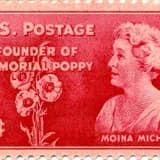
In March 1919, Moina Michael received a U.S. patent related to her memorial poppy work, marking formal recognition of her emblem concept.
In March 1919 (represented here by March 1, with the precise day not specified in secondary sources), Moina Belle Michael was reportedly granted a United States patent related to her poppy work. This patent is mentioned in veteran and auxiliary histories as formal recognition of aspects of the memorial poppy concept and its production, though surviving accounts do not clearly specify the patent number or exact grant date.
The patent’s significance lies in the way it acknowledged Michael’s innovation in transforming a poetic symbol into a reproducible emblem intended for broad public use. At a time when intellectual property protections for designs and fundraising mechanisms were still evolving, securing a patent helped legitimize her efforts and may have aided in coordinating the manufacture of silk poppies for fundraising campaigns.
For a woman educator in the early twentieth century to obtain such legal recognition was unusual, reflecting both her creativity and her determination to institutionalize support for veterans. The patent reinforced her authority when negotiating with organizations like the American Legion and the American Legion Auxiliary, ensuring that the poppy design could be standardized for large-scale distribution.
While details are incomplete, the March 1919 patent stands as a milestone in the professionalization of Michael’s work: it bridged the gap between personal humanitarian vision and the structured, legally recognized systems that underpinned later national and international poppy appeals.