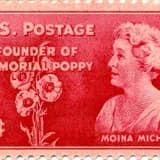
On November 9, 1948, the U.S. Post Office issued the 3-cent Moina Michael commemorative stamp, the first U.S. stamp honoring “The Poppy Lady.”
On November 9, 1948, the U.S. Post Office Department issued a 3-cent commemorative postage stamp honoring Moina Belle Michael and her role in establishing the red poppy as a memorial symbol for those who served in World War I. Postal-history sources identify this as the first U.S. commemorative stamp devoted specifically to her and to the poppy movement.
The stamp portrays Michael alongside red poppies, visually linking her personal story to the emblem she popularized. Its release four years after her death signaled official national recognition of her contributions as an educator and humanitarian, elevating a previously local Georgia figure to the status of a subject of federal commemoration.
This issue formed part of a broader trend in the late 1940s of honoring women reformers and philanthropists on U.S. stamps, reflecting growing public appreciation for female leadership in social causes. For the poppy movement, the stamp reinforced the flower’s association with organized remembrance and with specific individuals whose advocacy made that tradition possible.
Historically, the November 9, 1948 stamp marked a milestone in how the United States remembered World War I: not only generals and battles, but also the civilian woman whose idea helped sustain veterans and educate the public about sacrifice. It ensured that Michael’s name would circulate wherever the stamp was used, extending her legacy into everyday acts of mailing and communication.