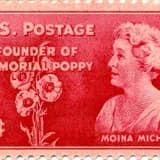
On September 27, 1920, the American Legion adopted the red poppy, championed by Moina Michael, as its official national symbol of remembrance.
On September 27, 1920 (within the dates of the American Legion’s national convention that ran September 27–29), the American Legion formally adopted the red poppy promoted by Moina Belle Michael as its official national symbol of remembrance for those who served in World War I. Convention records and postal-history summaries agree that the decision was taken at this late-September meeting, with September 27 commonly cited as the resolution date.
This adoption was a landmark moment: it represented the first official endorsement of the poppy by a major U.S. veterans’ organization, transforming Michael’s emblem from a grassroots idea into a sanctioned national symbol. The Legion’s decision opened the door to coordinated poppy distribution campaigns and fundraising drives, often carried out in partnership with the American Legion Auxiliary.
For Michael, a Georgia educator and civilian woman, influencing such a powerful, male-dominated organization in 1920—just as American women were gaining the right to vote—demonstrated the reach of her moral authority and advocacy skills. Her work had convinced veterans that the poppy could keep public attention focused on the war’s human cost and on the ongoing needs of the wounded.
The American Legion’s adoption of the poppy is historically significant because it institutionalized a new form of remembrance that combined symbolic wearing with practical support for veterans. This decision helped propagate poppy observances across the United States and eventually inspired parallel initiatives abroad, embedding the red poppy into commemorative rituals that continue each year around Veterans Day and Memorial Day.