← All women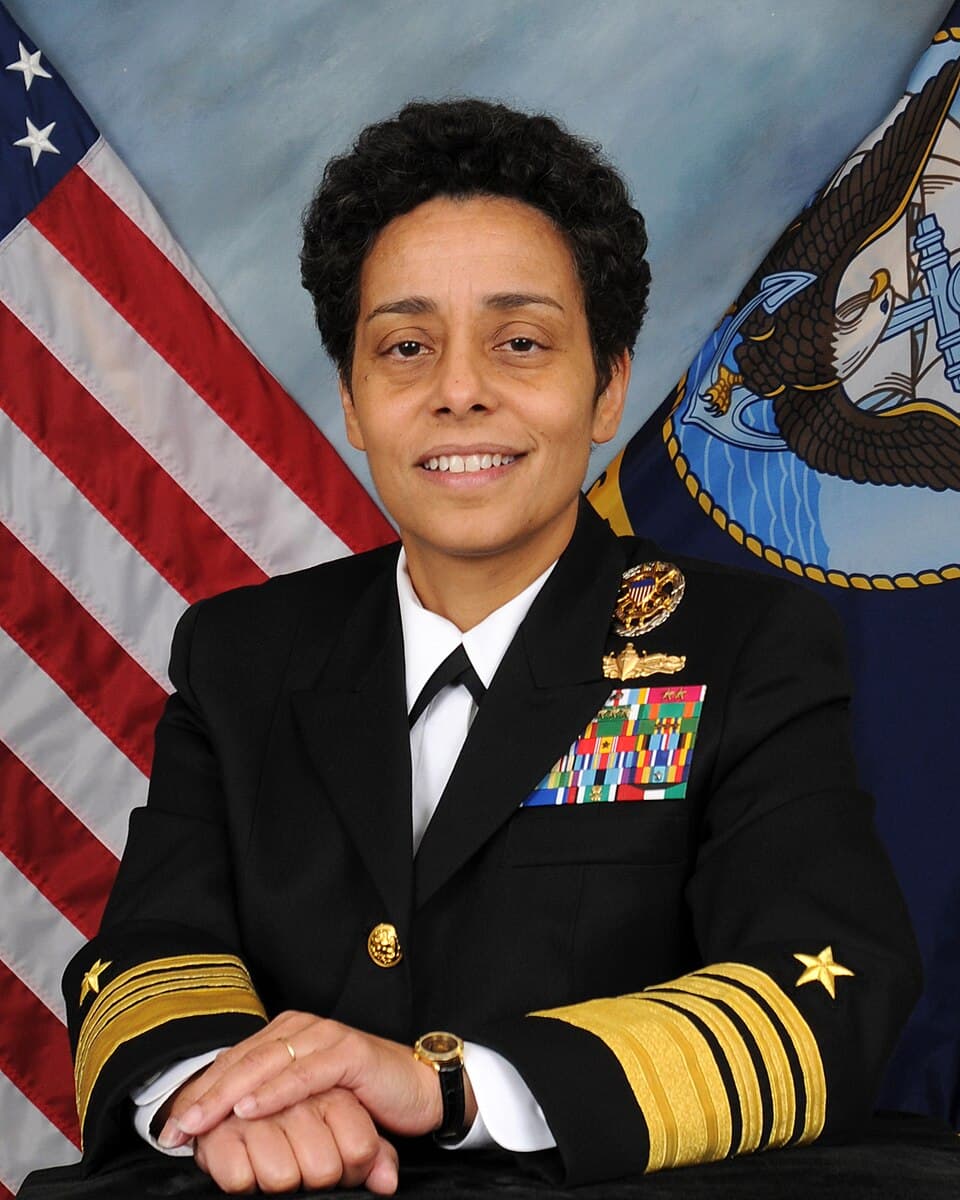
American · Aviation · Activism
Michelle J. Howard
April 30, 1960 – present
Early life and background
Michelle Janine Howard was born on April 30, 1960, at March Air Force Base near Riverside, California, into a military family. She was one of four children of Air Force Master Sergeant Nick Howard and his wife, Philippa Howard, who was Scottish-born. Howard spent part of her childhood in Colorado and graduated from Gateway High School in Aurora, where she emerged from a service-oriented upbringing that would later shape her commitment to military life.
Howard entered adulthood during a transformative era for women in American institutions. The U.S. Naval Academy had only recently begun admitting women, and the broader military was still in the early stages of opening senior operational paths to them. Her decision to pursue a naval career meant entering a profession in which women remained underrepresented and where race and gender could both limit advancement. That context makes her later accomplishments especially significant: her career was built not only on personal excellence, but also on persistence in a system that had not been designed for officers like her.
According to institutional and biographical sources, Howard entered the United States Naval Academy in 1978 and graduated in 1982 with a degree in mathematics. She was commissioned as an ensign in the Navy upon graduation. Her class was among the early cohorts that included women at Annapolis, a change that was still new enough to make her experience part of the first generation of women to build careers in the Academy’s formerly all-male pipeline.
Early career and professional development
Howard began her naval career in 1982, serving in assignments that built her expertise in engineering, operations, and shipboard leadership. Over time she took on a series of roles that prepared her for command at sea and in joint operations. Sources describing her career note service in positions such as chief engineer, first lieutenant, and executive officer, showing the breadth of technical and command experience that contributed to her rise through the Navy.
Her progression took place during a period when the Navy was slowly expanding the roles available to women. A 1980 policy shift allowed women to serve more broadly on support vessels, and the institutional changes of the 1980s and 1990s created the conditions for women officers to accumulate the sea service and leadership credentials once reserved for men. Howard benefited from those changes, but she also helped demonstrate that women could excel in the demanding roles that fed command opportunities.
Howard also completed advanced military education. In 1998, she received a master’s degree in military arts and sciences from the U.S. Army Command and General Staff College. That credential complemented her operational background and supported the strategic and planning responsibilities she would later take on as a senior officer.
Historic ship command and rise through flag rank
One of Howard’s defining achievements came on March 12, 1999, when she assumed command of the amphibious dock landing ship USS Rushmore. She became the first African American woman to command a U.S. Navy ship. That milestone was important because ship command in the Navy is both operationally demanding and symbolically central; it signifies that an officer has earned the confidence to be responsible for sailors, a vessel, and mission execution at sea.
Howard’s command of USS Rushmore helped establish her as a barrier-breaking officer in an institution where women and African Americans had long faced structural exclusion. It also placed her in a lineage of naval leaders whose authority at sea served as a pathway to higher responsibilities. For women in the military, especially Black women, the significance of ship command extended far beyond one assignment because it offered proof that senior command was attainable in a field historically dominated by white men.
In the years that followed, Howard advanced into increasingly senior positions. She commanded an expeditionary strike group and was involved in operations in the Indian Ocean and the Horn of Africa. During the 2009 Maersk Alabama crisis, she played a central leadership role in the naval response to the Somali pirate seizure of the vessel and the hostage-taking of Captain Richard Phillips. This episode brought her to broader public attention and highlighted the Navy’s evolving mission in maritime security and anti-piracy operations.
Her career continued to break new ground as she rose through flag rank. By the mid-2000s, Howard had become one of the first African American women to reach the upper echelons of naval leadership. She was selected for rear admiral, later became a vice admiral, and then advanced to the Navy’s highest rank. These promotions were historically important not only as personal achievements but also as evidence that a woman officer could rise from the Naval Academy to the highest levels of strategic military command.
Vice Chief of Naval Operations and four-star admiral
On July 1, 2014, Howard became the first woman to be promoted to four-star admiral in the U.S. Navy. On the same day, she was appointed Vice Chief of Naval Operations, becoming the first woman and the first African American to hold that office. The combination of these milestones made her one of the most significant figures in Navy history.
The vice chief position is the service’s second-highest uniformed post and carries responsibility for the Navy’s internal operations, readiness, and management. Howard’s appointment therefore represented both symbolic and practical trust. She was not only a historic first; she was placed in a role that helped shape the functioning of the entire service. Her elevation also underscored the changing nature of military leadership in the twenty-first century, where strategic vision, institutional management, cyber awareness, and coalition thinking had become essential.
Howard’s four-star promotion made her the highest-ranking woman in U.S. armed forces history at that time. It signaled the Navy’s recognition that barriers based on race and gender had been overcome not by abstract reform alone, but by decades of sustained professional excellence by women like Howard. Her ascent served as an important precedent for later generations seeking senior leadership in all branches of the armed forces.
Command in Europe and Africa
In 2016, Howard took on another landmark assignment when she assumed command of U.S. Naval Forces Europe, U.S. Naval Forces Africa, and Allied Joint Force Command Naples. In this role, she became the first woman four-star admiral to command operational U.S. Navy and NATO forces in those theaters. The assignment reflected both her experience and her reputation as a leader capable of handling complex multinational responsibilities.
This stage of her career is especially notable because it extended her influence beyond the Navy’s internal administration into alliance operations and regional security. Commanding NATO-linked forces required coordinating with allied militaries, managing mission priorities across a broad geographic area, and sustaining readiness in politically sensitive contexts. Howard’s leadership in this position showed that the Navy and its partners viewed her as fully qualified for the highest operational responsibilities.
Retirement and later roles
Howard retired from the U.S. Navy in December 2017 after roughly 35 years of service. Her retirement closed a career that had repeatedly expanded what women and African Americans could achieve in naval service. By then she had become a widely recognized public figure in military history, admired for both her operational accomplishments and her symbolic importance.
After retirement, Howard remained active in public life. Sources note that she held academic and advisory roles, including teaching international affairs and cybersecurity and serving on boards and commissions. She was also associated with the Naming Commission, which reviewed Department of Defense assets honoring the Confederacy and recommended renaming those assets. These later roles reflected her continued engagement with national security, institutional reform, and public memory.
Awards, honors, and recognition
Howard’s distinction has been recognized by major institutions and public bodies. The Smithsonian National Portrait Gallery added her portrait in 2022, placing her among figures considered historically consequential to the nation. She has also been profiled by organizations devoted to women’s history, military history, and African American history, each emphasizing her status as a barrier-breaker and a model of leadership.
Her recognition extends beyond formal awards. Howard’s name is regularly cited in discussions of the integration of the Navy, the opening of command roles to women, and the evolution of Black leadership in the armed forces. Her career also drew public notice because of the Maersk Alabama rescue mission, which helped cement her reputation far outside military circles.
Personal life
Reliable public sources available here focus primarily on Howard’s service and do not provide extensive detail about marriage or children. What is clear is that she came from a military family and built her own career within that tradition of service. Her biography is therefore best understood through the lens of professional achievement and institutional impact rather than private life.
Legacy and historical impact
Michelle J. Howard’s legacy rests on a series of firsts that changed the visible boundaries of military leadership. She was the first African American woman to command a U.S. Navy ship, the first woman to become a four-star admiral in the Navy, and the first woman and first African American to serve as Vice Chief of Naval Operations. These were not isolated honors; together they marked a sustained pattern of breaking barriers across the progression from line officer to the Navy’s highest levels.
Her importance to women’s history lies in the fact that she achieved these milestones within one of the most tradition-bound institutions in the United States. She advanced in a field where authority is tested under pressure, where command carries immediate operational consequences, and where entry into senior leadership had long been restricted by race and gender. Howard’s career demonstrates how institutional change becomes durable only when a new generation proves, through performance, that exclusionary assumptions were unfounded.
For the history of African American women in public leadership, Howard stands as a landmark figure. She translated opportunity into precedent, and precedent into lasting institutional memory. Her service is now part of the historical record of the U.S. Navy and of the broader struggle to make American public institutions more representative of the nation they serve.
Dated achievements
8 indexed.
- Apr301960Aviation
Birth of Michelle J. Howard
Michelle Janine Howard was born on April 30, 1960, at March Air Force Base.
View details Michelle Howard - Encyclopedia Britannica - Mar121999Aviation
First African American woman to command a U.S. Navy ship
Howard became the first African American woman to command a U.S. Navy ship on March 12, 1999.