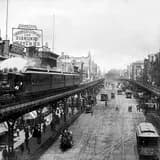
Walton patented a sound-dampening rail system for elevated railways, succeeding where Thomas Edison had failed, and sold the rights to New York's Metropolitan Railroad for $10,000.
On February 8, 1881, Mary Walton was awarded U.S. Patent No. 237,422 for a noise-abatement system designed to quiet the deafening screech and rumble of New York City's elevated railways. The invention, filed on January 7, 1879, cradled the steel rails inside wooden boxes lined with cotton padding, packed with sand, and sealed with asphalt — a design that absorbed vibration and dramatically muffled the sound of trains passing overhead.
By the late 1870s, elevated trains running above Manhattan's streets had become a source of intense public outcry due to the noise pollution they inflicted on residents and businesses below. Numerous inventors, including the celebrated Thomas Edison, attempted and failed to devise a workable solution. Walton, working largely alone and without formal engineering training, tested her invention using a model railway she built in the basement of her own home near the Sixth Avenue elevated line in Manhattan, where she operated a boarding house.
Her system proved effective and practical. She subsequently sold the rights to the Metropolitan Railroad of New York for $10,000 — a substantial sum at the time — and her method was later adopted by other elevated railway companies across the city. This achievement made her one of the very few women of the era to profit directly and publicly from a patented mechanical invention, and it remains a landmark case of a woman succeeding in a highly competitive, male-dominated engineering challenge that had stumped some of the era's most famous inventors.