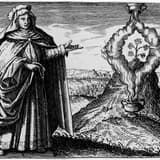
Later alchemical tradition recognized Mary the Jewess as a foundational, non-mythical alchemist and early female scientific author.
By 3rd-century testimony, Mary the Jewess had become a foundational authority in alchemy, and later tradition remembered her as the first true alchemist of the Western world. Zosimos of Panopolis treated her as a serious practitioner rather than a mythical symbol, an important distinction in a field where many figures were legendary or semi-legendary. Her work mattered because it linked practical laboratory technique with the emerging theoretical language of alchemy, helping transform the discipline from mystical speculation into an experimental craft.
Her reputation endured because later authors repeatedly credited her with inventions and methods central to laboratory work, including apparatus for controlled heating and distillation. In an era when women’s intellectual labor was rarely preserved under their own names, the survival of her name is itself historically significant. Modern scholarship notes that she is widely regarded as the first non-mythical Jewish woman to write and publish under her own name, which places her at a rare intersection of gender, ethnicity, and scientific authorship in antiquity.
Mary’s legacy is not simply that of a symbolic “mother of alchemy,” but of a figure whose attributed techniques influenced later alchemical and chemical practice for centuries. Her story also illustrates how ancient expertise could be transmitted through fragments, commentaries, and attribution rather than through complete surviving texts.