← All women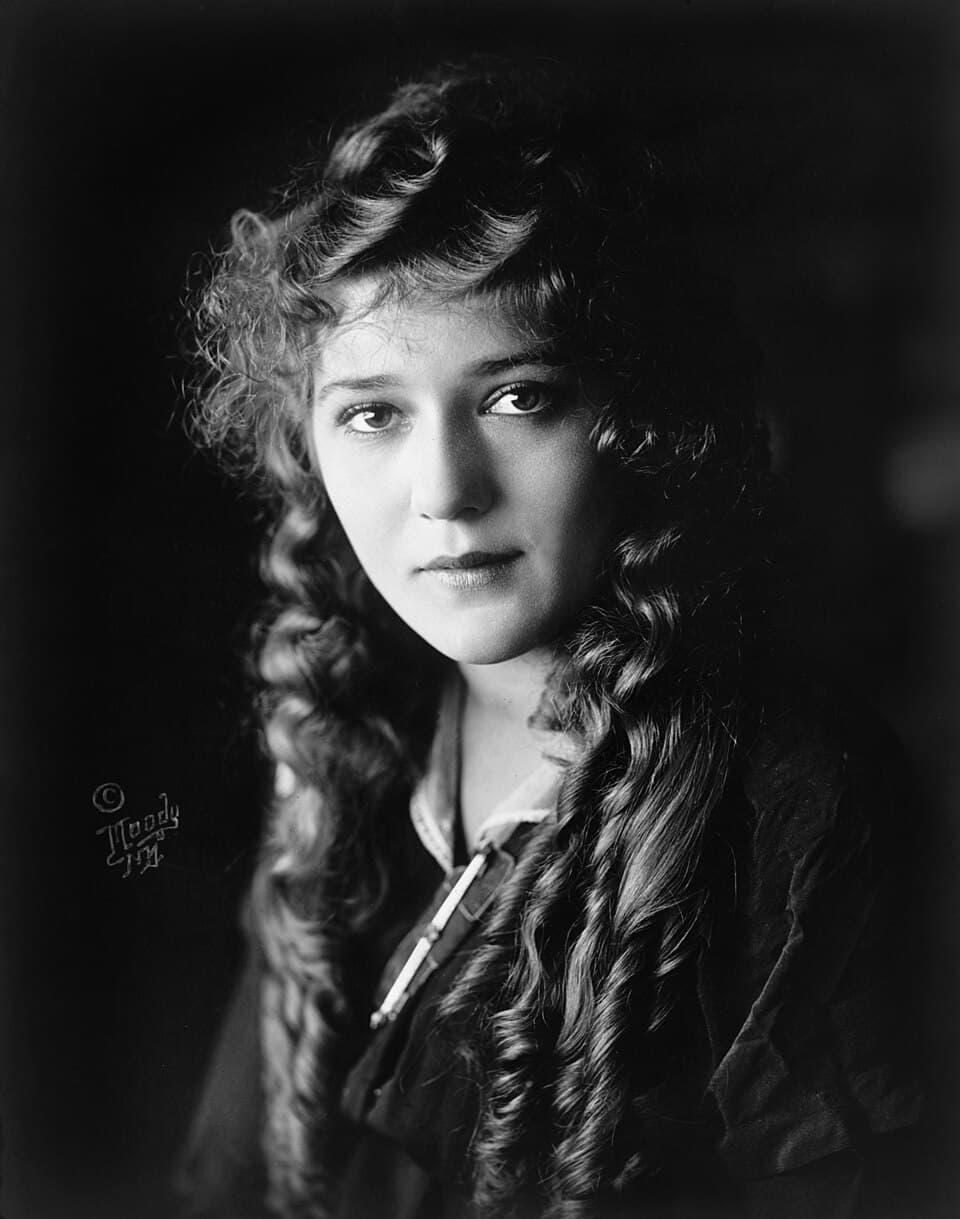
Canadian, American · Arts
Mary Pickford
April 8, 1892 – May 29, 1979
Early Life and Background
Mary Pickford was born Gladys Louise Smith on 8 April 1892 in Toronto, Ontario, Canada.[1][6][10] Her parents were John Charles Smith, an alcoholic who struggled to maintain steady work, and Elsie Charlotte Hennessy, who would become a driving force in her career.[10][11] Of English and Irish descent, Pickford grew up in modest, often precarious circumstances. Her father’s death from a workplace accident when she was still a child left the family—Gladys and her younger siblings Charlotte and John—dependent on their mother’s resourcefulness.[11][16]
Elsie began taking in boarders and soon pushed her children toward the theater as a means of economic survival.[3][11][16] Gladys made her stage debut around age six, performing with local stock companies and later touring with theatrical troupes across Canada and the United States.[8][16] Formal schooling was sporadic; the itinerant life of the stage offered practical education in performance, discipline, and the harsh realities of show business.
In 1907–1908, Gladys sought work in New York and approached Broadway producer David Belasco. Belasco agreed to hire her if she adopted a more distinctive name; she chose "Mary Pickford"—"Mary" from a family name and "Pickford" from her mother’s maiden line—marking the beginning of the persona that would become internationally famous.[1][11] Early roles in Belasco productions such as The Warrens of Virginia helped her refine her acting skills and gain experience in professional theater just as motion pictures were emerging as a new art form.[1][6]
Career Beginnings in Film
Pickford transitioned from stage to screen in 1909, the pivotal year in which she successfully auditioned for director D. W. Griffith at the Biograph Company in New York.[1][9][11] She signed a contract at $10 per day, a notable wage for a young actress, and entered the rapidly expanding world of motion pictures.[1][16] On 20 April 1909 she appeared in her first film, Her First Biscuits, in a small role as a young girl.[1][3] Within days she received her first starring part, playing Giannina in The Violin Maker of Cremona, released on 24 April 1909.[1][3]
Biograph’s one‑reel shorts allowed Pickford to hone a new style of acting tailored to the camera. She quickly abandoned the broad gestures of the stage in favor of nuanced facial expressions and controlled movement.[1][7] By the end of 1909 she had appeared in dozens of films, making her one of the most prolific performers in the medium.[9][11] Although early films rarely credited actors, audiences began to recognize "the girl with the curls," and exhibitors promoted her image to draw patrons.[5][18]
In 1910–1912 Pickford worked for several companies, including IMP (Independent Moving Pictures Company), Majestic, and Famous Players, gradually moving into feature‑length productions.[1][5] Her roles in films such as Tess of the Storm Country (1914) and Little Pal (1915) solidified her star persona as the resilient, sentimental ingénue who confronted hardship with moral courage.[1][6][8] This characterization resonated deeply with audiences during a period marked by rapid urbanization and social change, and it laid the foundation for her later marketing as "America’s Sweetheart."[1][5][6]
Rise to Stardom and Business Power
By the mid‑1910s, Mary Pickford had become one of Hollywood’s most bankable stars. Her films consistently topped box‑office charts, and fan magazines turned her into a household name across North America and beyond.[5][11] Crucially, she understood the economic value of her popularity and began to negotiate contracts that recognized her contributions.
On 24 June 1916, Pickford signed a million‑dollar contract with Famous Players–Lasky, becoming the first movie actress to negotiate such a deal.[16] The contract guaranteed her $10,000 per week, a portion of film profits, and substantial creative control over her productions.[1][6] In an era before widespread unionization, this agreement marked a groundbreaking shift in power from studio to star, especially for a woman performer.
Her films during this peak period—including Rebecca of Sunnybrook Farm (1917), Stella Maris (1918), Daddy‑Long‑Legs (1919), and later Polyanna (1920)—combined sentimental storytelling with polished production values.[1][5][6] Pickford was deeply involved in the creation of these works, often serving as an uncredited producer who influenced casting, scripts, and editing.[5][15] Contemporaries and later historians credit her with helping to define the language of feature‑length narrative cinema and the archetype of the film ingénue.[1][5]
United Artists and Industry Leadership
Unsatisfied with studio restrictions, Pickford sought greater autonomy over her films’ distribution and profits. In 1919, she joined forces with Charlie Chaplin, Douglas Fairbanks, and D. W. Griffith to co‑found United Artists, a pioneering distribution company designed to allow artists to control their own productions.[1][5][6][8] She was the only woman among the founding partners and played a central role in its early management.[15]
United Artists represented a radical challenge to the vertically integrated studio system that dominated Hollywood. By enabling filmmakers to own their negatives and share in earnings, it provided an alternative model of creative and financial independence.[5][15] Pickford’s participation signaled that a woman star could act not only as performer and producer but also as a corporate co‑owner.
Her industry leadership extended further. In 1927, Pickford was among the thirty‑six founders of the Academy of Motion Picture Arts and Sciences, the organization that would administer the Academy Awards.[5][15][18] The Academy aimed to mediate labor disputes, standardize production practices, and elevate film as an art form. As one of its few female founders, Pickford contributed to shaping the institution that would become the central arbiter of cinematic prestige.
Major Works and the Transition to Sound
By the 1920s, Pickford’s films showcased both her acting versatility and her growing maturity. Titles such as Sparrows (1926), a dark tale of children held captive in a swamp, revealed a willingness to move beyond lightweight sentimental fare into more serious subject matter.[1][5][15] Yet even as she sought new directions, her public image remained closely tied to youthful characters and her trademark golden curls.
On 30 April 1927, Pickford and Douglas Fairbanks inaugurated the tradition of celebrity handprints at Grauman’s Chinese Theatre, leaving their imprints in wet cement in the Hollywood forecourt.[3][14] This ceremony symbolized their status as the foremost film stars of their era and helped create a physical monument to Hollywood’s glamour and mythology.
Later that year, on 31 October 1927, Pickford’s film My Best Girl was released.[3] Often regarded as her final important silent feature, it paired her with actor Buddy Rogers in a romantic comedy about a shop girl and the boss’s son. The film showcased a more mature version of her persona and is considered a high point of silent‑era romantic storytelling.
Technological change soon forced a more radical transformation. As sound films gained popularity, Pickford understood that her girlish image—anchored in visual charm rather than voice—needed updating. On 21 June 1928, she publicly debuted a short bob haircut, cutting off the long curls that had become iconic.[3][14] The haircut, widely covered in the press, symbolized a break with her earlier screen identity and aligned her with modern 1920s styles.
The decisive move into sound came with Coquette, her first talkie. Premiering on 12 April 1929, the film cast Pickford as Norma Besant, a Southern young woman whose flirtations and defiance of social norms lead to tragedy.[3][6] Her performance emphasized vocal delivery and adult emotional complexity, demonstrating that she could adapt to the demands of microphone‑based acting.
At the 2nd Academy Awards on 3 April 1930, Pickford received the Academy Award for Best Actress for Coquette, becoming the second woman to win the category.[5][6][18] The award cemented her status as a serious sound‑era actress and recognized her successful transition from silent icon to talkie star, even as her overall popularity began to wane.
Awards, Honors, and Recognition
Throughout her career, Pickford garnered extensive recognition from audiences, critics, and institutions. During the 1910s and 1920s she was frequently described as Hollywood’s first international superstar and the first name box‑office draw of American cinema.[5][7][11] Her image appeared on postcards, advertisements, and magazine covers around the world, making her arguably the most famous woman of her day.
Her Academy Award for Best Actress in 1930 for Coquette provided formal validation of her acting talent.[5][6] Decades later, the Academy Honorary Award presented on 29 March 1976 acknowledged her "unique contributions to the motion picture industry," with the Academy highlighting her roles as founding member, United Artists co‑founder, and silent‑era star.[5]
Beyond awards, Pickford’s influence was recognized in industry discussions of star contracts and profit sharing. During the 1910s and 1920s she became one of the first actresses granted a percentage of film earnings, changing the economics of stardom.[8][14] Trade papers and journalists noted her savvy business sense, calling her "the most powerful woman in Hollywood."[8][14]
Personal Life
Mary Pickford’s personal life was closely intertwined with her professional career and public image. In 1911, she married Owen Moore, an actor she had met while working in film.[1][6] The marriage was troubled, marked by Moore’s alcoholism and jealousy of her success. Although they continued to work in the same industry, the relationship deteriorated, and Pickford sought an annulment or divorce.
During the mid‑1910s she formed a deep bond with actor Douglas Fairbanks, whose swashbuckling roles and charismatic persona complemented her own star image.[1][6] Their romance became one of Hollywood’s most celebrated partnerships. After resolving legal complications related to her first marriage, Pickford married Fairbanks in 1920
Pickford and Fairbanks did not have biological children, though she later adopted two: Roxanne and Ronald1936.[1][6] In 1937, Pickford married Buddy Rogers, her My Best Girl co‑star.[1][6] The union proved more stable, and they remained married until her death. Rogers supported her efforts in production and film preservation, and together they managed various business and charitable ventures. Pickford used her wealth and influence to support philanthropic causes, particularly within the film community. During the 1930s, she helped establish and promote the Motion Picture Relief Fund, which provided assistance to industry workers facing financial hardship.[5][8] In 1932, she launched the Payroll Pledge Program, encouraging studio employees to donate a portion of their wages to the fund, creating a sustained mechanism of support.[8] She was also involved in broader efforts to secure greater autonomy for filmmakers. In 1941, Pickford co‑founded the Society of Independent Motion Picture Producers (SIMPP), a group that advocated for fairer distribution terms and opposed the major studios’ control over exhibition.[5][15] Her participation underscored her long‑standing belief in artists’ rights and independent production. Although not an activist in the modern political sense, Pickford’s actions within the industry advanced causes that notably benefited workers and creative personnel. Her support for relief funds, independent distribution, and equitable contracts contributed to reshaping Hollywood’s economic and institutional structures. By the early 1930s, Pickford faced a changing industry and evolving audience tastes. Her attempt to maintain stardom in sound films, including works like The Taming of the Shrew (1929) opposite Fairbanks, met with mixed responses.[1][5] As younger stars emerged and new genres took hold, she chose to retire from acting rather than continue in roles she felt did not suit her. Pickford officially retired from the screen in 1933, following the film Secrets.[1][5][9] She remained active behind the scenes as a producer and businesswoman, continuing to manage her interests in United Artists and other ventures. Over time, however, she sold most of her UA stock and withdrew from day‑to‑day operations.[1][5] In later decades, Pickford invested in broadcasting and real estate, demonstrating a continued interest in media and finance.[1][5][11] She also supported film preservation, donating prints and advocating for the safeguarding of early cinema. Yet she increasingly avoided public appearances, disturbed by the sense that her silent work was being forgotten in an era dominated by television and contemporary stars.[11] Mary Pickford’s legacy spans performance, production, business, and institutional development. As an actress, she was instrumental in defining naturalistic screen acting, particularly in the silent era. Her expressive face and nuanced gestures helped move film away from stage‑bound theatricality toward a more intimate, psychologically focused style.[1][5][7] Her star persona—"America’s Sweetheart", "Little Mary", and "the girl with the curls"—embodied a specific cultural ideal of feminine virtue and resilience.[4][11][18] At the same time, her off‑screen business acumen challenged stereotypes of female passivity. Pickford’s ability to negotiate high salaries, profit participation, and creative control made her one of the first women to wield substantial economic power in Hollywood.[6][8][14] Institutionally, her role as co‑founder of United Artists and founding member of the Academy of Motion Picture Arts and Sciences left lasting structural marks on the industry.[1][5][15] United Artists provided an alternative to studio domination and foreshadowed later independent production movements; the Academy formalized mechanisms for industry self‑governance and artistic recognition. In women’s history, Pickford stands as a complex figure. She did not frame her actions in explicitly feminist terms, yet her career demonstrated that a woman could be simultaneously a beloved popular icon and a tough, strategic negotiator. Her willingness to challenge studio authority, invest in her own productions, and demand equitable contracts helped expand the possibilities for women in film and other creative fields.[8][14] Scholars and biographers—such as Eileen Whitfield in Pickford: The Woman Who Made Hollywood—have emphasized her central role in shaping Hollywood’s early decades and the modern idea of the movie star.[12] The growth of film studies and renewed interest in silent cinema since the late twentieth century have further cemented her reputation as a key architect of the medium. In her final decades, Mary Pickford lived largely at her estate, increasingly withdrawn from public life.[11][15] She struggled with health issues, including alcoholism, and felt ambivalent about the industry she had helped build but that, in her view, often neglected its pioneers.[11] Nevertheless, she remained in contact with a small circle of friends and collaborators and continued to manage aspects of her business affairs. The presentation of an Academy Honorary Award on 29 March 1976 brought a measure of renewed recognition.[5] The Academy highlighted her foundational contributions as a star, producer, and institutional leader. The televised acceptance from her home introduced her legacy to younger audiences who had never seen her films in theaters. On 29 May 1979, Mary Pickford died in Santa Monica, California, from complications of a cerebral hemorrhage.[1][6][10][13] She was 87 years old. Obituaries across major newspapers and broadcasts remembered her as "America’s Sweetheart" and the "Queen of the Movies," acknowledging both her artistic achievements and her role in establishing Hollywood’s global prominence.[1][6][18] In the years since her death, archives, museums, and film historians have worked to preserve and restore her films, ensuring that new generations can study and appreciate her work. The Mary Pickford Foundation, building on resources from her estate, supports film preservation and educational initiatives related to cinema history.[3] Through these efforts, Pickford’s contributions to performance, production, and the business of film continue to inform contemporary understandings of stardom and women’s roles in the entertainment industry.Philanthropy and Activism within the Industry
Later Career, Retirement, and Business Ventures
Legacy and Historical Impact
Later Life and Death
Dated achievements
11 indexed.
- Apr081892Arts
Birth of Gladys Louise Smith
Birth of Gladys Louise Smith (later known professionally as Mary Pickford) in Toronto, Ontario, Canada.
View details Wikipedia - Mary Pickford - Apr201909Arts
Mary Pickford's First Film Role
Mary Pickford performs in her first motion picture role with Biograph.
View details