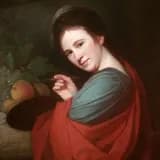
Mary Moser became one of only two women (with Angelica Kauffman) among the 36 founding members of the Royal Academy of Arts, London.
On 10 December 1768, King George III signed the Instrument of Foundation establishing the Royal Academy of Arts in London. Among its thirty-six founding members were only two women: Mary Moser and the Swiss-Austrian painter Angelica Kauffman. This made Moser one of the first women in Britain to receive full institutional recognition as a professional artist at the highest level.
This achievement was extraordinary given the social norms of eighteenth-century Britain, where women were categorically excluded from academic art training, particularly life drawing from nude models, which was considered essential to history painting and deemed improper for women to study. Despite this, Moser and Kauffman were admitted as full Academicians (RA), with voting rights and the ability to exhibit at the Academy's prestigious annual exhibitions.
Remarkably, no other woman would be elected as a full Royal Academician for another 168 years, until Annie Swynnerton's associate status in 1922 and full academician status was not achieved again by a woman until Laura Knight in 1936. This underscores just how singular and historically significant Moser's founding membership was.
Moser's status as a founding member cemented her place in art history not merely as a talented painter but as a trailblazer who broke through institutional barriers that would not be meaningfully challenged again for nearly two centuries.