← All women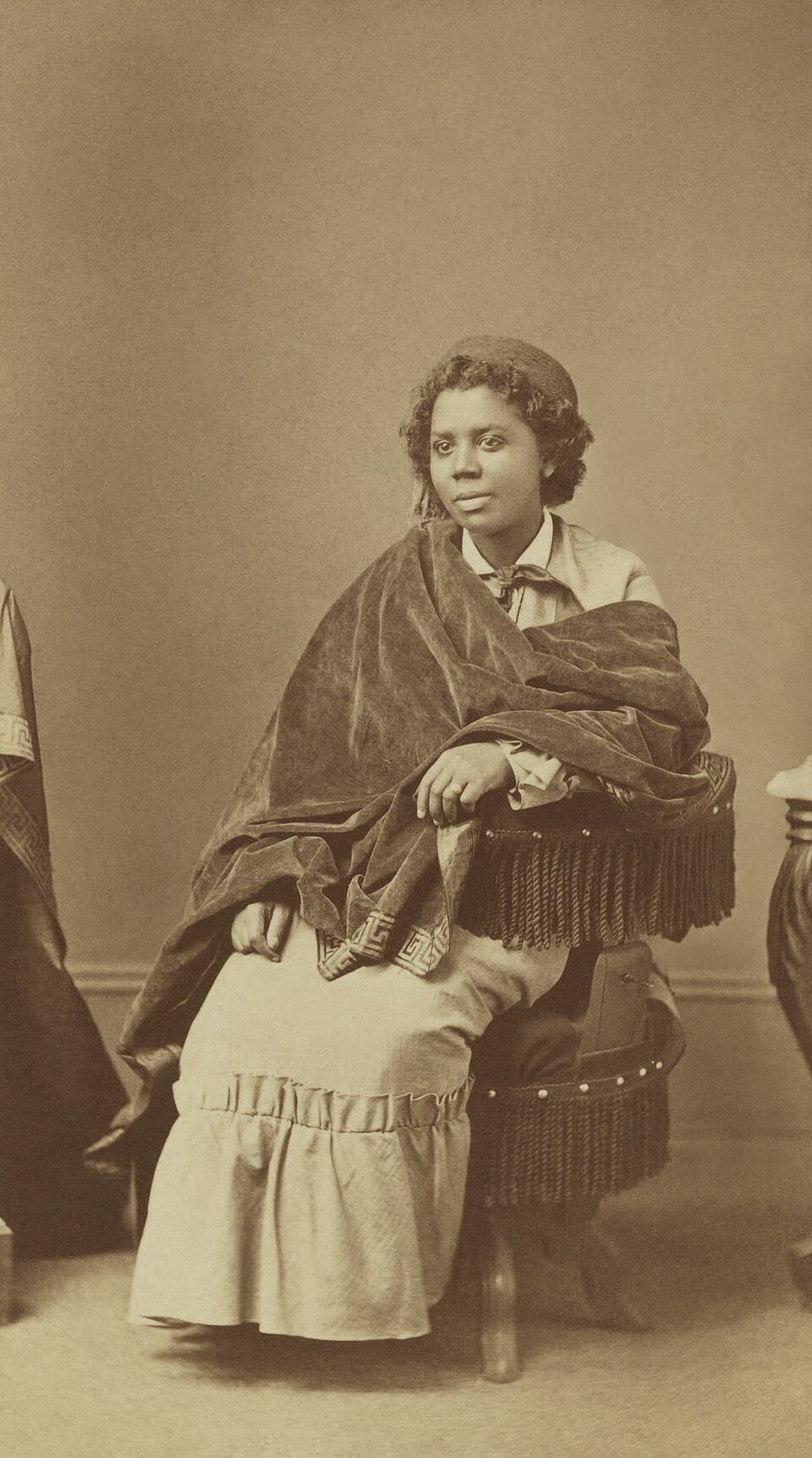
American · Arts
Mary Edmonia Lewis
July 4, 1844 – September 17, 1907
Early Life and Background
Mary Edmonia Lewis, often known simply as Edmonia Lewis and nicknamed "Wildfire", was born a free Black woman of mixed African American and Native American (Mississauga Ojibwe/Chippewa) descent in upstate New York, in a village then called Greenbush, now Rensselaer.[1][2][3][6][9] Most scholarly sources date her birth to about 1844; Lewis herself later claimed July 4, 1844, as her birthday, and that date appears on contemporary documents such as her passport and in several modern references.[2][3][14][16]
Her father was a free Black man, often described as a servant or laborer, while her mother was of Ojibwe and African American ancestry and worked as a craftswoman and weaver.[1][9][14] Orphaned at a young age, Lewis spent much of her childhood with her mother’s nomadic Ojibwe relatives, traveling around the Great Lakes region. She helped make and sell crafts to tourists and acquired the nickname "Wildfire" for her lively, independent disposition.[1][6][9] These early experiences immersed her in Native lifeways and artisanal practice, shaping her later interest in Indigenous themes and self-sufficient artistic labor.
Information about her early schooling is sparse, but by the late 1850s she was sent to live with family friends and attend secondary education in the United States.[4][6] In 1859 she enrolled at Oberlin College in Ohio, one of the first American institutions to admit both women and Black students.[1][2][4] Oberlin was a center of abolitionist activism and progressive education, offering Lewis rare access to higher learning at a time when Black and Indigenous women were almost entirely excluded from such opportunities.
Oberlin College and Racial Violence
Lewis’s years at Oberlin were formative but traumatic. According to later accounts, she took preparatory and possibly artistic courses and began to explore drawing and the fine arts.[1][4][6] In the early 1860s, however, she was caught up in a scandal that revealed the fragility of her position as a woman of color in a predominantly white community.
In 1862, Lewis was accused of having poisoned two white female classmates with a drink of spiced wine.[2][4][6] Although she was arrested, a local court acquitted her. Shortly after, before the start of term, she was brutally attacked by a mob who dragged her from her lodgings, beat her, and left her for dead at the edge of town.[2][4][6] The assault was widely understood to be racially motivated. Lewis sought the help of abolitionist lawyer John Mercer Langston, who obtained legal redress for the attack, but the college still refused to allow her to register for further courses.[4][6]
In 1863 she faced a second accusation, this time of theft of art supplies, and again was acquitted.[2][4][6] Nevertheless, she was effectively forced out of Oberlin without a degree. These incidents demonstrated the severe racism and sexism that could confront even those Black women who gained entry to progressive institutions. The experience scarred Lewis but did not end her pursuit of an artistic career.
Move to Boston and Artistic Training
Around 1863–1864, Lewis moved to Boston, seeking to reinvent herself as an artist in a city known for its abolitionist networks and cultural patronage.[1][2][6] There she met and studied informally with the sculptor Edward A. Brackett, who provided technical guidance and support.[1][6][16] She also developed connections with women sculptors such as Anne Whitney and benefited from the patronage of Boston’s reformist circles.
Lewis began her professional career by creating small portrait medallions and busts of abolitionist heroes and prominent figures, including John Brown and Colonel Robert Gould Shaw, commander of the Black 54th Massachusetts Regiment.[1][2][6][13] She sold these works to raise funds for further training and travel. Her bust of Shaw, in particular, drew attention from patrons connected to the Boston antislavery movement. As a Black and Native American woman producing likenesses of white male abolitionists, Lewis navigated complex racial and gendered expectations while claiming space in the public commemorative landscape.
Relocation to Europe and Rome’s Women Sculptors
By the mid‑1860s, Lewis had earned enough from her Boston commissions to travel to Europe.[1][2][6] She first visited Florence and then settled in Rome in 1865, where she joined a vibrant circle of expatriate American women sculptors, including Harriet Hosmer and others.[1][2][6] Rome offered access to marble quarries, skilled stone carvers, and a cosmopolitan community of artists and patrons.
Most sculptors in Rome employed local artisans to rough out or even fully carve works from plaster models. Lewis, however, insisted on doing all of her own stonework. She later explained that she feared critics would claim her sculptures were not truly her own if others carved them.[1][6] This decision reflected both her artistic integrity and her awareness that, as a woman of color, she had to counter skepticism about her authorship.
In Rome she adopted the professional name Edmonia Lewis and largely abandoned the childhood nickname "Wildfire" in public contexts.[6][8] She worked primarily in marble, creating portrait busts, religious scenes, and figural compositions that drew on both classical and American themes. Her studio became a destination for tourists, clergy, and reform-minded patrons, many of whom were intrigued by her background as much as by her art.
Major Works and Thematic Development
Lewis’s early Roman period produced several large-scale works that established her reputation. In 1867 she completed "Wooing of Hiawatha", inspired by Henry Wadsworth Longfellow’s popular poem "The Song of Hiawatha".[2][6] This was followed in 1868 by "Minnehaha", and in 1871 by "Marriage of Hiawatha" and a bust of Longfellow himself.[2][6][13] These sculptures treated Longfellow’s romanticized Native American characters with unusual sympathy and dignity, informed by Lewis’s own Ojibwe heritage.
Her works based on Longfellow’s poem appealed to American tourists who associated Indigenous peoples with a mythic past, yet Lewis used these themes to counter crude stereotyping, presenting Hiawatha and Minnehaha as noble, emotionally complex figures.[13] The warm reception of these pieces helped solidify her standing among American visitors and collectors.
Alongside Native American subjects, Lewis produced explicitly emancipation-themed sculptures engaging with the aftermath of the U.S. Civil War. In February 1866"Freedwoman and Her Child", often described by later commentators as the first feminist Emancipation statue by an African American artist, focusing on a Black mother and child rather than a male soldier or allegorical figure of Liberty.[14]
Her most famous emancipation work is "Forever Free", completed around 1867 and publicly dedicated in Boston in 1871.[6] This marble group depicts a newly emancipated Black man and woman with broken shackles at their feet, expressing both relief and determination. The sculpture became a powerful visual statement of post‑war liberation, aligning Lewis’s art with abolitionist memory and Reconstruction politics.
Lewis also turned to biblical narratives to explore themes of enslavement, exile, and faith. Her marble "Hagar", created by 1875, portrays the enslaved Egyptian servant Hagar at the moment of abandonment in the wilderness. Critics recognized Hagar as an allegorical figure for Black women’s suffering, and the work would later be exhibited in major American venues.[2][6]
In 1876 she completed her most ambitious sculpture, "The Death of Cleopatra", a life-size marble depicting the Egyptian queen immediately after suicide. Unlike more sanitized neoclassical images of Cleopatra alive and regal, Lewis’s version presents the queen slumped in a chair, the asp at her breast, rendered with arresting realism.[2][6] The choice of such a controversial subject, and the unflinching treatment of death, marked Lewis as a daring and original sculptor.
Centennial Exposition and International Recognition
Lewis’s career reached a high point with her participation in the Centennial Exposition in Philadelphia, the United States’ first official world’s fair, which opened on May 10, 1876.[2][6] "The Death of Cleopatra" was exhibited in the exposition’s art galleries and quickly became one of the most talked‑about works on view.[2]
Contemporary commentators remarked on the sculpture’s emotional power and technical skill, noting its departure from idealized neoclassicism in favor of stark realism. Some praised its originality, while others found it disturbing.[2][3] Nonetheless, its inclusion in such a national showcase signaled that Lewis had achieved a level of prominence few women, and no other Black woman, enjoyed in American sculpture.
Despite this success, "The Death of Cleopatra" experienced an uneven post‑exposition history. The work was not immediately purchased and eventually fell into obscurity, reportedly serving as a grave marker at a Chicago racetrack before being rediscovered in the 20th century.[2] Today, it is held by the Smithsonian American Art Museum, where it is regarded as Lewis’s masterpiece and a landmark of 19th‑century American art.[1][2]
Exhibitions in Chicago and Boston
Lewis’s large-scale works were also exhibited in major American cities beyond Philadelphia. In August 1870, her statue "Hagar" received its first major public showing at Farwell Hall in Chicago, a significant venue for lectures and cultural events.[6] The exhibition marked her emergence as a serious sculptor in the Midwest and connected Hagar’s biblical story to contemporary conversations about race and gender.
In 1871, her emancipation group "Forever Free" was publicly dedicated in Boston, where abolitionist sentiment had deep roots.[6] The dedication ceremony highlighted the sculpture’s role as a visual monument to the end of slavery and underscored Lewis’s place within New England’s culture of reform. These events helped make her a familiar name among American art patrons even as she continued to live and work primarily in Rome.
Later Career and the World’s Columbian Exposition
Lewis remained based in Rome through the 1870s and beyond, periodically traveling to the United States to solicit commissions and exhibit work.[2][6] She continued to produce sculptures on religious, classical, and American themes, including a series of busts of notable figures and additional Hiawatha-inspired pieces such as "The Old Arrowmaker and His Daughter" (completed 1872).[2][6]
Despite shifting artistic tastes, she maintained a transatlantic clientele and participated in major exhibitions. Notably, her works—including "Hiawatha" and a bust of Phyllis Wheatley, the first published African American woman poet—were shown at the World’s Columbian Exposition in Chicago, which opened on May 1, 1893.[2][6] The fair, commemorating the 400th anniversary of Columbus’s arrival in the Americas, drew millions of visitors and aimed to showcase American progress.
Lewis’s presence at the Columbian Exposition, decades after her first acclaim, demonstrated the longevity of her career and the continuing appeal of her work. The choice of Hiawatha and Wheatley as subjects underscored her commitment to representing Indigenous and Black figures within spaces that often marginalized them. Her sculptures offered alternative narratives of American identity amid the fair’s triumphant rhetoric.
Awards, Honors, and Contemporary Reception
As a woman of color in a deeply segregated society, Lewis did not receive the formal honors or academic positions that many of her white male contemporaries enjoyed. Nonetheless, contemporaneous accounts and later institutional recognitions attest to the esteem in which her work was held.
In her own time, she earned critical praise in newspapers, art journals, and travel accounts, particularly for "The Death of Cleopatra," "Forever Free," and her Hiawatha series.[2][3][6] She secured commissions from American and European patrons, including members of the clergy and aristocracy, which allowed her to sustain herself entirely through sculpture—a significant achievement for any woman in the 19th century.
In the 20th and 21st centuries, major institutions have acknowledged her pioneering role. The Smithsonian American Art Museum, the National Park Service, and the National Women’s History Museum all recognize her as the first African American and Native American sculptor to achieve national and international recognition and as the first professional BIPOC sculptor in the United States.[1][4][19] Her works have been featured in scholarly exhibitions and digital initiatives, including Google Arts & Culture and specialized women‑artists platforms.[1][8][9]
Personal Life
Relatively little is known about Lewis’s intimate personal life, and surviving records do not document any marriage or children.[2][3][6] She appears to have devoted herself primarily to her art and professional networks. As an expatriate in Rome and later a resident of other European cities, she moved within circles of artists, patrons, and clergy rather than maintaining a settled domestic household.
Sources indicate that Lewis was a practicing Catholic, and religious themes appear frequently in her work.[2][3][6] Her faith likely shaped both her subject choices and her community ties, particularly in Rome, where she sometimes received commissions for religious sculpture. Her burial in a Roman Catholic cemetery in London further confirms the importance of Catholicism in her life.[4][6][19]
Lewis also had to manage the public fascination with her identity. Visitors to her studio often expressed more curiosity about her race and background than about her technique. She strategically presented herself in ways that could attract patronage while resisting exoticization, insisting on her seriousness as an artist and the universality of her themes.[1][6]
Later Life and Death
By the late 19th century, neoclassical sculpture was losing favor to newer artistic movements, and Lewis’s production appears to have slowed.[2][6] She continued to receive some commissions and maintained a presence in Europe, but detailed records of her later years are fragmentary. For much of the 20th century, biographers were uncertain about when and where she died, with many works citing approximate years or assuming she remained in Rome until her death.[6]
This uncertainty was resolved through modern archival research. Biographer Marilyn Richardson, using newly digitized records and London archival sources, discovered that Lewis had in fact died of chronic kidney disease (Bright’s disease) on September 17, 1907, at the Hammersmith Borough Infirmary in London, United Kingdom.[3][4][6][19] She was buried in St. Mary’s Roman Catholic Cemetery at Kensal Green, London.[6][19] These findings corrected decades of misinformation and were subsequently adopted by the National Park Service and major reference works.[3][4][19]
Legacy and Historical Impact
Lewis’s legacy rests on both her artistic achievements and the barriers she broke in the world of sculpture. She is widely regarded as the first African American and Native American sculptor to attain national and international recognition and as the first professional BIPOC sculptor in the United States.[1][4][11][14][19] Her career demonstrated that a woman of color could succeed in a highly technical, capital‑intensive field long dominated by white men.
Her work expanded the iconography of emancipation, race, and gender in American art. Sculptures such as "Freedwoman and Her Child" and "Forever Free" introduced Black women and families into the visual language of liberation, challenging male‑centered narratives and offering what scholars now recognize as early feminist interpretations of emancipation.[6][14] "Hagar" connected biblical servitude to contemporary debates about Black womanhood, while "The Death of Cleopatra" interrogated power, autonomy, and mortality through a striking female subject.[2][3]
Her Hiawatha series and other Indigenous-themed works provided rare sympathetic representations of Native characters, informed by her Ojibwe upbringing.[1][6][13] In contrast to many 19th‑century depictions produced by white artists, Lewis’s sculptures emphasized dignity and emotional depth, resisting caricature.
Beginning in the 1980s, art historians and institutions initiated a substantial reevaluation of Lewis’s career. Exhibitions, scholarly articles, and catalogues have brought her work back into public view and highlighted the structural reasons for her earlier neglect.[6][14] The acquisition and prominent display of "The Death of Cleopatra" by the Smithsonian American Art Museum played a key role in this reassessment, positioning the sculpture as a central work in the history of American neoclassicism and Black women’s artistry.[1][2]
Digital projects and women’s history initiatives have further amplified her story. The National Women’s History Museum, the National Park Service, and various women‑artists platforms now present Lewis as a foundational figure in Black, Indigenous, and women’s art history.[4][8][19] Her life appears in educational resources, museum labels, and online biographies that emphasize the intersection of race, gender, and transatlantic artistic practice.
Lewis’s insistence on carving her own marble, her reliance on the patronage of abolitionist and reformist networks, and her choice of politically charged subjects illustrate how artistic labor can function as a form of social critique. Her career also reveals the precariousness of recognition for women of color: celebrated in her time, she was later marginalized, only to be rediscovered through painstaking archival work and institutional commitment.
Today, Edmonia Lewis stands as a symbol of resilience and innovation. Her sculptures continue to inspire critiques of historical memory, and her biography serves as a case study in how structural racism and sexism shape whose stories are preserved. As museums and scholars increasingly focus on inclusive narratives, Lewis’s work occupies a central place in the reimagined canon of American and international art.
Historical Significance
From the perspective of women’s history, Lewis’s significance is multifaceted:
- She broke gender and racial barriers in a demanding fine art medium, demonstrating that a woman of color could master marble sculpture and sustain a professional career across continents.[1][4][19]
- She contributed foundational imagery to the visual culture of emancipation and Reconstruction, foregrounding Black women and families in ways that anticipated later feminist and civil rights iconography.[6][14]
- Her transatlantic life—moving from upstate New York to Boston, Rome, and London—embodied the global dimensions of 19th‑century art and the diaspora of Black and Indigenous creators.[1][2][6]
- The modern reconstruction of her biography exemplifies how archival research can rectify the historical erasure of women of color and secure their place in scholarly and public memory.[3][4][6][19]
In the broader trajectory of American art, Edmonia Lewis’s story underscores the importance of looking beyond mainstream narratives to recognize the contributions of artists who worked at the intersections of race, gender, and nationality. Her sculptures, once nearly forgotten, now stand as enduring witnesses to both the injustices and the aspirations of her time.
Dated achievements
8 indexed.
- Jul041844Arts
Birth in Greenbush, New York (claimed date)
Edmonia Lewis claims July 4, 1844, as her birthdate in Greenbush, NY.
View details Mary Edmonia Lewis Biography - Britannica - Feb011866Arts
Creates "Freedwoman and Her Child"
First feminist Emancipation statue by an African American, created by Edmonia Lewis.