← All women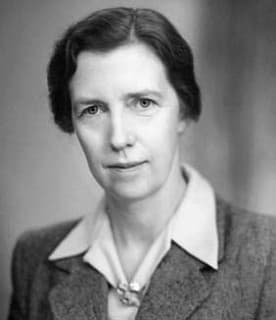
British · Science
Mary Cartwright
December 17, 1900 – April 3, 1998
Early Life and Education
Mary Lucy Cartwright was born on 17 December 1900 in the small village of Aynho, Northamptonshire, England. She was the daughter of Reverend William Digby Cartwright, a clergyman, and Lucy Maud Bombas Cartwright. Growing up in a rectory household, Mary was one of several children, and though her family valued education, mathematics was not necessarily seen as a natural path for a young woman of her era.
She attended Leamington High School before moving to Godolphin School in Salisbury, where her mathematical talent first became evident to her teachers. Despite the pervasive assumption of the time that mathematics was unsuitable or unnecessary for women, Cartwright pursued her passion with determination. In 1919, she won a place to study mathematics at St Hugh's College, Oxford, one of the small number of women's colleges that allowed women to study at Oxford University, though women were not yet permitted to receive full degrees on the same terms as men at the time she began.
Cartwright graduated with a first-class degree in mathematics in 1923—a rare and impressive achievement for a woman at the time, given the significant social and institutional barriers women faced in pursuing rigorous scientific education. After a period of teaching in schools, she returned to Oxford to pursue postgraduate research, earning her DPhil in 1930 under the supervision of the eminent mathematician G. H. Hardy, with further guidance from E. C. Titchmarsh.
Academic Career and Early Research
Following her doctorate, Cartwright secured a research fellowship at Girton College, Cambridge, in 1930, marking the beginning of her long association with Cambridge University. She quickly established herself as a formidable mathematician specializing in complex analysis and function theory, publishing significant papers on entire and meromorphic functions during the early 1930s.
In 1934, she became a Lecturer at Girton College and continued to build her reputation within the highly male-dominated world of Cambridge mathematics. Her early work focused on function theory, but a pivotal moment in her career came through a collaboration that would define much of her later legacy.
Collaboration with J. E. Littlewood and Wartime Research
In the late 1930s, Cartwright began a scientific partnership with the renowned mathematician John Edensor Littlewood, a collaboration that would prove enormously influential, both for her career and for the broader field of mathematics. Their work was initially motivated by a very practical wartime problem: the British government, through the Department of Scientific and Industrial Research, had asked mathematicians to study the erratic and unpredictable behavior of radio and radar valve circuits used in early warning systems during the buildup to and during the Second World War.
Cartwright and Littlewood turned their attention to the underlying differential equations governing these electrical circuits—specifically nonlinear differential equations of the type known as the Van der Pol equation. Where engineers had observed strange, seemingly chaotic oscillations in the circuits that defied straightforward explanation, Cartwright and Littlewood provided rigorous mathematical analysis showing that such systems could indeed exhibit extremely complex, seemingly erratic behavior, even though they were governed by deterministic equations.
Their landmark papers, published throughout the 1940s, provided some of the earliest rigorous mathematical demonstrations of what would later become known as chaotic dynamics—a field that would not be formally named or widely recognized until decades later, following the popularization of chaos theory in the work of Edward Lorenz and others in the 1960s and beyond. The mathematical structures they identified are now referred to as the Cartwright–Littlewood theorem, and their equations remain a foundational reference point in the study of dynamical systems. Their work is now recognized as decades ahead of its time, predating the formal establishment of chaos theory as a discipline.
Leadership at Girton College
In 1948, Cartwright was appointed Mistress of Girton College, Cambridge, a position she held until her retirement in 1968. As Mistress, she led one of Cambridge's foremost women's colleges through two crucial decades of change, overseeing its academic development and advocating for the advancement of women's education at a time when Cambridge colleges remained largely segregated by sex and women were still fighting for equal recognition within the university.
During her tenure, she also served as a Reader in Mathematical Analysis at Cambridge University (from 1959), continuing her research even while carrying significant administrative responsibilities.
Honors and Recognition
Cartwright's contributions to mathematics were formally recognized through a series of unprecedented honors for a woman in her field:
- In 1947, she became the first woman mathematician elected a Fellow of the Royal Society, one of the highest scientific honors in Britain.
- In 1963, she received the Sylvester Medal from the Royal Society for her contributions to mathematics.
- She served as President of the London Mathematical Society from 1961 to 1963, and later, in 1969, became associated with further leadership recognition within mathematical societies.
- She was the first woman President of the Mathematical Association (1951–1952).
- In 1969, she was created Dame Commander of the Order of the British Empire (DBE) in recognition of her services to mathematics.
- In 1968, she received the De Morgan Medal, one of the most prestigious awards given by the London Mathematical Society.
These honors collectively marked her as one of the most decorated women in the history of British mathematics, breaking barriers in institution after institution that had, for centuries, been the exclusive preserve of men.
Personal Life
Mary Cartwright never married and had no children, dedicating her life fully to mathematics, teaching, and academic administration. She was known among colleagues and students for her rigor, discipline, and quiet determination, as well as for her warmth and mentorship of younger mathematicians, particularly women navigating the still male-dominated world of Cambridge academia.
She was deeply committed to her Anglican faith throughout her life, a legacy of her upbringing in a clergyman's household, and she remained connected to Girton College and Cambridge's mathematical community long after her formal retirement.
Later Life, Death, and Legacy
After retiring as Mistress of Girton College in 1968, Cartwright remained an active presence in the mathematical community, continuing to write, lecture, and mentor for many years. She lived a long life, ultimately passing away on 3 April 1998 in Cambridge, England, at the age of 97.
Mary Cartwright's legacy endures on multiple fronts. Mathematically, her work with Littlewood on nonlinear differential equations is now recognized as pioneering, prescient research that anticipated the field of chaos theory by several decades; contemporary mathematicians studying dynamical systems continue to reference the Cartwright–Littlewood results. Institutionally, she broke down barriers for women in mathematics and science at a time when such barriers were formidable and often taken for granted—her election to the Royal Society, her presidencies of major mathematical societies, and her damehood all represented firsts that opened doors for the women who followed her.
Today, Cartwright is remembered not only as a brilliant and original mathematician but as a role model and trailblazer whose career demonstrated, contrary to the prevailing assumptions of her time, that women could achieve the very highest levels of distinction in mathematics. Institutions including Girton College, the London Mathematical Society, and various mathematical history archives continue to honor her memory and her scientific contributions.
Dated achievements
3 indexed.
- Dec171900Science
Birth of Dame Mary Cartwright
Mary Lucy Cartwright was born on 17 December 1900 in Aynho, Northamptonshire, England.
View details MacTutor History of Mathematics - Mary Cartwright - Oct031969Science
First Woman President of the London Mathematical Society
Mary Cartwright became the first woman President of the London Mathematical Society in 1969.