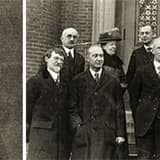
Calkins introduced her original theory of self-psychology to the academic literature in 1900.
In 1900, Mary Whiton Calkins first published her theory of self-psychology, a distinctive and original contribution to psychological theory that positioned the conscious self as the central unit of psychological analysis, rather than isolated mental elements or purely behavioral responses.
This theoretical framework was unusual for its time. Where much of experimental psychology was moving toward atomistic, elementalist analyses of consciousness (as in structuralism) or toward strictly observable behavior, Calkins insisted that psychology must account for the unified, experiencing self as an irreducible starting point. She argued that all mental processes—perception, memory, emotion—are always experiences of a self, and that psychology could not be complete without addressing this personal, relational dimension of consciousness.
Her self-psychology anticipated later developments in personalistic and humanistic psychology, and it distinguished her intellectually from many of her contemporaries, including her mentors William James and Hugo Münsterberg. It also reflected her dual identity as both psychologist and philosopher, since the theory drew heavily on philosophical considerations of selfhood and personal identity.
This 1900 publication marked the beginning of a sustained theoretical project that Calkins would continue to develop and defend for the rest of her career, including in her 1906 APA presidential address, cementing her reputation as an original systematic thinker rather than merely an experimentalist.