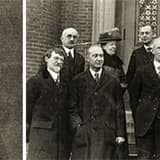
Calkins returned to Harvard in 1892 to conduct memory research under psychologist Hugo Münsterberg.
In 1892, Mary Whiton Calkins returned to Harvard University to work under the newly arrived German-trained psychologist Hugo Münsterberg, who had been recruited by William James to direct the psychological laboratory. Although Harvard would not grant women formal degrees, Münsterberg welcomed Calkins into his lab and supported her research ambitions.
During this period, Calkins undertook intensive studies of memory, building on associationist principles that were then at the frontier of experimental psychology. Her work would culminate in an original experimental technique for studying paired associations in memory, a method that became foundational to later cognitive psychology and is still recognized today as the paired-associate learning paradigm.
This return to Harvard was significant not only for the research she would produce, but as an act of persistence against a university that refused to formally acknowledge her scholarly status. She completed all requirements for a Ph.D., including a dissertation praised by her examining committee, yet Harvard declined to confer the degree upon her because she was a woman, offering her a Radcliffe College degree instead, which she refused on principle.
Her time at Harvard under Münsterberg cemented her reputation as a serious experimentalist and set the stage for her groundbreaking publications on association in the years that followed.