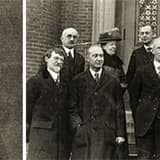
Calkins became the first woman elected president of the American Philosophical Association in 1918.
In 1918, Mary Whiton Calkins was elected the first woman president of the American Philosophical Association, making her the only person in history to have served as president of both the American Psychological Association and the American Philosophical Association—a testament to the breadth and depth of her scholarly contributions across both disciplines.
This achievement came two decades after her groundbreaking election to the APA presidency in 1898, and it reflected Calkins's increasing focus, in the latter part of her career, on philosophical questions of metaphysics, ethics, and the nature of personal identity, alongside her ongoing work in psychology. Her philosophical writings developed the metaphysical implications of her self-psychology theory, arguing for a personalistic idealism in which reality is fundamentally constituted by selves in relation.
Her election as president of the American Philosophical Association was another significant barrier broken for women in American academia. Philosophy, like psychology, was a discipline dominated almost entirely by men in university positions, and Calkins's leadership of the association demonstrated the high regard in which her philosophical work was held by her peers, despite her having been denied a Harvard Ph.D. decades earlier.
This dual presidency across two major academic disciplines remains a singular achievement in American intellectual history, and it is frequently cited as one of the clearest demonstrations of Calkins's extraordinary and wide-ranging scholarly influence.