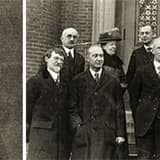
Calkins served her term as the first woman president of the APA in 1905.
Mary Whiton Calkins served in 1905 as the first woman to hold the presidency of the American Psychological Association, an office to which she had been elected in 1898 and which she took up as the association's leadership rotated among its most distinguished members. Some sources date her formal presidential service to 1905, reflecting the association's practice of electing officers ahead of their term of active leadership.
During her tenure, Calkins used her platform to advocate for a psychology grounded in the reality of conscious, unified selves rather than one reduced to disconnected sensory elements or purely mechanistic explanations. Her leadership of the APA at a time when the organization was still defining professional standards for the discipline gave her considerable influence over how psychology as a science would be practiced and taught in the United States.
As the first woman to hold this position, Calkins broke a significant institutional barrier in American science. Her presidency demonstrated that a woman could rise to the very top of a major scientific professional organization, even one composed almost entirely of male academics, at a time when women were frequently excluded from professorships, laboratories, and doctoral degrees.
Her presidency remains a landmark reference point in histories of women in psychology and science more broadly, cited as proof of both the obstacles she overcame and the eventual, if partial, recognition of her scholarly excellence by her professional peers.