← All women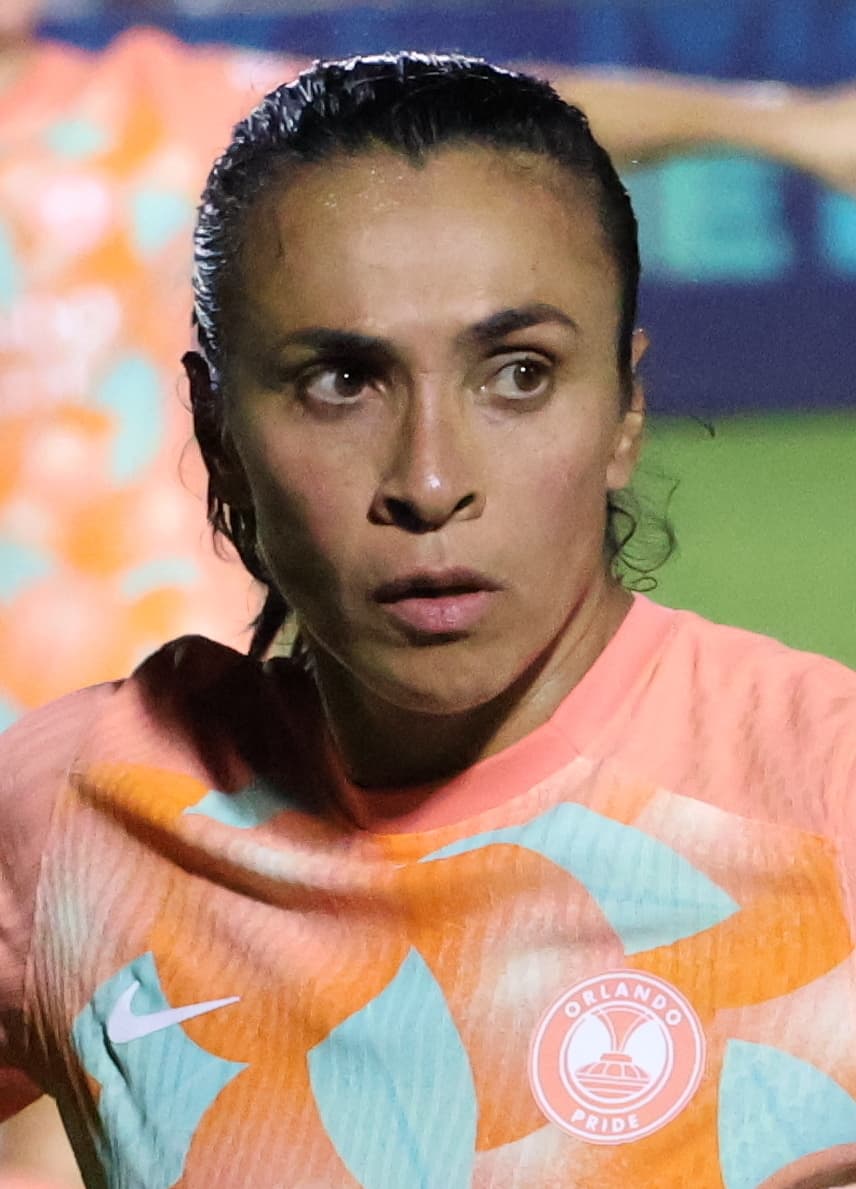
Brazilian · Sports
Marta Vieira da Silva
February 19, 1986 – present
Early Life and Background
Marta Vieira da Silva was born on 19 February 1986 in Dois Riachos, a small town in the northeastern Brazilian state of Alagoas.[1][4][8][10][15] She grew up in a family of modest means in a region marked by economic hardship, where opportunities for girls in sport were limited and football was overwhelmingly dominated by boys and men.[8][12] From an early age, Marta showed a strong affinity for the game, playing barefoot in the streets and on improvised pitches with boys’ teams in her hometown.[9][7]
Her determination to play football often meant confronting social expectations that discouraged girls from participating in the sport. Accounts of her childhood highlight how she persisted despite skepticism from adults and peers, using informal games to develop the technical skill and flair that would later characterize her professional career.[7][8] Marta’s formative experiences in Dois Riachos—learning to play in constrained conditions, improvising with limited equipment, and facing gender‑based barriers—shaped both her style of play and her later commitment to advocating for women and girls in sport.
Career Beginnings and Development
Marta’s talents eventually attracted attention beyond her hometown. As a teenager she moved away from Dois Riachos to pursue football more seriously, joining CR Vasco da Gama’s women’s team in Rio de Janeiro at around age 14.[9][7] This step exposed her to a more structured competitive environment and helped her transition from informal street football to organized club play. Her performances quickly signaled that she was an exceptional prospect.
In 2002, Marta made her senior debut for the Brazil women’s national team, an unusual achievement for someone still in her mid‑teens.[1][7][15] Her early inclusion in the national setup reflected not only her technical quality—close control, dribbling ability, and finishing—but also her composure and confidence against international opponents. That same year, she began to attract interest from clubs abroad.
A major turning point came when she moved to Sweden to play in the Damallsvenskan, one of the strongest women’s leagues in Europe. She joined Umeå IK, where she would become a central figure in a side that dominated Swedish women’s football.[9][15] With Umeå, Marta helped the team secure multiple league titles and reach UEFA Women’s Champions League finals in the late 2000s, using her creativity and goal‑scoring ability to drive the club’s success.[9]
Rise to International Prominence
Marta’s international profile began to rise sharply with Brazil’s success in regional competitions. In 2003, she helped Brazil win the Copa América Femenina and was part of the squad that captured the gold medal in women’s football at the Pan American Games in Santo Domingo.[1][15] On 25 April 2003, she scored her first senior international goal in a 3–0 win over Peru at the Copa América, an early milestone that signaled her impact at full international level.[1]
Brazil’s gold medal at the Pan American Games, confirmed on 2 August 2003, was one of Marta’s first major titles with the national team and helped establish Brazil as a dominant force in women’s football across the Americas.[15] These successes reinforced her growing reputation and provided a platform for further achievements on the world stage.
In 2004, Marta continued to excel in youth and senior international competitions. She played in the FIFA U‑19 Women’s World Championship in Thailand and, on 28 August 2004, was named the tournament’s Best Player, recognizing her as the standout talent among the world’s top young footballers.[15][14] That same year, she took part in the Athens Olympic Games, where Brazil reached the final of the women’s football tournament. On 28 August 2004, Brazil secured the silver medal, giving Marta her first Olympic podium finish.[4][9]
World Cups, Olympic Games, and Global Stardom
Marta’s performances at the FIFA Women’s World Cup cemented her standing as one of the game’s greatest players. She first appeared at the World Cup in 2003, and her role expanded in subsequent editions. The 2007 FIFA Women’s World Cup was particularly significant. Marta scored seven goals, helping Brazil reach the final, and on 10 July 2007 she was awarded both the Golden Boot (top scorer) and the Golden Ball (best player), underscoring her dominance of the tournament.[4][15][16]
Marta continued to represent Brazil at multiple Olympic Games. After the Athens silver in 2004, she again led Brazil to the final at the Beijing 2008 Olympics, where the team earned another silver medal on 23 August 2008.[4][9] These back‑to‑back Olympic silvers demonstrated Brazil’s competitiveness and highlighted Marta’s capacity to influence major tournaments.
She remained a central figure at subsequent World Cups, scoring in the 2011 and 2015 editions and extending her World Cup goal tally. As of the mid‑2020s, Marta holds the record for most goals in FIFA Women’s World Cup history, with 17 goals.[1][6][15][16] Her World Cup and Olympic appearances also made her one of the most experienced players in international women’s football.
At the Tokyo Olympics (Tokyo 2020, held in 2021 due to the COVID‑19 pandemic), Marta again played for Brazil, appearing in the opening match on 21 July 2021.[9] She later added another Olympic medal to her collection: at the Paris 2024 Olympics, Brazil’s women’s team reached the final, and on 10 August 2024 Marta won a third Olympic silver medal.[4][9]
Club Career and Professional Achievements
At club level, Marta’s career spans multiple countries and leagues. Her time with Umeå IK in Sweden was particularly influential. She helped the club win four consecutive Swedish league titles and reach Champions League finals in 2007 and 2008.[9] Her creativity, dribbling, and scoring prowess made her one of the most feared forwards in European women’s football.
Following her success in Sweden, Marta played for several clubs in the United States, including Los Angeles Sol, FC Gold Pride, and Western New York Flash, during the era of Women’s Professional Soccer (WPS).[15] Her impact continued when she joined the Orlando Pride in the National Women’s Soccer League (NWSL), where she has served as a key attacking player and a leader within a growing professional league.[9][10][15]
Across her club career, Marta has earned numerous individual and team honors, including domestic league titles, cup wins, and MVP awards. Her club performances, particularly in Sweden and the United States, helped elevate the competitive standard and visibility of women’s leagues and demonstrated that women’s football could sustain high‑quality professional competition.
Awards, Honors, and Recognition
Marta’s list of individual awards is unparalleled in women’s football. She has been named FIFA World Player of the Year a record six times, in 2006, 2007, 2008, 2009, 2010, and 2018.[1][4][5][7][8][15][16] The first five awards came consecutively, making her the only player, male or female, to win the accolade five years in a row.[4][7][16] On 3 November 2008, she received the 2008 FIFA World Player of the Year award, part of this remarkable run.[15] On 20 December 2010, she was again honored, marking her fifth consecutive title.[15]
In 2018, FIFA updated its awards format, and Marta was named The Best FIFA Women’s Player. The award was presented on 24 September 2018, confirming her status at the top of the game more than a decade after her first global honors.[1][15]
Beyond FIFA awards, Marta has received recognition from confederations, leagues, and media organizations for her contributions to football. She is widely referred to as the “queen of football,” reflecting both her playing style and her symbolic role in the sport.[7][8] She has also been honored by Brazilian institutions and international bodies for her influence on gender equality and sport.
Records and Barrier‑Breaking Firsts
Marta’s career is distinguished by multiple records that transcend gender boundaries. She is the all‑time leading scorer for the Brazil national team, across both men’s and women’s sides, with more than 120 international goals as of the mid‑2020s.[1][2][10][15] She also holds the record for most goals in the FIFA Women’s World Cup, with 17.[1][6][15][16]
On 13 June 2019, at the 2019 Women’s World Cup, Marta became the first footballer of any gender to score in five different World Cup tournaments, when she found the net against Australia.[15] This record highlights her sustained excellence across World Cups from 2003 to 2019. Only a few players have appeared at five World Cups, and scoring in each one requires remarkable consistency.
Just days later, on 18 June 2019, she scored her 17th World Cup goal against Italy, becoming the all‑time leading scorer in FIFA World Cup history, male or female and surpassing German striker Miroslav Klose’s men’s record of 16.[1][15] This achievement placed a women’s player at the top of one of football’s most iconic statistical categories, challenging long‑held assumptions that the most celebrated records in the sport would always be held by men.
These barrier‑breaking firsts have been widely cited in discussions of gender equity in sport. Marta’s records demonstrate that women, given sustained opportunities to compete at elite levels, can set global benchmarks and reshape the historical narrative of football.
Activism, Advocacy, and Goodwill Work
In addition to her athletic achievements, Marta has become a prominent advocate for women and girls in sport. On 22 October 2009, she was appointed a United Nations Development Programme (UNDP) Goodwill Ambassador, using her platform to support initiatives focused on poverty reduction and youth opportunity.[15][16]
Later, she was named a UN Women Goodwill Ambassador for women and girls in sport, with UN Women describing her as an icon and role model who is widely regarded as the best female soccer player of all time.[16] In this role, Marta has spoken publicly about the importance of equal access to sport, the need for investment in women’s football, and the power of athletics to empower girls.
Her advocacy draws on her own experiences growing up in a poor region of Brazil and facing limited opportunities. Marta has emphasized that football changed her life and that she wants future generations of girls to have the chance to play, compete, and succeed without facing the obstacles she encountered.[7][16] Through appearances at UN events, media engagements, and social media, she has used her visibility to challenge stereotypes, promote gender equality, and encourage institutions to support women’s sport more robustly.
Personal Life
Marta holds dual citizenship, Brazilian and Swedish, reflecting her long association with Swedish football through her club career.[2][16] This dual nationality has facilitated her movement between leagues and underscores the international dimension of her career.
While detailed information about her private relationships and family life is limited in the major reference sources, Marta is known to keep much of her personal life out of the spotlight, focusing public attention on her football and advocacy work. She has used her public platforms primarily to discuss sport, equality, and youth empowerment rather than personal matters.
Legacy and Historical Impact
Marta is widely regarded as one of the greatest footballers of all time, frequently described as the greatest female player in history.[1][4][5][7][8][15][16] Her combination of technical skill, creativity, competitive drive, and leadership has made her a central figure in the development and popularization of women’s football.
Her legacy operates on several levels. Statistically, she stands at the pinnacle of World Cup scoring and Brazil’s international goal charts. Narratively, she embodies the story of a girl from a poor Brazilian town who rose to global prominence, challenging gender norms and structural inequities in sport. Symbolically, her achievements have provided powerful images—dribbling past defenders, scoring decisive goals, lifting trophies—that have helped convince fans, media, and institutions that women’s football is worthy of serious attention and investment.
As a UNDP and UN Women Goodwill Ambassador, Marta has extended her impact beyond the pitch to the realms of global advocacy and policy. Her efforts to promote sport for girls and gender equality have made her a role model not only for aspiring footballers but for young women seeking to challenge barriers in any field.[16]
In Brazil, Marta’s success has contributed to a gradual expansion of opportunities for women in football, inspiring a new generation of players and supporting the growth of domestic leagues and youth programs. Internationally, her records and awards have helped integrate women’s football into mainstream football history, encouraging historians and statisticians to consider women’s achievements on equal footing with those of men.
Later Career and Continuing Influence
Into the 2020s, Marta has continued to play at a high level for both club and country. With the Orlando Pride in the NWSL, she remains an influential attacking player and a veteran leader in a league that has become one of the world’s premier platforms for women’s football.[9][10][15] Her ongoing presence in the Brazil national team, including at the Tokyo and Paris Olympics, demonstrates her enduring fitness and tactical adaptability.
As of the mid‑2020s, Marta is still an active player, and her career continues to evolve. Nevertheless, her historical impact is already clear: she has reshaped expectations about what women can achieve in football, set records that transcend gender, and used her voice to advocate for equality and opportunity. Future assessments of football history are likely to place Marta among the sport’s most transformative figures, alongside legendary players from the men’s and women’s games alike.
Her story—from Dois Riachos to global stadiums, from barefoot street matches to Olympic finals, from local obscurity to UN ambassador—illustrates how sport can serve as a vehicle for social change and personal empowerment. For women’s history, Marta stands as a landmark figure whose achievements will remain central to discussions about gender, sport, and global culture in the twenty‑first century.
Dated achievements
15 indexed.
- Feb191986Sports
Birth of Marta Vieira da Silva
Marta Vieira da Silva was born on this day in Dois Riachos, Alagoas, Brazil.
View details Marta (footballer) - Wikipedia - Aug022003Sports
Pan American Games gold medal
Marta helped Brazil win a gold medal in women's football at the 2003 Pan American Games.