← All women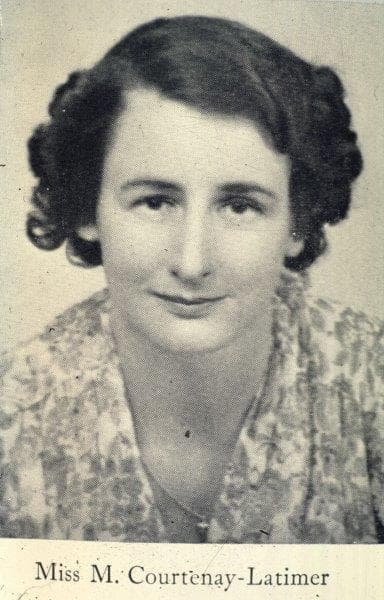
South African · Science · Exploration
Marjorie Courtenay-Latimer
February 24, 1907 – May 17, 2004
Early Life and Background
Marjorie Eileen Doris Courtenay-Latimer was born on 24 February 1907 in East London, in the Eastern Cape region of what was then the Cape Colony in South Africa.[12][4][9] Some secondary accounts list Aliwal North as her birthplace, but detailed biographical work based on family records and local sources identifies East London as the most reliable location.[12][6] She was the eldest of six daughters born to Eric Henry Courtenay-Latimer, a stationmaster with South African Railways, and Willie Fulton (née Raitt), who had British settler roots in South Africa and children from a previous marriage.[12][9][15]
Biographical studies describe Marjorie’s father as calling her a "quaint little serious-minded child," suggesting an early personality marked by curiosity and determination.[10][17] Growing up in a white settler family, she had access to local natural landscapes along the coast, which nurtured an intense interest in animals, plants, and shells. She reportedly kept pets and assembled small collections, showing an inclination toward natural history well before she entered any formal scientific environment.[10][15]
Courtenay-Latimer’s schooling was modest. Evidence from later biographical work indicates that she never obtained a tertiary degree and may not have achieved matriculation, the standard school-leaving qualification.[10][17] In the early twentieth-century South African context, where opportunities for women in higher education and science were limited and typically reserved for the upper middle class, this lack of formal credentials would later shape both the challenges she faced and the distinct path by which she came to scientific prominence.
Career Beginnings and Development
In 1931, when she was in her mid-twenties, Courtenay-Latimer secured a position as the founding curator of the East London Museum, a new institution in the coastal city of East London.[3][14][17] Contemporary accounts suggest that she "backed into" the job rather than following a conventional professional route: she had no formal training in museum science or biology, yet her longstanding interest in natural history and her local knowledge made her a practical choice for a small museum seeking energetic staff.[3][10]
The East London Museum officially opened to the public in 1936, with Courtenay-Latimer as its first curator.[17] She was responsible for building collections almost from scratch, in a setting with limited budgets and modest institutional support. Her duties included acquiring specimens, preparing exhibits, performing taxidermy, and engaging with visitors. As a young woman in a field dominated by men, she had to assert her authority in daily interactions with fishermen, hunters, and local officials who were more accustomed to dealing with male scientists.[17]
To overcome resource constraints, Courtenay-Latimer cultivated relationships with local communities, particularly the fishing industry. She visited docks and fish markets, encouraged captains to alert her about unusual catches, and accepted specimens from residents.[3][19] This immersive, network-based approach to curatorial work proved crucial: it embedded the museum in regional life and created channels through which rare organisms could reach scientific attention.
Over the following decades, she developed the East London Museum into a respected regional natural history institution. Colleagues and visitors later described her exhibits as lively and engaging, crafted to appeal to both scientific audiences and the general public.[15] Her career would eventually span more than forty years at the museum, during which she advanced from curator to director and became a central figure in South African museum circles.[18]
The Coelacanth Discovery (1938–1939)
Courtenay-Latimer’s most renowned contribution to science began in December 1938. On 22 December 1938, while she was working at the East London Museum, she received a telephone call from Captain Hendrik Goosen, skipper of the trawler Nerine.[3][11] Goosen had just brought in a catch of what he considered "garbage fish" and, remembering her earlier requests to be notified of anything unusual, invited her to come inspect the catch.[11][19]
The following day, 23 December 1938, Courtenay-Latimer went to the harbour to examine the catch. On the deck of the Nerine, she saw a large, strikingly blue fish with thick, lobed fins and a distinctive three-lobed tail.[17][12] The fish did not match any species she knew from existing guides. Intrigued by its unusual morphology, she arranged for the specimen to be transported to the East London Museum.
Preserving the fish proved difficult. In the summer heat and with limited facilities, Courtenay-Latimer struggled to prevent the specimen from decomposing. She ultimately opted for taxidermy, skinning and stuffing the fish to create a museum mount.[6][7] During this period she attempted to contact various scientists, eventually focusing on the chemist and amateur ichthyologist James Leonard Brierley (J.L.B.) Smith, who taught at Rhodes University in Grahamstown.
Smith’s initial response was delayed; communication challenges and the holiday season slowed the process.[7][19] When he finally saw the specimen, however, he immediately realised its significance. The fish was identified as a living member of the coelacanths, lobe-finned fishes known only from fossil records dating back hundreds of millions of years and believed to have gone extinct around 65 million years earlier.[7][17]
On 18 March 1939, Smith published a letter in the journal Nature announcing the discovery and formally naming the species Latimeria chalumnae.[3][7] In this nomenclature, he honoured Courtenay-Latimer by establishing the genus Latimeria, and referenced the nearby Chalumna River in the species name. The publication confirmed that a "living fossil" lineage had survived into the modern era and transformed the East London Museum specimen into a global scientific icon.
Courtenay-Latimer’s role in the discovery was pivotal. Without her ongoing engagement with local fishers, her decision to visit the harbour promptly, and her determination to preserve the specimen despite practical obstacles, the fish might have been discarded or lost. Her actions, taken despite limited formal training and operating within a male-dominated scientific culture, directly led to one of the twentieth century’s most celebrated zoological discoveries.[17]
Beyond the Coelacanth: Curatorial and Research Work
Although the coelacanth became the defining episode of her career, Courtenay-Latimer’s contributions to natural history extended far beyond a single fish. Over more than four decades at the East London Museum, she built extensive collections of birds, mammals, fishes, plants, and cultural artefacts, transforming the institution into a key repository for Eastern Cape biodiversity.[17][18]
She pursued research on a variety of taxa. Later accounts note that she published around 40–42 scientific and popular papers, especially in ornithology and marine biology.[15][17] Her work often drew on specimens acquired through strandings, by-catches, and local donations, reflecting her commitment to integrating regional observations into scientific records.
In 1963, Courtenay-Latimer authored a paper titled "Gray’s Beaked Whale, Mesoplodon grayi" in the Annals of the Cape Provincial Museums.[8] This study documented anatomical and distributional information about a rarely seen deep-diving whale, based on South African specimens. Beaked whales were poorly understood at the time, and her contribution helped fill gaps in knowledge about Southern Hemisphere cetaceans.
She also wrote on birds, including local species of waterfowl and coastal birds, and contributed to conservation discourse in South Africa. Collecting specimens for the museum often required killing animals, yet she became known as an advocate for the protection of habitats and species, arguing for careful management and the scientific value of collections.[15] Her dual role as collector and conservationist mirrored broader tensions in twentieth-century museum practice.
Awards, Honours, and Recognition
Over time, Courtenay-Latimer’s work received significant institutional recognition. Most prominently, the coelacanth species bearing her name, Latimeria chalumnae, serves as a permanent scientific honour, embedding her surname in zoological nomenclature and evolutionary discussions.[3][7]
She was awarded an honorary D.Phil. (honoris causa) from Rhodes University, reflecting her impact on South African science despite lacking formal academic degrees.[18][10] She became a Fellow of the South African Museums Association and an Honorary Life Vice-President of the same organisation, marking her leadership in museum affairs.[18]
Locally, the city of East London recognised her contributions by making her a Freeman of the City.[18] These honours acknowledged not only the coelacanth discovery but also her decades of dedication to building and directing the East London Museum. Biographical sources portray her as a respected figure in professional museum circles by the late twentieth century.[17]
Internationally, her story has been retold in books, documentaries, and radio programmes. Encyclopedic entries in multiple languages—English, French, Portuguese, Spanish, German, Arabic, Japanese, and Swahili—describe her as the discoverer or preserver of the living coelacanth and a South African museum official whose work attracted worldwide attention.[1][4][5][6][8][9][11]
Personal Life
Details of Courtenay-Latimer’s personal life are less extensively documented than her professional work. Biographical accounts emphasise her close ties to her family, including her parents and sisters, and suggest that her responsibilities at home and at the museum demanded significant energy.[12][10] There is no strong evidence in the principal sources that she married or had children; many narratives focus on her identity as a dedicated curator whose life was closely entwined with the museum.
Her personality emerges in memoirs and oral histories as determined, meticulous, and sometimes uncompromising. Colleagues and friends described her as passionate about specimens and exhibits, willing to travel, climb, or improvise to secure and prepare materials.[15][17] She could be outspoken in defending the museum’s interests and in insisting upon proper recognition for its work.
Later accounts note that she faced financial and health challenges in old age, including difficulties in securing adequate care, which friends and supporters sought to address.[15][18] Nonetheless, she remained associated with the East London Museum community and the broader network of South African museum professionals.
Legacy and Historical Impact
Courtenay-Latimer’s legacy rests above all on her role in bringing the coelacanth to scientific attention. The discovery of Latimeria chalumnae changed understanding of vertebrate evolution and the persistence of ancient lineages. Coelacanths became central to debates about the transition from water to land in vertebrate history, as their lobe-finned anatomy evoked early stages in the evolution of tetrapods.[7][17]
Her actions in 1938 also exemplify the significance of museum work—and particularly women’s curatorial labour—in scientific discovery. She operated in a small, regional museum far from elite metropolitan centres and without formal academic credentials, yet her observational skills and persistence proved critical. Scholars have used her story to highlight how discovery often depends on the everyday practices of specimen collection, preservation, and networking.[17]
In the context of South African history, Courtenay-Latimer stands as an important figure in the development of national scientific infrastructure. The East London Museum, shaped under her leadership, became a model for other regional museums and played a role in documenting coastal and terrestrial biodiversity.[17][18] Her career illustrates the growth of professional museum practice in the country during the mid-twentieth century.
From a gender perspective, her life has attracted attention as an example of a woman attaining scientific prominence despite systemic barriers. Later studies and commemorations emphasise how she carved out authority as an "amateur" biologist and curator in a male-dominated environment, sometimes facing marginalisation in published narratives of the coelacanth discovery.[10][17] Her 1989 reminiscences, in which she recounts her own version of events, are particularly important for reclaiming women’s voice in the history of science.
By the early twenty-first century, biographies and scholarly articles were explicitly framing Courtenay-Latimer as a pioneering museum curator and a symbolic figure in South African scientific heritage.[10][17] Anniversary events and museum exhibits continue to present her story to the public, reinforcing her status in both scientific and popular memory.
Later Life and Death
In her later decades, Courtenay-Latimer remained a prominent presence in the East London Museum and in South African museum circles, even after stepping down from day-to-day leadership. She received various honours and maintained contact with colleagues, students, and visiting researchers interested in the coelacanth and in the museum’s collections.[18]
She faced health difficulties and increasing frailty in old age. Friends and associates sought to secure appropriate care and financial support for her, reflecting both her importance to the community and the challenges faced by retired professionals whose contributions had not necessarily translated into material security.[15][18]
Marjorie Courtenay-Latimer died on 17 May 2004 in East London after a short illness, aged 97.[18][4][6] Obituaries in South African and international media commemorated her as the woman who had "ended the rumors of the fish’s extinction" by recognising and preserving the coelacanth.[14] Rhodes University’s memoir described her as having "earned an international reputation for saving the famous fossil fish for science" and noted her honorary degrees and professional honours.[18]
Following her death, interest in her life and work increased. A detailed biography was published and reviewed in the South African Journal of Science, tracing her trajectory from "serious-minded child" to Freeman Dame Dr Marjorie Courtenay-Latimer DSc, FSAMA, MCC, DMSS.[10] Subsequent scholarship has continued to situate her within broader narratives of South African science, museum history, and women’s roles in discovery.
Ongoing Commemoration
The significance of Courtenay-Latimer’s discovery has been repeatedly commemorated. In 1952, the capture of a second coelacanth near the Comoro Islands, after fourteen years in which her specimen remained unique, confirmed that the lineage persisted and reinforced the importance of her earlier action.[3][8]
In 1989, her own "Reminiscences of the Discovery of the Coelacanth" provided a key primary source for historians and helped correct narratives that had downplayed her agency.[8][10] Around 2000, biographical and historical works increasingly framed her as a pioneering curator and a central figure in South Africa’s scientific heritage.[17]
On 22 December 2012, Rhodes University and the East London Museum jointly commemorated the anniversary of her discovery, highlighting how her recognition of the strange fish netted off East London in 1938 had put the museum and city on the scientific map.[11] On 22 December 2018, the 80th anniversary of the coelacanth episode was marked by museums and public history initiatives, emphasising the enduring impact of her work.[17]
These commemorations, along with multilingual encyclopedia entries and media programmes, ensure that Marjorie Courtenay-Latimer remains recognised not only as the discoverer of a remarkable fish but also as a symbol of women’s underappreciated labour in the history of science and museums.
Dated achievements
10 indexed.
- Feb241907Science
Birth of Marjorie Courtenay-Latimer
Marjorie Eileen Doris Courtenay-Latimer was born in East London, South Africa, becoming a museum curator famed for the coelacanth discovery.
View details Wikipedia: Marjorie Courtenay-Latimer - Dec221938Science
Call from Captain Goosen about unusual fish catch
Courtenay-Latimer received a call about an unusual fish catch from Captain Goosen, leading to her discovery of the coelacanth.