← All women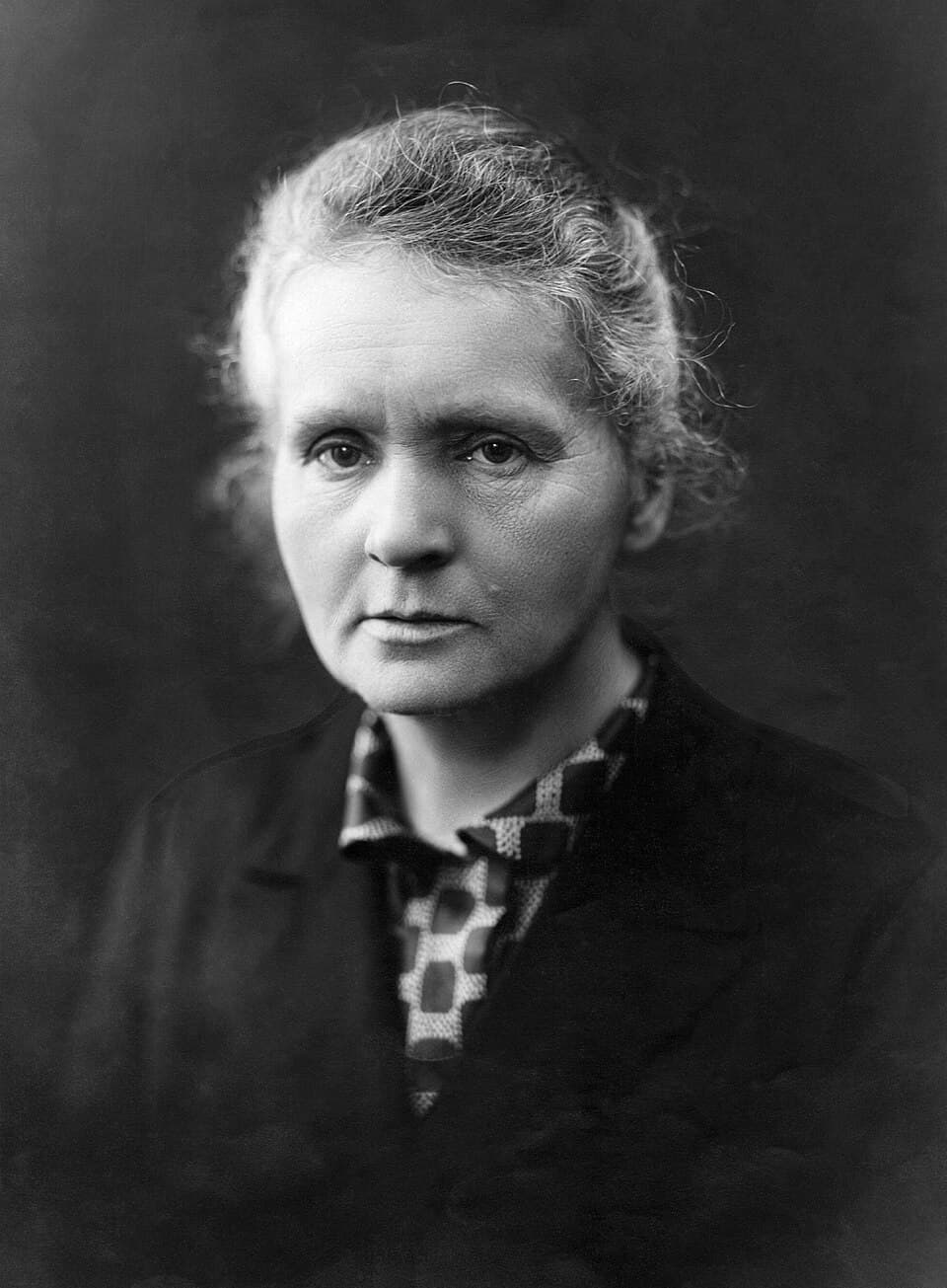
Polish, French · Science · Medicine
Marie Skłodowska-Curie
November 7, 1867 – July 4, 1934
Early Life and Background
Marie Skłodowska-Curie, born Maria Salomea Skłodowska on 7 November 1867 in Warsaw, was a Polish-born physicist and chemist who became a naturalized French citizen and one of the most influential scientists of the 20th century.[4][12] She was the youngest of five children in a family of teachers. Her father, Władysław Skłodowski, taught mathematics and physics and later became a school principal, while her mother, Bronisława, directed a girls’ boarding school.[1][4] The household placed a strong emphasis on education and Polish culture, despite living under Russian imperial rule in the Congress Kingdom of Poland.
The Russian authorities restricted Polish-language education and suppressed patriotic activity, forcing Polish families to cultivate national identity in private. Marie’s father lost his school position partly because of his support for Polish independence and his refusal to conform to Russian policies.[1] The family’s finances deteriorated, and Bronisława’s death from tuberculosis when Marie was ten added emotional strain.[4] These early experiences of political oppression, financial hardship, and bereavement shaped her resilience and determination.
Marie was an excellent student, graduating with a gold medal from a Russian gymnasium in Warsaw.[1][6] However, the University of Warsaw did not admit women, so she and her sister Bronisława participated in the clandestine "Flying University," an underground network offering higher education in Polish.[1] To support Bronisława’s medical studies in Paris, Marie worked several years as a governess in rural Poland, continuing to study science independently and saving money for her own education abroad.[4][9]
Move to Paris and Academic Formation
In 1891, at age 24, Marie moved to Paris and adopted the French form of her name, "Marie."[4] She enrolled at the University of Paris (Sorbonne), studying physics, mathematics, and chemistry. Living in modest conditions and sometimes suffering from cold and hunger, she nonetheless excelled academically, earning a degree in physics in 1893 and another in mathematics in 1894.[1][4][9] Her academic success at a leading European university was unusual for a woman at the time.
During this period, Marie sought research work and was introduced to physicist Pierre Curie, an expert in crystals and magnetism. They shared scientific interests and a respect for each other’s intellect. Marie initially worked in Pierre’s laboratory, conducting studies on the magnetic properties of steel and later turning to the emerging phenomenon of uranium radiation.[4][9] Their collaboration soon extended beyond the laboratory.
Marriage and Collaborative Beginnings
Marie Skłodowska married Pierre Curie in July 1895 in a simple civil ceremony in Sceaux, near Paris.[4][12] The couple reportedly eschewed traditional trappings such as a wedding gown and celebration, preferring a practical life dedicated to science. They used bicycles for recreation and research trips and valued intellectual companionship over social status.
Their partnership became one of the most famous scientific collaborations in history. Pierre encouraged Marie’s independent research and supported her access to laboratory facilities that were often closed to women. Marie’s work in this phase focused increasingly on the mysterious emissions from uranium salts, first observed by Henri Becquerel in 1896.[4][9] She soon embarked on investigations that would redefine atomic science.
Beginnings of Radioactivity Research
In 1896 and 1897, Marie Curie began systematic studies of the "Becquerel rays" emitted by uranium, seeking to understand their origin and behavior.[3][12] She used an electrometer designed by Pierre and his brother Jacques to measure air ionization around uranium compounds, revealing that the emissions were stable over time and independent of the physical or chemical state of the uranium.[4][9] These results suggested that the radiation was an intrinsic property of the atom.
Marie introduced the term "radioactivity" to describe this phenomenon, framing it as a fundamental characteristic rather than a simple chemical reaction.[3][9] She extended her measurements to other elements and minerals, discovering that thorium and certain uranium ores were even more strongly radioactive than pure uranium.[4] This observation implied the existence of unknown substances within the ores and set the stage for the discovery of new elements.
Discovery of Polonium and Radium
By mid-1898, Marie concluded that pitchblende and other uranium-rich ores contained new, intensely radioactive elements. On 18 July 1898, she and Pierre Curie, with Gustave Bémont, published a short note in Comptes Rendus announcing a new element, which they named polonium in honor of her native Poland.[2][3][10] Polonium’s naming carried a political and emotional charge, since Poland had been partitioned and did not exist as an independent state.
Later that year, after further separations and measurements, the Curies reported another element with even more potent radiation, radium. Their second Comptes Rendus note, dated 26 December 1898, described radium’s extraordinary activity and its derivation from pitchblende.[7][10][12] These discoveries established Marie Curie as a pioneer of radiochemistry, demonstrating that radioactivity could lead directly to the identification of new elements.
In subsequent years, Marie undertook the physically demanding task of isolating radium. Working in an improvised, poorly ventilated shed, she processed tons of pitchblende, boiling, stirring, and precipitating solutions to concentrate the radioactive fraction.[4][9] In 1902 she succeeded in producing radium chloride in a form pure enough for precise characterization.[3][12] Her determination in carrying out this labor-intensive work was central to the eventual isolation of metallic radium around 1910.[8]
Doctorate and Scientific Recognition
On 25 June 1903, Marie Curie defended her doctoral thesis on radioactive substances at the University of Paris, becoming the first woman in France to earn a Ph.D. in science.[7] Her dissertation presented detailed measurements of radioactivity in various compounds and elements, introducing rigorous quantitative methods that were crucial for the emerging field. The jury reportedly awarded her the highest distinction.
That same year, the Nobel Committee considered awarding the Prize in Physics to Henri Becquerel and Pierre Curie alone. Swedish mathematician Gösta Mittag-Leffler intervened to ensure recognition of Marie’s contributions, and she was added as a co-laureate.[4][16] The 1903 Nobel Prize in Physics honored Becquerel "for the discovery of spontaneous radioactivity" and the Curies "for their joint researches on the radiation phenomena discovered by Professor Henri Becquerel."[4][5][12]
On 10 December 1903, Marie Curie became the first woman to receive a Nobel Prize when she accepted the award in Stockholm with Pierre Curie and Henri Becquerel.[4][5][16] The honor brought international attention, financial support, and further validation of her scientific leadership at a time when women rarely held advanced scientific degrees or positions.
Academic Career and the Sorbonne
In April 1906, Pierre Curie died after a street accident in Paris, leaving Marie a widow with two young daughters.[4][7] Despite profound personal grief, she chose to continue their work. The University of Paris decided that she should succeed Pierre in his chair of physics, a remarkable appointment for a woman.
On 5 November 1906, Marie Curie delivered her inaugural lecture at the Sorbonne, becoming the first woman to teach at the Sorbonne and the first female professor of physics at the University of Paris.[2][3] She began by repeating Pierre’s last lecture almost verbatim, then gradually made it her own, demonstrating both respect for his contributions and her readiness to lead the field.
Her professorship gave her stable institutional support and access to better laboratory facilities. She continued investigations of radium’s properties and behavior, refining radiochemical techniques and supporting the growing medical interest in radium therapy.[4][9]
Second Nobel Prize and Isolation of Radium
Through the first decade of the 20th century, Marie Curie focused on isolating radium and understanding its chemical and physical characteristics. In 1910, she succeeded in isolating pure metallic radium, providing definitive proof of its elemental status and enabling accurate determination of its atomic weight.[8][12] This work was technically challenging and relied on novel methods of fractional crystallization and careful measurement.
In 1911, the Royal Swedish Academy of Sciences awarded Marie Curie the Nobel Prize in Chemistry for "the discovery of the elements radium and polonium, by the isolation of radium and the study of the nature and compounds of this remarkable element."[4][12] She received the prize at the ceremony in Stockholm on 10 December 1911, becoming the first person to win two Nobel Prizes and the only individual ever to hold Nobel Prizes in two different scientific fields.[4][9][16]
The period surrounding the second Nobel was difficult personally. French newspapers sensationalized Marie’s private life, particularly her friendship with physicist Paul Langevin, subjecting her to xenophobic and misogynistic attacks.[4] The Nobel Committee explicitly stated that the prize was awarded solely on scientific merit, and she attended the ceremony despite the controversy, reaffirming her commitment to science over public scandal.
World War I and Mobile X-Ray Units
During World War I, Marie Curie shifted much of her energy from pure research to medical applications. Recognizing the value of X-rays for locating bullets and diagnosing fractures, she organized a fleet of mobile radiography units known as "petites Curies" and established X-ray installations in field hospitals.[4][9][12]
Curie personally learned automobile mechanics and X-ray operation, trained doctors and nurses, and raised funds for equipment. Her efforts brought imaging technology to the front lines and are credited with saving or improving the treatment of countless wounded soldiers.[9] She also promoted training courses for radiological workers, many of whom were women, thereby extending women’s technical participation in wartime medicine.
Radium Institutes and Later Research
Marie Curie’s later career centered on institutionalizing radioactivity research. In Paris, she became the director of the Radium Institute (Institut du Radium), which evolved into a leading center for studies of nuclear physics, chemistry, and medical applications.[4][9] In Warsaw, she supported the creation of a sister institute, the Radium Institute, which opened after her fundraising trips and organizational guidance.[13]
She mentored several notable scientists, including her elder daughter Irène Joliot-Curie and son-in-law Frédéric Joliot-Curie, who later won the Nobel Prize in Chemistry in 1935 for their work on artificial radioactivity.[7][9] Through teaching and institutional leadership, Marie Curie helped shape a new generation of researchers in nuclear science and radiobiology.
Unlike many contemporaries, Curie deliberately did not patent her methods for producing or measuring radium, believing that scientific knowledge should belong to humanity rather than private profit.[1][13] This stance reflected both ethical conviction and a desire to promote widespread research and therapeutic use.
Awards, Honours, and Recognition
Beyond her two Nobel Prizes, Marie Curie received numerous honours. She was the first woman to become a professor at the University of Paris and gained membership in various scientific academies and societies, though some institutions continued to resist admitting women.[2][4][9] She was widely regarded as one of the greatest scientists of her era.
Her achievements were groundbreaking for women in science. She was the first woman Nobel laureate, the first woman in France with a doctorate in science, the first female Sorbonne professor, and the first person with two Nobel Prizes.[4][7][9][16] These milestones challenged institutional barriers and broadened public imagination about women’s roles in research, teaching, and leadership.
Personal Life and Family
Marie and Pierre Curie had two daughters: Irène (born 1897) and Eve (born 1904).[4][7] Irène pursued physics and chemistry, eventually sharing the 1935 Nobel Prize in Chemistry with her husband Frédéric Joliot-Curie.[7] Eve took a different path, becoming a writer and war correspondent; she authored a well-known biography of her mother, Madame Curie.[4][9]
After Pierre’s death, Marie’s relationship with Paul Langevin, a former student of Pierre, drew public scrutiny and hostility, particularly because Langevin was separated but still married. The episode exposed deep-seated prejudices about women’s morality and foreigners in France, but Marie refused to withdraw from scientific life.[4]
Despite fame, she maintained a frugal lifestyle and modest demeanor. She reportedly worked long hours in the laboratory, rarely seeking public attention, and often declined honours that would distract from research.[4][9]
Legacy and Historical Impact
Marie Skłodowska-Curie’s scientific contributions reshaped physics, chemistry, and medicine. By defining radioactivity as an atomic property, discovering polonium and radium, and developing methods to isolate and measure radioactive substances, she helped usher in the era of nuclear science.[3][4][9] Her work laid foundations for later developments, including nuclear energy, radiotherapy in cancer treatment, and the use of radioactive tracers in biology and industry.
Her legacy also has a profound gender dimension. Curie demonstrated that women could excel at the highest levels of scientific endeavor despite institutional exclusion. She became an enduring symbol of women’s intellectual capability and a role model for generations of female scientists worldwide.[3][16] Organizations, prizes, and research programs—such as the Marie Skłodowska-Curie Actions of the European Union—now carry her name, supporting researchers and explicitly acknowledging her impact on science and gender equality.[17]
Historians and science educators often highlight Curie’s refusal to patent her discoveries, her commitment to education, and her willingness to accept personal risk in service of knowledge and humanitarian work.[1][9] Her life story appears in textbooks, biographies, films, and exhibitions, emphasizing persistence, ethical responsibility, and dedication.
Later Life and Death
In her later years, Marie Curie continued to direct the Radium Institute in Paris and travel internationally to promote scientific collaboration and raise funds, including a notable trip to the United States in the early 1920s to receive a gram of radium donated by American women.[7][9] She remained active in mentoring younger scientists and advocating for the peaceful use of radioactivity.
Decades of exposure to ionizing radiation, often without adequate protection, increasingly affected her health. She handled radium compounds directly, stored radioactive materials in her desk, and worked closely with early X-ray apparatus. The long-term biological effects of such exposures were not yet fully understood.[4][10]
On 4 July 1934, Marie Skłodowska-Curie died at the Sancellemoz Sanatorium in Passy, Haute-Savoie, France, from aplastic anemia or acute leukopenia attributed to cumulative radiation exposure.[1][4][5][10][12] She was 66 years old. Her remains were later transferred to the Panthéon in Paris, where she became the first woman to be interred on her own merits, a posthumous acknowledgment of her extraordinary contributions to science and humanity.[4]
Her death underscored the risks of early radioactivity research but also highlighted the enduring value of her work. Today, Marie Skłodowska-Curie is remembered not only as a trailblazing scientist but also as a figure whose life encapsulates the challenges and possibilities of women’s participation in science in the modern era.
Dated achievements
8 indexed.
- Nov071867Science
Birth of Marie Skłodowska-Curie
Marie Skłodowska-Curie was born on November 7, 1867, in Warsaw, then part of the Russian Empire.
View details Marie Curie - Encyclopedia Britannica - Jul181898Science
Discovery of Polonium
Publication announcing the discovery and naming of polonium by Marie and Pierre Curie in honor of Poland.