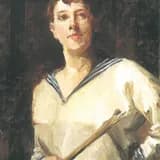
Marianne Werefkin died on 6 February 1938 in Ascona, Switzerland, the town that had become her adopted artistic home for over two decades.
Marianne Werefkin died on 6 February 1938 in the lakeside town of Ascona, Switzerland, where she had lived since 1918 following her relocation from Munich during the upheavals of the First World War. By the time of her death, she had become a central figure in the artistic community of Ascona, a haven for avant-garde thinkers, dancers, and painters in the early twentieth century.
Her final decades were marked by financial hardship after the Russian Revolution stripped her family of its wealth and the pension on which she had long relied. Despite poverty, she continued to paint and remained an intellectual and spiritual anchor for younger artists in the region, co-founding the group Der Große Bär (The Great Bear) in 1924 to support emerging talents.
Werefkin's death marked the end of a remarkable and unconventional life that had spanned the Russian Empire, Belle Époque Munich, and the bohemian art colonies of Switzerland. She was buried in Ascona, and the town later honored her legacy: the Museo Comunale d'Arte Moderna in Ascona holds a significant collection of her works, and in 1988 the Marianne Werefkin Foundation was established to preserve and study her artistic estate.
Her passing closed the chapter on one of the most original voices of early European Expressionism, a woman whose theoretical writings and visual innovations influenced the Blue Rider movement even as she herself was long overshadowed by her male contemporaries.