← All women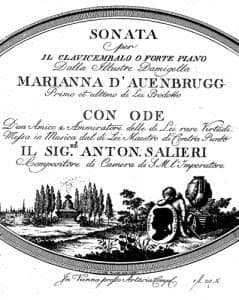
Austrian · Arts
Marianna Auenbrugger
July 19, 1759 – August 25, 1782
Early life and family background
Marianna Auenbrugger was born in Vienna in 1759 and baptized on 19 July 1759. She was the daughter of the physician Leopold Auenbrugger and Anna von Priestersberg, and the younger sister of Katharina Franziska Auenbrugger. Contemporary and later biographical sources place her within a cultured Viennese milieu that connected medicine, literature, and music. Her father was not only a physician but also a figure with literary ties to the musical world: he wrote the German libretto for Antonio Salieri’s comic opera Der Rauchfangkehrer. That family connection likely helped bring the Auenbrugger household into contact with leading musicians in Vienna.
Sources describe Marianna as having been sickly from a young age, and later accounts suggest that illness affected her physical development and shortened her life. Even so, she appears to have received a thorough musical education. In eighteenth-century Vienna, a girl of her social standing would most often have been taught privately at home rather than in a public conservatory, and her musical training seems to have taken place in precisely that elite domestic setting. This kind of education gave talented women access to high-level instruction, but it also meant that their careers depended heavily on family status, patronage, and the willingness of prominent men to notice their abilities.
The surviving record of Auenbrugger’s childhood is limited, which is typical for women musicians of the period. Much of what is known comes through later reference works, biographical dictionaries, and the traces left by her musical associations. What is clear is that she grew up in a home where music was cultivated and where her own talent was recognized early enough to place her in contact with some of Vienna’s foremost composers.
Training and musical formation
Auenbrugger studied with Joseph Haydn and Antonio Salieri, together with her older sister Katharina. This is one of the strongest indications of her musical standing, because access to instruction from two of the most prominent composers in Vienna was reserved for musicians of high promise or status. Haydn’s connection with the sisters is especially significant. Later evidence suggests that he admired their playing and insight into music, and that he valued them highly enough to dedicate a set of sonatas to them.
Salieri’s role in her formation is also important. He was active in the Viennese court and operatic world, and his instruction placed Auenbrugger within the broader network of late eighteenth-century classicism. Because women composers rarely entered public institutions on equal terms with men, private tutelage by major composers was often one of the few ways for them to acquire advanced training. In Auenbrugger’s case, that tutelage seems to have been especially fruitful: later sources describe her as a respected pianist and composer in Vienna.
The musical world in which she was trained was competitive and socially stratified. Women could be admired as performers, but composition remained far less accessible, and publication was often mediated by male relatives, teachers, or patrons. Auenbrugger’s career therefore exemplifies both opportunity and limitation: she had access to serious instruction and elite recognition, yet her surviving catalogue is extremely small, and her life ended before a sustained public career could develop.
Career as pianist and composer
By the late 1770s and early 1780s, Auenbrugger had earned a reputation as a capable and admired pianist and composer in Vienna. Several sources describe her and her sister as highly valued keyboard players. This matters because keyboard performance was one of the principal avenues through which women could attain musical prestige in the eighteenth century. At salons and private gatherings, gifted women could display technique, taste, and expressive control, and those performances could attract the notice of major composers.
One of the clearest signs of her standing is Haydn’s dedication of a cycle of six sonatas to the Auenbrugger sisters in 1781. Dedications to women were not unusual, but this one signals that the sisters had become known beyond a small domestic circle. Haydn’s gesture indicates that he considered their musicianship worthy of public association with his own work. For women in Auenbrugger’s position, such a dedication provided rare recognition from the mainstream repertory world.
Auenbrugger is also associated with a Keyboard Sonata in E-flat major, described in modern sources as her only known or only published composition. The sonata was published after her death, and the publication is traditionally linked to Antonio Salieri, who reportedly financed it at his own expense and paired it with his funeral ode De si piacevoli. Although the exact date of publication is not securely documented in the sources provided, the work remains central to her legacy because it is the principal surviving composition under her name. Its preservation allows her to be recognized not merely as a talented performer, but as a composer whose music entered print in the age of Mozart and Haydn.
Recognition and reputation
Although Marianna Auenbrugger’s life was brief, she was evidently respected by contemporaries. Later biographical notices and modern reference projects describe her as a musician of genuine ability and note the admiration of her teachers and colleagues. In a period when women’s artistic achievements were frequently minimized or absorbed into family reputations, such recognition is especially notable. Her name survives because it was attached to a Haydn dedication, to a posthumous publication, and to brief but meaningful mentions in historical music writing.
Her reputation also reflects the importance of informal musical networks in eighteenth-century Vienna. Women like Auenbrugger often gained visibility through salons, elite education, and the patronage of powerful men. These channels could confer real prestige, but they also made a woman’s artistic identity vulnerable to early death, lack of publication, or later neglect. Auenbrugger’s case is typical of many women composers of the classical era: praised in her lifetime, documented only fragmentarily afterward, and gradually recovered by later scholarship interested in expanding the canon.
In modern musicology, she has become an example of how women contributed to classical Vienna beyond the small group of names traditionally remembered. Her association with Haydn and Salieri, and the survival of her sonata, have made her a useful figure in studies of women’s composition, keyboard culture, and the social history of music. Even though she did not leave a large body of work, the documentation that does survive shows that she was not a marginal amateur but a musician taken seriously by leading figures of her day.
Personal life
Very little is securely documented about Auenbrugger’s private life beyond her family and musical education. The available sources do not record a marriage or children, and no substantial personal correspondence survives in the materials consulted here. What can be said with confidence is that her family background shaped her opportunities. Her father’s professional status likely placed her in a household where education and cultural accomplishment were valued, and her sister’s shared musical training suggests that music was a family pursuit rather than an isolated talent.
The fact that both sisters studied with Haydn and Salieri also implies that the Auenbrugger household had the connections necessary to support advanced instruction for women. In the social world of late eighteenth-century Vienna, such access was not universal. A young woman’s ability to pursue composition depended on the expectations of family, the resources of the home, and the willingness of influential teachers to invest in her development. Auenbrugger’s case shows that these conditions could converge to produce a short but meaningful musical career.
Death and posthumous publication
Auenbrugger died in Vienna on 25 August 1782, probably of consumption, the period term commonly used for tuberculosis. She was only in her early twenties. Her early death is one reason her name remains attached to just a handful of surviving references, but it also helps explain the emotional tone of the posthumous publication of her sonata.
According to later accounts, Antonio Salieri paid for the publication of her Keyboard Sonata in E-flat major at his own expense and attached his own funeral ode to it. This gesture is historically significant because it preserved her music at a moment when the works of women composers were especially likely to disappear. Publication was expensive and not easily accessible to women without male allies; Salieri’s intervention therefore served both as memorial and as practical preservation.
Her death marked the end of a career that had not yet reached its full potential. Because she died so young, later generations have had to reconstruct her importance from scattered sources rather than from a broad body of repertory. Yet the very fact that her music was published and her name was honored by Haydn’s dedication means that she occupied a real place in Vienna’s classical culture.
Legacy
Marianna Auenbrugger’s legacy lies less in the size of her surviving output than in what her career reveals about women’s musical life in eighteenth-century Vienna. She demonstrates that women could be recognized as serious keyboard artists and composers, even within a culture that offered them fewer public pathways than men. Her association with Haydn and Salieri places her firmly within the classical mainstream, while the posthumous publication of her sonata shows that her music was valued enough to be preserved.
For modern scholars, Auenbrugger is important as part of the recovery of women in music history. Her life illustrates how many female musicians were remembered only in fragments: a birth entry, a dedication, a single published work, and a death record. That fragmentary record is itself instructive. It shows how women’s contributions were often filtered through the reputations of fathers, brothers, teachers, and patrons, and how much historical reconstruction is needed to recover their agency.
Today Auenbrugger is increasingly included in reference works, online projects, and performances devoted to women composers. These efforts restore visibility to a musician whose life was brief but whose contemporaries clearly regarded her as gifted. Her story is therefore not only a biography of one Viennese pianist and composer, but also a case study in the broader challenge of recovering women’s artistic histories from the archives of the classical era.
Dated achievements
3 indexed.
- Jul191759Science
Birth of Marianna Auenbrugger in Vienna
Marianna Auenbrugger was born (baptized) in Vienna, Austria, on 19 July 1759, into the family of the physician Leopold Auenbrugger.
View details Marianne von Auenbrugger – Wikipedia (German) - Jan011781Science
Haydn Dedicates Six Sonatas to Marianna and Katharina Auenbrugger
Joseph Haydn dedicated a set of six keyboard sonatas to Marianna Auenbrugger and her sister Katharina, published by Artaria in Vienna in 1781.