← All women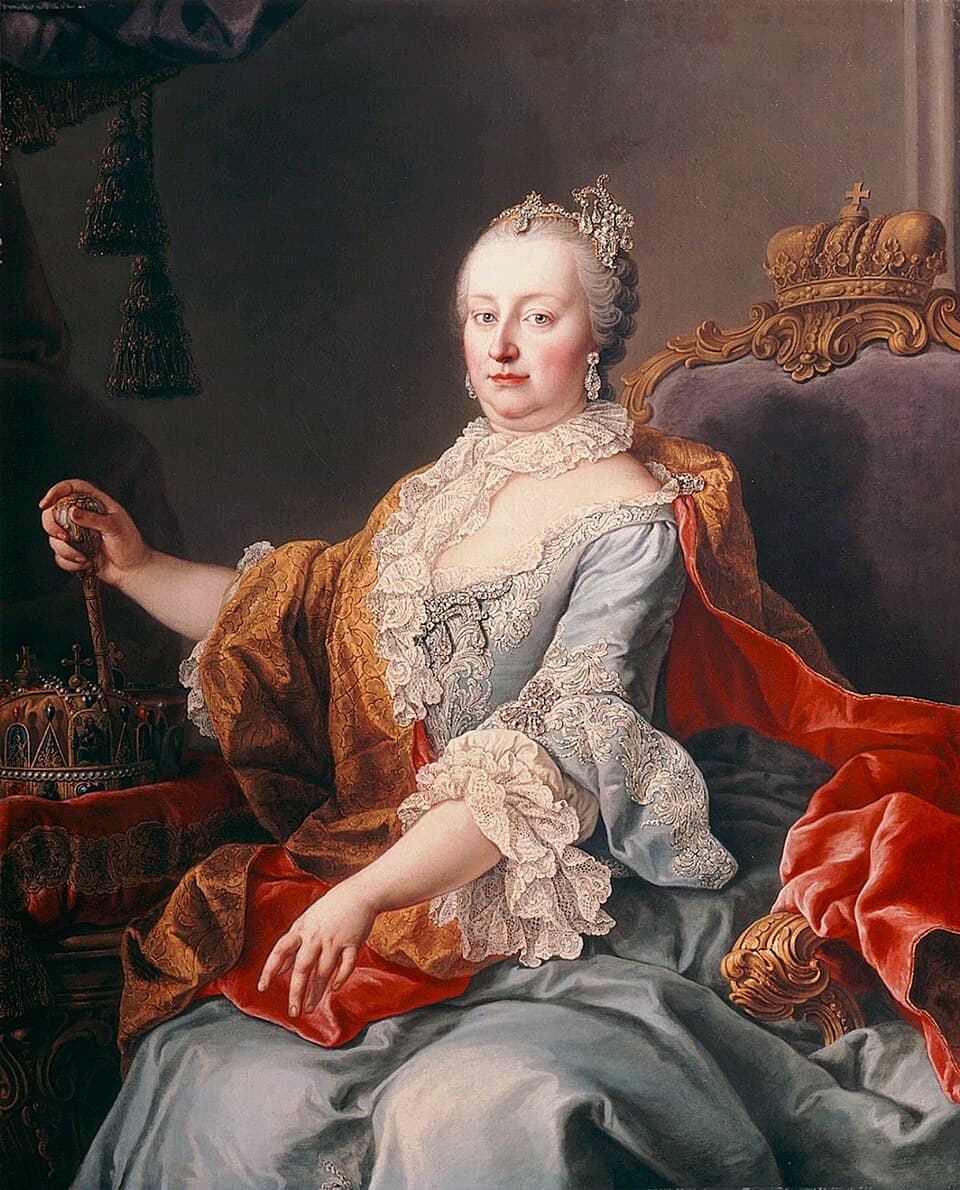
Austrian · Politics
Maria Theresa
May 13, 1717 – November 29, 1780
Early Life and Dynastic Background
Maria Theresa Walburga Amalia Christina was born on 13 May 1717 in Vienna, the capital of the Habsburg monarchy, as the eldest surviving daughter of Holy Roman Emperor Charles VI and Elisabeth Christine of Brunswick‑Wolfenbüttel.[1][2] Her birth immediately carried dynastic significance. Charles VI had promulgated the Pragmatic Sanction in 1713, declaring that in the absence of a male heir his daughters could inherit the Habsburg hereditary lands.[2][1] This controversial measure aimed to secure the continuity of the Habsburg line but challenged entrenched expectations of male succession in Central Europe.
Despite the importance of her position as designated heiress, Maria Theresa did not receive the systematic political and military education accorded to male heirs in other royal houses.[2][8] Contemporary observers noted her deep religious faith, shaped by Catholic piety at the Viennese court, and a personality combining emotional warmth with a strong sense of duty.[2] She was trained in languages, courtly manners, and music, and was exposed to state business largely through observation of her father’s councils rather than formal instruction.[2][7]
Her childhood unfolded in a court preoccupied with the fragility of the Habsburg succession and the need to win international recognition for the Pragmatic Sanction. European powers, including Prussia, Bavaria, and France, accepted the arrangement only conditionally and often with reservations.[2] These diplomatic maneuvers would later affect Maria Theresa profoundly when she came to the throne and saw the commitments to her inheritance immediately tested by war.
Marriage and Family
In 1736, Maria Theresa married Francis Stephen of Lorraine, a match engineered to strengthen Habsburg ties with the House of Lorraine and secure a suitable consort for a future female sovereign.[1][2] As part of the diplomatic arrangements, Francis exchanged his ancestral Duchy of Lorraine for the Grand Duchy of Tuscany, bringing him into closer alignment with Habsburg interests.[1]
The marriage was by most accounts affectionate and enduring. Between 1737 and 1756 Maria Theresa bore sixteen children, thirteen of whom survived to adulthood.[2][8] Among them were future emperors Joseph II and Leopold II, the queen of France Marie Antoinette, and several other daughters married into major European royal houses, including the Bourbons and Wittelsbachs.[1][8] Motherhood did not diminish her political engagement; she frequently conducted government business while pregnant and continued to involve herself intimately in dynastic marriages, using her children as instruments of diplomacy.
The scale of her family and the strategic marriages she arranged contributed to the web of alliances known as the "Diplomatic Revolution" of the mid‑18th century, in which Austria shifted from traditional rivalry with France to alliance, symbolized by Marie Antoinette’s betrothal to the future Louis XVI.[1][3] These alliances were intended to stabilize Habsburg positions in Europe but also brought her family into the center of the crises that would later engulf the French monarchy.
Accession and the War of the Austrian Succession
On 20 October 1740, Charles VI died, and Maria Theresa, then twenty‑three, succeeded him as archduchess of Austria, queen of Hungary and Bohemia, and sovereign of the Habsburg hereditary lands under the Pragmatic Sanction.[2][1] She thereby became the only woman to rule the Habsburg dominions in her own right and the last ruler of the direct Habsburg line.[1][7]
Her accession immediately triggered the War of the Austrian Succession (1740–1748). Several powers, most notably Frederick II of Prussia, challenged her inheritance, arguing that the Pragmatic Sanction lacked binding force or exploiting the perceived weakness of a female ruler.[2][3] Frederick invaded Silesia in late 1740, initiating a conflict that would dominate much of Maria Theresa’s early reign.[2]
Maria Theresa, lacking military training and faced with disorganized finances and a poorly prepared army, nonetheless mobilized impressive resistance. She secured the loyalty of the Hungarian nobility through a dramatic appeal at the Diet of Pressburg, where her speech and visible vulnerability reportedly moved nobles to pledge their "lives and blood" in her defense.[2][4] Although forced to cede most of Silesia to Prussia under the Treaty of Aix‑la‑Chapelle in 1748, she preserved the bulk of the Habsburg monarchy against a coalition of militarily superior opponents.[2][3]
During the war, Maria Theresa began the administrative and fiscal reforms that would characterize her rule. She increased direct taxation on the nobility in some territories, reorganized military recruitment, and strengthened central organs of governance to better coordinate war efforts.[2][7] These measures helped transform a fragmented set of princely lands into a more coherent political entity.
Imperial Politics and the Habsburg-Lorraine Dynasty
Because many imperial electors doubted that a woman could hold the Holy Roman imperial title, Maria Theresa did not seek election herself. Instead, she worked to secure the imperial crown for her husband, Francis StephenEmperor Francis I, restoring Habsburg influence in imperial institutions.[1][2]
On 13 September 1745, Francis’s election was followed by his coronation as emperor, and Maria Theresa was acknowledged as Holy Roman Empress consort.[1][2] On 4 October 1745, she was ceremonially crowned Holy Roman Empress in Frankfurt am Main.[1] Despite the formal distribution of titles, real power over the Habsburg hereditary lands remained in her hands. Francis played a significant but largely supportive role in domestic administration and finances, while Maria Theresa dominated high policy and reform initiatives.[2]
The establishment of the Habsburg‑Lorraine dynasty through their marriage ensured dynastic continuity and helped stabilize the monarchy after the crises of the 1740s. Through careful management of succession and marriage alliances, Maria Theresa positioned her sons to inherit both the Habsburg lands and the imperial dignity, while her daughters spread her family’s influence across Europe.[1][3]
Reform of Administration and Finance
Maria Theresa’s reign is often characterized as a formative period of "enlightened absolutism" in Austria.[1][6] Determined to strengthen the state, she undertook a far‑reaching program of centralization and modernization while retaining a strong belief in monarchical authority and social hierarchy.
In the 1740s and 1750s she reorganized the central administrative machinery, streamlining the chancelleries and establishing more coherent lines of responsibility.[2][7] In the early 1760s she created bodies such as the State Council (Staatsrat), staffed by professional officials rather than high nobles, to advise on major policy decisions.[2] These reforms reduced the autonomy of provincial estates and strengthened Vienna’s control over composite territories.
Fiscal reforms were equally important. In 1753 she introduced more centralized tax systems that, for the first time in some lands, imposed regular direct taxation on the nobility and, cautiously, on certain Church properties.[2] She also pursued mercantilist policies, including by 1754 the creation of a state‑controlled customs union to promote internal trade and increase revenue.[2][7] Later measures, such as establishing a state monopoly on tobacco in the 1770s, further expanded the monarchy’s fiscal base.[2]
These administrative and financial reforms did not transform the monarchy into a constitutional state, but they did significantly enhance its capacity to wage war, manage population, and pursue long‑term policy. Many historians therefore regard Maria Theresa as a key architect of "modern" Austria.[2][3][8]
Military Challenges: Seven Years’ War and Aftermath
Despite her efforts, Maria Theresa could not reverse the loss of Silesia, and her rivalry with Prussia continued. In the Seven Years’ War (1756–1763), she allied with France and Russia in a bid to regain Silesia and contain Frederick II’s ambitions.[1][2] Although Austrian forces performed more effectively than in the earlier conflict, the war ended without major territorial gains for her; Silesia remained under Prussian control.[1][2]
The war nonetheless had important consequences. It underscored the need for further military and administrative modernization and pushed Maria Theresa more firmly toward the diplomatic realignment known as the Diplomatic Revolution, in which Austria abandoned its long rivalry with France.[1][3] The heavy costs of extended warfare reinforced her determination to consolidate fiscal and bureaucratic power at home.
Educational and Public Health Reforms
One of Maria Theresa’s most enduring achievements lay in the field of education. On 13 March 1754, she promulgated the General School Ordinance for primary schools, establishing state‑supervised compulsory education for children in key crown lands.[7][1] The ordinance standardized curricula, mandated teacher training, and placed schooling under government oversight, although the Church continued to play a role in many institutions.
Compulsory education under her rule extended gradually through subsequent reforms, including measures in the 1770s that strengthened state control of curricula and widened the geographic reach of schooling.[2][7] While implementation varied by region, the overall effect was to expand literacy and basic education among both boys and girls, particularly in urban and semi‑rural areas.
Maria Theresa also invested in public health. She encouraged the study of infant mortality, sought to improve midwifery, and supported efforts to regulate burial practices to reduce disease.[7] Smallpox inoculation campaigns, influenced by Enlightenment medical thinking, were promoted for children, including within her own family.[7][4] These measures reflected her concern for the welfare of subjects but also her desire for a healthier, more productive population.
From the perspective of women’s history, her educational and health reforms are especially significant. They broadened access to basic schooling for girls and contributed to the professionalization of midwives, areas where state policy rarely focused before. A female sovereign thus played a central role in shaping everyday life and opportunities for women and children across her empire.
Legal and Social Policy: Penal Reform and the Robot Patent
Maria Theresa’s reign saw important developments in legal reform. On 2 January 1776, under her authority, Austria implemented penal reforms that abolished judicial torture and removed capital punishment from the penal code, substituting forced labor in most cases.[7][1] These changes aligned with Enlightenment critiques of cruelty in criminal justice and reflected her interest in rational, orderly governance.
The abolition of torture was especially notable, as torture had long been embedded in European legal practice for extracting confessions. While the new system did not provide strong protections for defendants and continued to impose severe penalties, it nonetheless marked a substantial narrowing of the state’s use of extreme physical coercion.[7]
In the realm of agrarian and social policy, Maria Theresa and her co‑regent son Joseph II issued the Robot Patent on 13 March 1771, which regulated and limited the corvée, the unpaid labor obligations owed by peasants to their landlords.[7][2] The patent required more clearly defined obligations and introduced supervision to prevent the most abusive demands, though it fell short of abolishing serfdom.
These measures demonstrate Maria Theresa’s cautious approach to social reform. She sought to protect peasant livelihoods and curb noble excesses without dismantling the fundamental hierarchies underpinning the monarchy. Her policies foreshadowed more radical changes under Joseph II, who would later push further toward emancipation of the peasantry and greater religious toleration.
Religion, Culture, and Limits of Enlightened Rule
Maria Theresa is often described as an "enlightened absolutist", yet her relationship to Enlightenment ideas was selective. She was a devout Catholic who believed that religion was essential to social order and the legitimacy of monarchy.[6][2] She supported measures to rationalize ecclesiastical administration, including attempts to limit papal interference and regulate monastic life, but she remained generally hostile to religious pluralism and skeptical of Protestant and non‑Christian communities.
Her government censored works deemed irreligious or politically subversive and maintained close control over universities and intellectual life.[2] Jews and other minorities faced restrictions, and her policies in regions such as Galicia included efforts at cultural "civilizing" that reflected contemporary prejudices.[6]
In cultural matters, Maria Theresa’s court patronized the arts, music, and architecture, helping Vienna develop as a major cultural center in the later 18th century.[1][16] She commissioned building projects and supported institutions that enhanced the prestige of the dynasty. However, these initiatives primarily served dynastic and confessional aims rather than a broad liberalization of culture.
Her reign thus illustrates the complexities of "enlightened" monarchy: she embraced administrative rationalization, education, and certain humanitarian legal reforms, yet she defended confessional orthodoxy and social hierarchy, and limited many aspects of personal and intellectual freedom.
Co-Regency with Joseph II and Later Reign
On 18 August 1765, Emperor Francis I died suddenly in Innsbruck, plunging Maria Theresa into deep mourning.[2] She continued to rule the hereditary Habsburg lands, while her eldest son Joseph II was elected Holy Roman Emperor, creating a formal co‑regency.[1][2]
The relationship between mother and son was complex. Joseph, imbued with Enlightenment ideas, advocated more sweeping reforms than his mother considered prudent. He pushed for greater religious toleration, broader peasant emancipation, and extensive bureaucratic restructuring.[6] Maria Theresa, though supportive of many improvements, often sought to moderate his initiatives, fearing social disruption and the loss of traditional supports for monarchy.
In practice, Maria Theresa retained strong control over domestic policy until her death, while Joseph exerted greater influence in foreign affairs and in some reform projects. Their partnership produced significant advances but also a legacy of tensions that would shape Joseph’s solo reign after 1780.[2][6]
In her later years, Maria Theresa’s health declined, but she remained actively involved in state business, frequently meeting ministers and reviewing proposals.[11][2] She adopted permanent widow’s dress and deepened her religious practices, reflecting personal grief and a growing awareness of mortality.
Awards, Honors, and Contemporary Reputation
As a reigning monarch, Maria Theresa did not receive "awards" in the modern sense, but she accumulated titles and honors that reflected her position: archduchess of Austria, queen of Hungary and Bohemia, and Holy Roman Empress consort.[1][2] She was recognized by contemporaries as a central figure in European power politics and was frequently praised for her fortitude during wartime.
Even in her own lifetime, some observers referred to her as one of the most capable rulers of the Habsburg dynasty.[3][8] Foreign ambassadors commented on her intelligence, diligence, and emotional investment in governance, noting that she approached state business not merely as a duty but as a moral responsibility to her subjects.[13]
Personal Life, Character, and Views on Gender
Maria Theresa’s personal life intertwined closely with her political role. She combined the roles of wife, mother of sixteen, and sovereign ruler, an unusual configuration in 18th‑century Europe.[13][2] She was deeply attached to Francis I, and his death in 1765 affected her profoundly. She adopted simple, dark clothing thereafter and cultivated an image of pious widowhood.[2]
Her correspondence and decisions reveal a ruler who conceived of monarchy as a paternal—and in her case maternal—responsibility. She often described herself as a "mother of her peoples" and believed that her subjects’ welfare justified extensive intervention in their lives.[6][13] At the same time, she held conservative views on gender roles, opposing some forms of female participation in intellectual and political life and expecting her daughters to conform to traditional expectations of obedience and marital duty.
Maria Theresa’s approach to balancing public and private roles has attracted particular attention from historians of women. She navigated a court and diplomatic environment that often doubted women’s capacity for rule, yet she insisted on her authority, used maternal imagery strategically, and demonstrated sustained capability in high politics.[4][13]
Legacy and Historical Impact
By the time of her death on 29 November 1780, Maria Theresa had ruled for forty years, transforming the Habsburg monarchy into a more centralized, administratively capable state.[2][11] Her reforms in taxation, education, military organization, and justice laid foundations on which her successors, particularly Joseph II, would build.
Historians often credit her with preserving a "ramshackle" empire that might otherwise have disintegrated under the pressure of 18th‑century warfare.[3][8] She lost Silesia, but she kept the core of the monarchy intact and strengthened its institutions enough that the Habsburg empire could survive into the early 20th century.[3] As such, she is widely regarded as one of the most important monarchs in Central European history.[1][9]
From a women’s‑history standpoint, Maria Theresa’s reign is critical. She stands as the only woman to have ruled the Habsburg hereditary lands in her own right and demonstrates that female sovereignty at the heart of European politics was both possible and effective, even within structures designed for male rulers.[1][7] Her success undermined arguments that women were inherently unsuited to government, while her use of maternal imagery and emphasis on family responsibilities showed how gender norms could be repurposed to legitimize female authority.
Modern scholarship continues to reassess her legacy, highlighting both her achievements and the limits of her reforms. Recent biographical and thematic studies emphasize her role in shaping the Austrian Enlightenment, her complex relationship with religion and toleration, and the ways in which she both challenged and reinforced gendered expectations of power.[6][13]
Later Life and Death
In the last decade of her life, Maria Theresa’s health deteriorated, but she remained engaged in governance and in efforts to mediate between her own conservative instincts and Joseph II’s more radical agenda.[2] She continued to attend council meetings and review state papers, insisting on the monarch’s duty to remain informed.
In November 1780 she fell ill, and on 29 November 1780 she died of pneumonia in Vienna, aged sixty‑three.[11][2] Her death ended an era often considered the beginning of "enlightened absolutism" in the Habsburg lands.[1][6] She was interred in the Imperial (Capuchin) Crypt in Vienna in a double sarcophagus alongside her husband Francis I, symbolizing their shared dynastic project and the continuity of the Habsburg‑Lorraine line.[11][2]
Joseph II’s subsequent reign would witness more sweeping reforms and growing tensions, but he inherited a state whose basic structures owed much to his mother’s decades of labor. Maria Theresa’s death thus marked both an end and a transition: the passing of a conservative yet reform‑minded matriarch and the opening of a new, more radical chapter in the history of the Habsburg monarchy.
Dated achievements
9 indexed.
- May131717Politics
Birth in Vienna
Maria Theresa was born in Vienna on May 13, 1717.
View details Britannica - Maria Theresa - Oct201740Politics
Accession as ruler of the Habsburg dominions
Succeeded as the first female ruler of the Habsburg dominions on October 20, 1740.
View details