← All women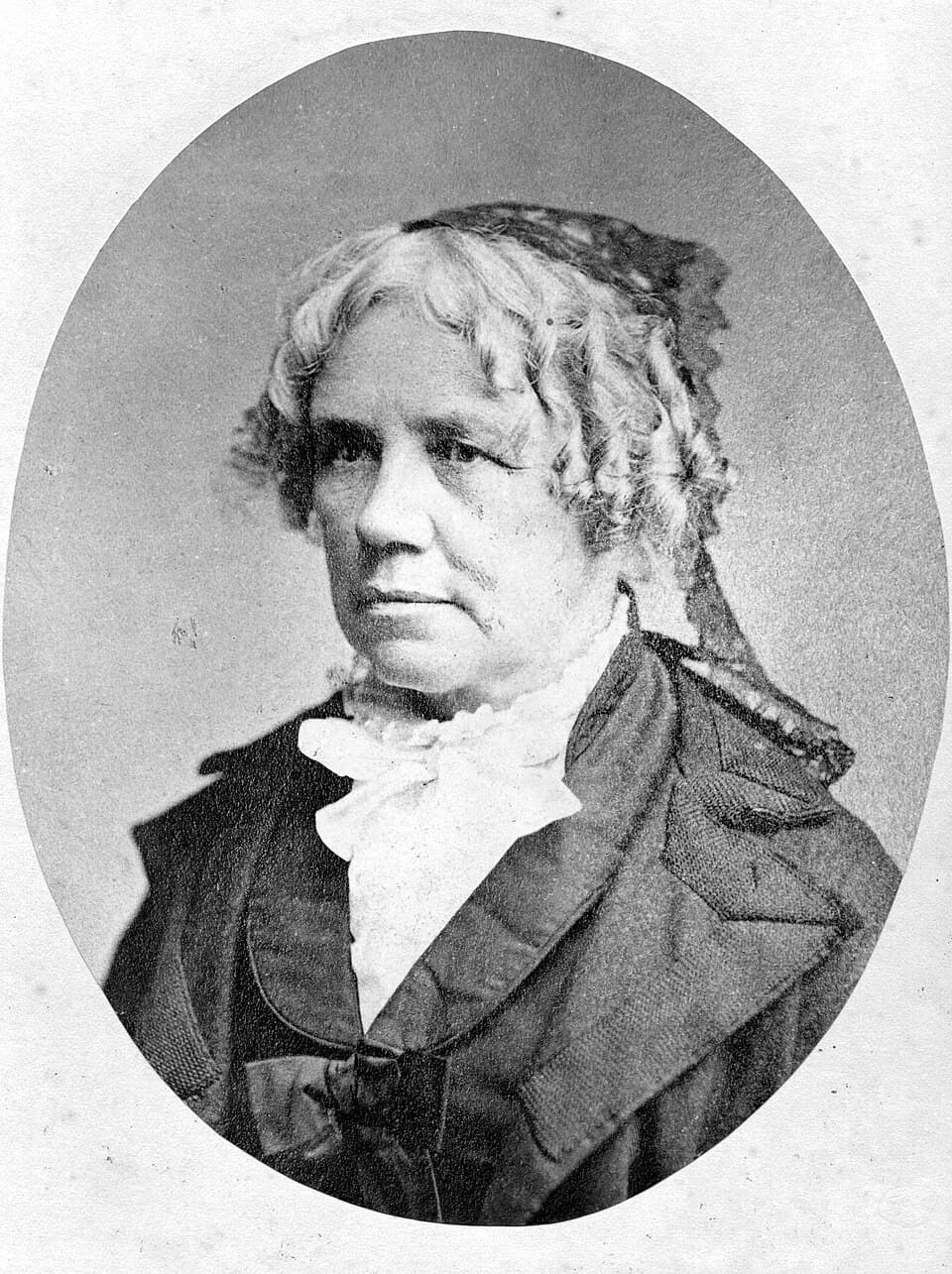
American · Science
Maria Mitchell
August 1, 1818 – June 28, 1889
Early life and background
Maria Mitchell (pronounced Ma-RYE-ah) was born on 1 August 1818 on the island of Nantucket, Massachusetts, into a large Quaker family headed by William Mitchell and Lydia Coleman Mitchell.[1][4][6] Her father was a schoolteacher, surveyor and skilled amateur astronomer, and her mother worked in a library and managed the household.[1][4] The Mitchells were part of Nantucket’s tight-knit Quaker community, which, compared with much of 19th-century America, held relatively egalitarian views about women’s education and intellectual capabilities.[1][10] Growing up in a bustling whaling port that depended on precise navigation, Maria was surrounded by practical applications of astronomy and mathematics.[1][3]
Mitchell was the third of ten children.[1][4] From early childhood she showed an aptitude for numbers and observation. William Mitchell taught his daughter advanced arithmetic, geometry and navigation at home and involved her directly in his astronomical work.[1][4][6] He set up a small observatory on Nantucket and trained Maria to grind lenses, calibrate instruments and keep meticulous observing logs.[1][6] This hands-on apprenticeship, unusually rigorous for a girl at the time, laid the foundation for her later professional competence.
Her formal schooling began at a local girls’ school, but she soon attended the school her father ran, where the curriculum went well beyond what was typical for girls, emphasizing mathematics and science as well as languages.[4][9] At seventeen she opened her own school on Nantucket, enrolling both girls and boys and insisting on equal instruction for her female students.[9] This early venture into teaching anticipated her later career as an educator and her conviction that women deserved access to advanced study.
Career beginnings: librarian, educator and practical astronomer
In 1836 Mitchell accepted a position as a librarian at the Nantucket Atheneum, a role she would hold for two decades.[4] The job gave her access to a wide range of books and scientific periodicals at a time when women’s access to such resources was limited. She read voraciously in astronomy, mathematics, philosophy and literature, integrating self-directed study with nightly observations in the family observatory.[1][4]
Alongside her library work, Mitchell assisted her father with astronomical and nautical calculations. The U.S. Coast Survey, responsible for improving coastal charts and navigation, increasingly relied on precise determinations of latitude, longitude and time. Over the 1840s and 1850s, the Mitchells contributed observations and computations that were incorporated into nautical almanacs and charts, making Maria one of the first American women to be employed—albeit informally and intermittently—in federally supported scientific work.[4][6][7]
Mitchell’s early reputation grew quietly. She became known among a small circle of astronomers for high-quality timing of stellar occultations and for scrupulous records of celestial events.[4] Yet she remained outside formal scientific institutions. As a woman in a remote island community, she lacked access to university posts or observatory appointments, and her contributions circulated mainly through her father’s contacts and official channels like the Coast Survey.
Discovery of “Miss Mitchell’s Comet” (1847)
Mitchell’s life changed dramatically on the night of 1 October 1847. While “sweeping” the sky with a small refracting telescope from the rooftop of her family home in Nantucket around 10:50 p.m., she detected a faint, nebulous object close to Polaris that did not appear on existing charts.[3][6][10] She tracked its motion and realized she had discovered a new telescopic comet—an object visible only through a telescope rather than to the naked eye.
At the time, the Danish government had long sponsored a prize, offered originally by King Frederick VI and administered under his successor King Christian VIII, for the first telescopic discovery of each new comet.[3][4][6] Several astronomers in Europe and America were competing for the 1847 prize. Mitchell promptly recorded the comet’s position and motion and her father forwarded the observation to Professor William C. Bond at Harvard College Observatory and to officials associated with the Danish prize.[3][6]
In the months that followed, other observers reported the same comet, and questions of priority arose. On 11 February 1848, authorities formally recognized that Maria Mitchell had recorded the object first, confirming her as the discoverer and fixing the comet’s designation—initially “1847 VI,” later C/1847 T1—in astronomical catalogues as “Miss Mitchell’s Comet.”[3][10]
Awards, honors and early recognition
The confirmation of Mitchell’s priority made her an international celebrity. In 1848 she was awarded a gold medal from the King of Denmark for the discovery, becoming both the first woman and the first American to receive this particular comet prize.[1][4][6][7] The medal bore the Latin inscription celebrating her as the discoverer of a new telescopic comet. Reports of the award appeared in newspapers and scientific journals in Europe and the United States, emphasizing the novelty of a woman comet-discoverer.
Mitchell’s achievement resonated beyond astronomy. At the Seneca Falls Convention of 1848, widely recognized as the first women’s rights convention in the United States, delegates cited her recent discovery as evidence of women’s intellectual capabilities and as a symbolic challenge to prevailing gender norms.[10] Activists noted that she was the first American and only the third woman known to have discovered a comet, using her accomplishment to bolster arguments for women’s access to education and professional careers.
In 1848, in direct recognition of her comet work, Mitchell was elected the first woman fellow of the American Academy of Arts and Sciences, becoming the only woman among its members at the time.[2][4][6][10] Two years later, in 1850, she became the first female member of the American Association for the Advancement of Science (AAAS).[4][7][10] These elections were extraordinary in a period when scientific societies were overwhelmingly male and often explicitly excluded women.
Building a scientific career in mid‑nineteenth‑century America
Following her comet discovery, Mitchell continued to work as Nantucket Atheneum librarian while expanding her astronomical research. She corresponded with leading astronomers, including Bond at Harvard and European observers, and contributed data to ephemerides and nautical almanacs.[4][6] Her continued collaboration with the U.S. Coast Survey on timing and positional measurements solidified her reputation as a reliable professional-caliber observer.[4][7]
Mitchell also began to travel. In 1857–1858 she toured Europe with Quaker friends, visiting observatories in Britain, France and Italy and meeting prominent scientists.[4][6] She was received with respect by many colleagues, though some institutions were hesitant to grant a woman full access to their facilities. These encounters sharpened her awareness of both the possibilities and limitations facing women scientists.
Throughout the 1850s and early 1860s, Mitchell’s public profile grew. She gave lectures that combined descriptions of astronomical phenomena with reflections on the importance of scientific education, especially for women. She increasingly spoke against slavery and in favor of women’s rights, aligning herself with broader reform movements in New England’s liberal and Quaker circles.[10][13]
Professor of astronomy at Vassar College (1865–1888)
A major turning point came with the founding of Vassar College in Poughkeepsie, New York. Established by Matthew Vassar, the college was envisioned as a high-standard institution of higher learning for women, equivalent in rigor to men’s colleges. In 1865 the trustees recruited Maria Mitchell as the college’s first professor of astronomy and as director of its observatory.[4][5][7]
Mitchell accepted and moved from Nantucket to Poughkeepsie, leaving her Atheneum post after twenty years of service. At Vassar, she found both an institutional home and a platform for her educational philosophy. The college built an observatory equipped with what was then a large equatorial refracting telescope, along with transit instruments and clocks, and gave Mitchell considerable autonomy in designing the astronomy curriculum.[5][7]
Her teaching emphasized direct engagement with the sky. Students learned to handle instruments, make precise measurements, reduce data, and compare their results with published ephemerides.[5][7] Under her supervision, they observed sunspots, measured the positions of comets and double stars, and participated in special campaigns for events such as solar eclipses and the transit of Venus.[4][5] Mitchell insisted that women could and should undertake serious research, not merely descriptive or popular astronomy.
As a faculty member, Mitchell was also a visible advocate for women’s intellectual equality. She pressed Vassar’s administration on issues of pay equity—at one point protesting that male professors earned more than she did despite equal or lesser qualifications—and she supported students who sought advanced training in mathematics and science.[5][10] Her presence on the founding faculty helped establish Vassar’s reputation as a college where women could pursue rigorous scientific study.
Major scientific work at Vassar
While teaching at Vassar, Mitchell continued her own observing programs. She directed long-term studies of Jupiter’s belts and satellites, Saturn’s rings, and the surfaces of the Moon and Sun.[4][5] She and her students carefully measured sunspots, contributing observations that fed into contemporary debates about the periodicity of solar activity.[4][5] They also observed comets and variable stars, training students in the methods that professional observatories used.
Mitchell’s research was shaped by the limitations of a teaching observatory and by the heavy demands of instruction, but it remained within the mainstream of mid‑nineteenth‑century positional and descriptive astronomy. Her work emphasized careful measurement and the training of observers, rather than theoretical innovation. Nevertheless, by making women visible contributors to observational campaigns, she broadened the workforce of astronomy.
She also published popular and semi-technical articles that explained astronomical concepts to lay audiences and argued for the importance of scientific literacy. Her writing combined clear exposition with reflections on the moral and intellectual value of understanding the cosmos, themes that resonated with both religious and secular readers.[4][7]
Advocacy for women in science and education
From midlife onward, Mitchell increasingly used her scientific standing to advocate for women’s rights. She became involved with the emerging women’s higher-education movement and with suffrage activism, working alongside figures such as Elizabeth Cady Stanton and Lucy Stone.[10] Her own life story—self-taught in advanced subjects, discoverer of a celebrated comet, and professor at a women’s college—offered powerful testimony in debates about whether women could benefit from and contribute to higher learning.
In the 1870s she helped found the American Association for the Advancement of Women, serving as one of its early presidents.[6][7] Within this organization she promoted the study of science by women and encouraged the formation of networks among female professionals. She delivered widely quoted addresses urging women to pursue original research and not to accept subordinate roles.
Mitchell also took strong positions on issues of educational policy and pay. She argued that women faculty should receive salaries equal to those of men for the same work and criticized curricula that shunted women into ornamental or narrowly domestic subjects. At Vassar she was known for challenging students to aim beyond conventional expectations of marriage and family and to consider careers in teaching, research and public service.[5][10]
Personal life and beliefs
Maria Mitchell never married and had no children.[2][4] Biographers have noted that remaining single likely afforded her a degree of independence that would have been difficult to reconcile with a married woman’s domestic obligations in the nineteenth century.[4][7] She formed close friendships with colleagues, former students and reformers, including several long-term, emotionally intense relationships with women, though the historical record does not permit definitive conclusions about their nature.[4]
Mitchell’s Quaker upbringing shaped her religious and philosophical outlook. She saw no conflict between scientific inquiry and faith, viewing the study of the heavens as a way to apprehend divine order.[1][10] At the same time, she was influenced by liberal and Transcendentalist currents in New England thought, emphasizing individual conscience, moral progress and the value of questioning received authority. Her writings include reflections on the ethical dimension of scientific work and on the importance of humility in the face of the vast universe.
Later life, retirement and death
In her later years at Vassar, Mitchell struggled with health problems, including what contemporary sources describe as a brain disease.[4][8] Nevertheless, she continued to teach and observe into the 1880s, gradually reducing her workload as younger faculty took on more responsibilities. She officially retired from Vassar in 1888 after more than two decades on the faculty and was succeeded by her former student Mary W. Whitney, who had trained under her in astronomy.[4][5]
After retirement, Mitchell lived with family in Lynn, Massachusetts. Her health declined, and she died there on 28 June 1889 at the age of 70.[2][4][6][8] Obituaries in scientific journals and popular newspapers celebrated her as a pioneering woman astronomer, a dedicated teacher and a champion of women’s education. She was buried in Nantucket’s Prospect Hill Cemetery, returning to the island community where her astronomical career had begun.[1][4]
Posthumous recognition and legacy
Mitchell’s influence did not end with her death. In 1905 she was elected to the Hall of Fame for Great Americans, one of the earliest national pantheons in the United States, becoming one of the first women scientists honored there.[9] Her Nantucket home and observatory were preserved, and in the early twentieth century the Maria Mitchell Association was founded to maintain her legacy, operate observatories and a natural science museum on Nantucket, and promote science education.[1]
In astronomy, her name is commemorated in several ways, including the continued recognition of “Miss Mitchell’s Comet” in historical catalogues and, in the twentieth century, the naming of a lunar crater “Mitchell” in her honor alongside that of her contemporary, the American astronomer Hugh Mitchell.[4] More broadly, her career is regularly cited in histories of women in science as a turning point in the professionalization of female astronomers.
Mitchell’s most enduring legacy lies in the educational and institutional changes she helped initiate. As the first professional woman astronomer in the United States, the first woman elected to the American Academy of Arts and Sciences, the first female member of AAAS, and the first woman professor of astronomy, she broke multiple institutional barriers.[2][4][6][10] Perhaps equally important, as a teacher at Vassar she trained a generation of women who carried her methods and ideals into other colleges and observatories, gradually normalizing women’s presence in scientific professions.
Her life also furnished a key narrative for suffragists, educators and later feminist historians. They have emphasized how Mitchell’s achievements challenged claims that women were biologically or intellectually unfit for advanced scientific work and how she used her own authority to advocate for those who followed. Today, historians of science and gender studies scholars continue to analyze her career as a case study in the intersection of science, gender, religion and reform in nineteenth‑century America.[7][10][12]
More than two centuries after her birth, Maria Mitchell remains a central figure in women’s history and the history of astronomy. Her combination of observational skill, educational commitment and social advocacy illustrates how an individual scientist can alter both a discipline and the broader structures that govern who is permitted to participate in it.
Dated achievements
7 indexed.
- Aug011818Science
Birth of Maria Mitchell
Maria Mitchell was born in Nantucket, Massachusetts, and would become the first professional woman astronomer in the United States.
View details Maria Mitchell - MacTutor History of Mathematics - Oct011847Science
Discovery of 'Miss Mitchell’s Comet'
Maria Mitchell discovered a new telescopic comet near Polaris on October 1, 1847, later named “Miss Mitchell’s Comet.”