← All women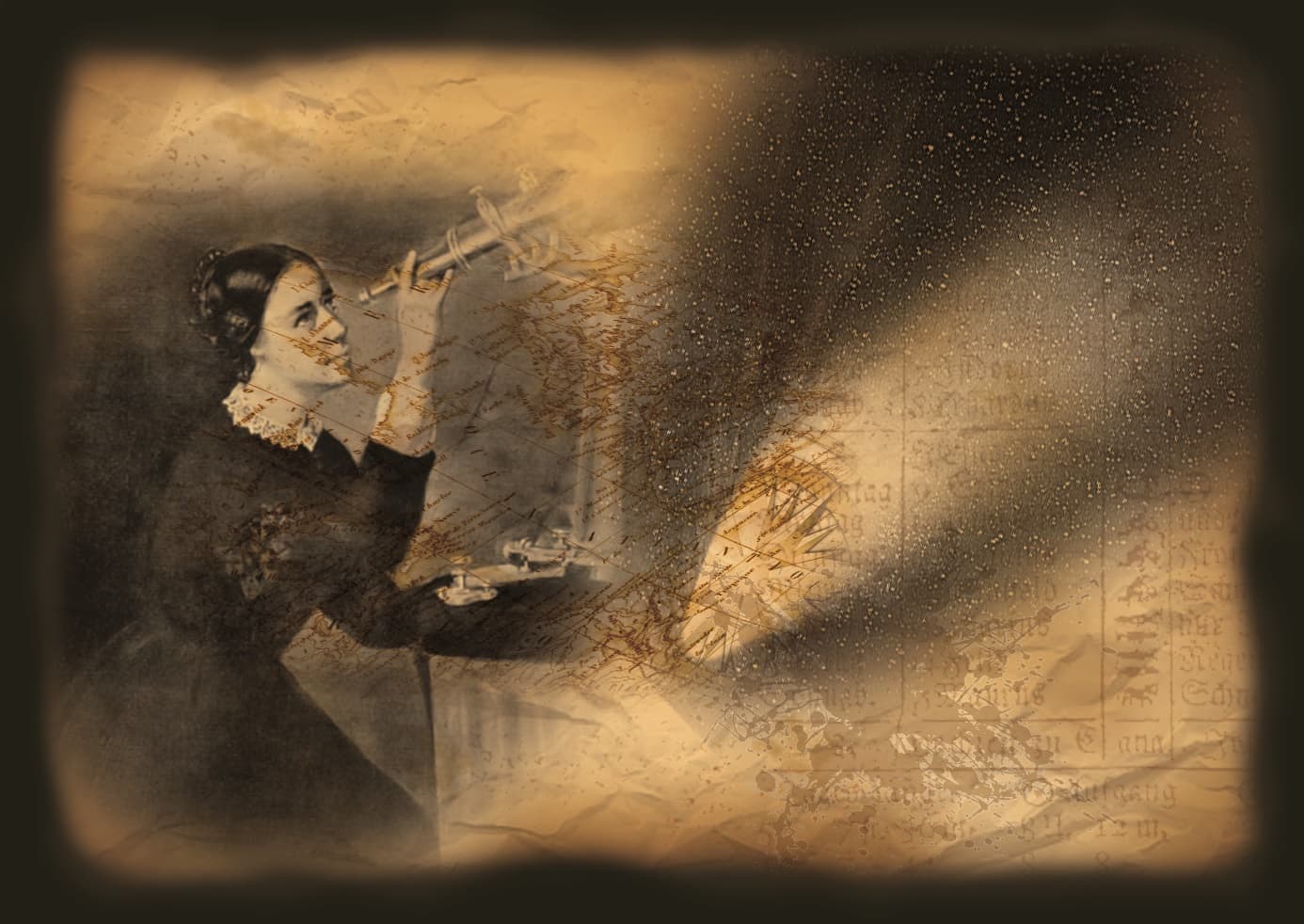
German · Science
Maria Kirch
February 25, 1670 – December 29, 1720
Early life and background
Maria Margaretha Kirch was born Maria Margaretha Winckelmann on 25 February 1670 in Panitzsch near Leipzig, in Saxony. She later became known by the married name Kirch, and historical sources also render her name as Maria Margaretha Kirchin or Maria Winkelmann-Kirch. She lived at a time when women were rarely admitted to formal scientific training, yet the biographical record repeatedly emphasizes that her father supported her education, giving her unusual access to intellectual development for a woman of her era.
Kirch’s early life is important because it helps explain how she entered astronomy through observation and calculation rather than through university study. In the late seventeenth century, scientific knowledge in the German lands often circulated through apprenticeships, households, and scholarly families rather than formal institutions alone. This made astronomy one of the few branches of learning in which a talented observer could, under favorable circumstances, contribute substantially without a university degree. Kirch appears to have benefited from precisely such a setting.
Accounts of her formation also point to the influence of Christoph Arnold, an autodidact astronomer whose interest in the sky helped awaken Kirch’s own. She later married mathematician and astronomer Gottfried Kirch in 1692. Their partnership became central to both of their careers, and for much of her working life she was involved in the same observational and computational tasks as her husband.
Marriage, family, and working partnership
Kirch’s marriage to Gottfried Kirch was both a personal relationship and a professional collaboration. The pair worked together on astronomical observations, calculations, calendars, and ephemerides. These products were not merely academic exercises; they were practical tools used for timekeeping, prediction, and navigation. Astronomers in this period often depended on calendar production for income, and the Kirchs became well known for this kind of labor.
Their family life was closely tied to science. Several later accounts note that their children also took part in astronomical work, making the Kirch household a center of learned activity. Maria’s role in that environment was substantial, but like many women of the period she was frequently described publicly as an assistant rather than as an equal colleague, despite evidence of real intellectual partnership.
The gendered structure of early modern science shaped how this collaboration was remembered. Men more often received official titles, salaries, and public recognition, while women’s labor was absorbed into domestic or supportive categories. Kirch’s career reveals the tension between actual competence and public invisibility: she worked as an astronomer, but institutions did not always grant her the status that matched her contribution.
Career beginnings and astronomical work
Kirch emerged as a skilled observer and calculator in the orbit of Gottfried Kirch’s astronomical work. Together they contributed to the production of calendars and planetary tables for scientific and practical use. Such work required sustained accuracy, patience, and a deep familiarity with the movement of celestial bodies. Her involvement in these tasks indicates a level of expertise that went far beyond casual participation.
Her standing as an astronomer grew through both routine work and significant discoveries. The early eighteenth century was a period when astronomy was becoming increasingly systematic, with observation tied to mathematical prediction and public print. Kirch participated fully in this world, and her published writings show that she was capable of presenting astronomical events in her own voice rather than through a male intermediary.
Although opportunities were limited by her gender, Kirch appears to have cultivated respect among contemporaries who understood her abilities. Later summaries of her life describe her as one of the most famous female astronomers of her time, a designation earned not through institutional rank but through visible contribution to astronomy at a moment when women rarely received credit for such work.
Discovery of the comet of 1702
Kirch’s most celebrated achievement came on 21 April 1702, when she discovered the comet of 1702 (C/1702 H1). Standard biographies identify her as the first woman to discover a comet. The discovery occurred during routine nightly observations, a reminder that major scientific breakthroughs often depend on careful, repetitive work rather than dramatic inspiration.
The historical importance of this event lies not only in the comet itself but in the uneven way it was acknowledged. Initial credit went to Gottfried Kirch, a pattern that reflected broader assumptions about male authorship and female invisibility. Maria’s role was later recognized, and Gottfried eventually admitted that she had made the discovery. That correction matters because it restores authorship to the person who actually observed the object and preserves the event as a landmark in the history of women in science.
In early eighteenth-century astronomy, comet discovery had scientific prestige. Comets were not yet fully understood, and observing one required timely and disciplined attention to the sky. Kirch’s success demonstrated both technical competence and the ability to work at the frontier of contemporary astronomy. Her discovery remains her most enduring claim to historical significance.
Publications and scientific authorship
Kirch did not remain known only for the comet. In 1707, she published observations of the aurora borealis under her own name. In 1709, she produced a pamphlet on the conjunction of the Sun with Saturn and Venus. In 1712, she published work on the approaching conjunction of Jupiter and Saturn. These publications demonstrate sustained engagement with astronomy and a continuing role as an author in a scientific culture that usually privileged men.
Her writings are historically important because they show that she was not simply assisting another astronomer. She observed, computed, and published. In the early modern period, publication was a principal route to reputation, and Kirch’s ability to attach her name to astronomical work was itself notable. It also made her one of the few women of her era whose scientific output entered the printed record in a visible way.
These works also reflect the practical side of astronomy. Conjunctions and celestial phenomena were used in the production of calendars and ephemerides, tying Kirch’s scholarship to everyday needs. Astronomy was not abstract in her world; it was a discipline connected to timekeeping, prediction, and public utility. Kirch’s participation in that work helped make scientific knowledge usable beyond elite scholarly circles.
After Gottfried Kirch’s death
When Gottfried Kirch died in 1710, Maria Kirch faced a difficult professional transition. She sought to continue his role as astronomer and calendar calculator for the Berlin scientific establishment, but she was not appointed. This refusal is one of the clearest examples of the barriers women faced in learned institutions even when they possessed the necessary expertise.
Her exclusion is especially striking because she had already demonstrated competence in precisely the work the position required. The denial was not based on lack of ability but on the gender norms of the time. Women could contribute to scientific labor, but they were often denied the offices, salaries, and formal authority that converted labor into recognized status. Kirch’s case illustrates how institutional structures could erase accomplishment even while relying on it.
Despite this setback, she continued to be associated with astronomy and remained active in observation and calculation for as long as she could. Her persistence shows that women’s scientific careers in this period often depended on personal resilience as much as on intellect.
Recognition, honors, and historical reputation
Kirch did not receive the kind of official honors that later generations would associate with scientific achievement, but she was respected in her time as a notable astronomer. Later historians have restored her place in the narrative of women in science, emphasizing that she was one of the most accomplished female astronomers of the early modern period and the first woman credited with discovering a comet.
Her historical reputation has been shaped by the contrast between accomplishment and recognition. She worked in a male-dominated scientific culture, published under her own name, and contributed to the astronomical knowledge of her era, yet her work was often framed through her relationship to her husband. Modern scholarship has increasingly treated her as an independent scientist whose achievements deserve recognition in their own right.
That reassessment matters beyond biography. Kirch’s story helps historians understand how women contributed to the development of astronomy despite exclusion from formal institutions. She is now remembered not as a curiosity, but as an important participant in the scientific revolution’s broader social history.
Later life and death
Maria Margaretha Kirch died on 29 December 1720 in Berlin. She was 50 years old. By the time of her death, she had left behind a record of observational work, published writings, and an enduring place in the history of astronomy. Her final years were shaped by the continuing challenge of pursuing scientific work without equal institutional standing, but her reputation as a skilled astronomer survived.
Her death closed a life that had bridged household-based scientific practice and the emerging institutions of early Enlightenment astronomy. The arc of her career—from a pastor’s daughter in Saxony to an astronomer known across the German lands—captures both the possibilities and constraints of women’s intellectual labor in her era.
Legacy
Kirch’s most durable legacy is that she stands as a pioneer for women in astronomy. She is remembered as the first woman to discover a comet, but her significance extends further. She published scientific observations, contributed to calendar work, and demonstrated that a woman could perform the observational and mathematical tasks essential to astronomy.
Her life also serves as a case study in how women’s work could be obscured. The initial misattribution of the comet discovery to her husband and the later denial of an official post after his death both show the structural forces that limited women’s recognition. At the same time, the recovery of her name in historical scholarship shows how such contributions can be reclaimed.
For historians of science and women’s history, Kirch is important not only because of what she discovered but because of what her career reveals about the organization of knowledge in early modern Europe. She belongs to the small group of women whose work helps demonstrate that women were present at the making of modern science, even when institutions tried to keep them at the margins.
Dated achievements
7 indexed.
- Feb251670Science
Birth of Maria Margaretha Kirch
Birth of German astronomer Maria Margaretha Kirch in Panitzsch near Leipzig.
View details Britannica: Maria Kirch - Apr211702Science
Discovery of the Comet of 1702
Kirch discovered the comet of 1702, becoming the first woman known to discover a comet.
View details