← All women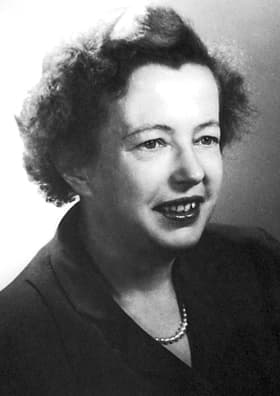
German, American · Science
Maria Göppert Mayer
June 28, 1906 – February 20, 1972
Early Life and Background
Maria Gertrud Käte Goeppert, later known as Maria Goeppert Mayer, was born on 28 June 1906 in Kattowitz, Upper Silesia, then part of Germany and now Katowice, Poland.[8][1][3][5] She was the only child of Friedrich Goeppert, a pediatrician and professor, and Maria, née Wolff, a French teacher and accomplished pianist.[1][4][12] Her father came from a long line—six generations—of university professors, and the family’s intellectual atmosphere deeply shaped her ambitions.[10][12]
In 1910 her father accepted a position at the University of Göttingen, and the family moved to this university town that soon became one of Europe’s leading centers for mathematics and theoretical physics.[1][10][12] Growing up in Göttingen, Goeppert attended a Gymnasium at a time when such rigorous secondary education was uncommon for girls in Germany.[10][12] The Weimar-era expansion of educational opportunities coincided with her formative years, making it possible—though still unusual—for a woman to aspire to advanced scientific study.
Göttingen’s vibrant intellectual community introduced her to mathematics and physics early. She was influenced by the scholarly expectations of her family and by the presence of major figures such as mathematician David Hilbert and, later, physicist Max Born, who turned Göttingen into a center of quantum mechanics.[1][12] This environment nurtured her curiosity and convinced her that she could pursue science despite the limited career prospects for women.
Education and Academic Formation
Goeppert initially enrolled at the University of Göttingen intending to study mathematics, but she soon gravitated toward physics as quantum theory revolutionized the field.[1][12] She joined the institute headed by Max Born, where a generation of future Nobel laureates was being trained.[1][4] Göttingen in the late 1920s was one of the world’s hubs for theoretical physics, attracting scholars such as Werner Heisenberg, Pascual Jordan, and Enrico Fermi; Goeppert was one of very few women participating in this community.[1][12]
Under Born’s supervision, she undertook research in quantum mechanics that led to her doctoral dissertation. In 1930 she completed her thesis work on multiphoton processes, and in 1931 she formally completed her Ph.D. in physics at Göttingen.[12][4] Her dissertation provided the first theoretical description of two-photon absorption, analyzing how an atom can simultaneously absorb two photons to reach an excited state.[4][5] This pioneering work introduced the concept of a virtual intermediate state and became a cornerstone of what is now called nonlinear optics.[4][13]
Her achievement was exceptional for the time: very few women in Germany earned doctorates in theoretical physics, and her work was immediately recognized by peers for its originality. Although two-photon absorption would not be observed experimentally until after the development of lasers, her theory proved prescient, and the unit of two-photon absorption cross-section was later named the GM (Goeppert-Mayer) in her honor.[4][13]
Marriage, Emigration, and Career Beginnings
In 1930, Maria Goeppert married Joseph Edward Mayer, an American physical chemist who had been working in Göttingen.[12] Their marriage coincided with the completion of her dissertation. When Mayer accepted a position in the United States, she faced the common dilemma for women scientists of the era: how to maintain a research career while following a spouse’s appointments.
In 1930–1931
During these early years in the U.S., she continued theoretical work in nuclear and atomic physics. In 1935, she published an important paper on double beta decay, extending methods she had introduced in her thesis and contributing to the understanding of rare nuclear processes.[12][14] Although still relatively early in the history of nuclear physics, this research showed her ability to identify and analyze subtle aspects of nuclear structure. Goeppert Mayer’s most celebrated work concerns the structure of atomic nuclei. In the 1940s, as nuclear physics expanded rapidly in the wake of fission’s discovery and wartime research, she became deeply involved in theoretical investigations of nuclear energy levels and stability. After the Mayers moved to Chicago in 1946, Maria received a faculty appointment associated with the University of Chicago’s Institute for Nuclear Studies and the newly established Argonne National Laboratory.[2] At Argonne she served as a senior physicist in the Theoretical Physics Division, splitting her time between Argonne and the university.[2] It was here that she developed the mathematical model for nuclear shells, the work for which she would later be awarded the Nobel Prize.[2][8] A key puzzle in nuclear physics concerned certain numbers of protons or neutrons—magic numbers—for which nuclei exhibited unusual stability. In 1949, Goeppert Mayer and the German physicist J. Hans D. Jensen independently proposed the nuclear shell model, in which nucleons (protons and neutrons) are distributed in energy shells analogous to the arrangement of electrons in atomic orbitals.[8][5][13] By introducing spin–orbit coupling and other refinements, they showed how the magic numbers arise naturally from the structure of these shells. This model explained a wide range of experimental data, offering a coherent picture of nuclear energy levels and transitions. It became a foundational tool for nuclear physics, informing studies of isotopes, nuclear reactions, and the synthesis of elements in stars.[3][8] In 1950, Goeppert Mayer and Jensen co‑authored the book "Elementary Theory of Nuclear Shell Structure", which consolidated their work into a standard reference and guided generations of physicists.[10][3] The shell model ranks among the major conceptual advances in 20th‑century nuclear theory. Across her career, several contributions stand out: Collectively, these works reshaped both nuclear physics and quantum optics. Her two-photon work was initially ahead of the available technology, but after the advent of lasers it became central to techniques such as two-photon fluorescence microscopy. Her nuclear shell model, by contrast, had immediate and wide influence, guiding experimental programs and theoretical extensions across the globe. The pinnacle of Goeppert Mayer’s recognition came with the 1963 Nobel Prize in Physics. On 29 October 1963, the Royal Swedish Academy of Sciences announced that one half of the Nobel Prize in Physics would be shared by Maria Goeppert Mayer and J. Hans D. Jensen for their discoveries concerning nuclear shell structure, with the other half awarded to Eugene Wigner.[8][13] This decision established her as one of the world’s leading theoretical physicists. She thus became the second woman ever to receive the Nobel Prize in Physics, following Marie Curie in 1903, and the first American woman physics laureate.[8][4][10][7] On 10 December 1963, she formally received the prize at the Nobel Prize Award Ceremony in Stockholm.[8] Contemporary accounts note that at the time she and Curie were the only women to have won a Nobel in physics, and she was the only living woman with a Nobel in any science.[13] Beyond the Nobel, her work earned further institutional recognition. In 1973, the American Physical Society established the Maria Goeppert Mayer Award, intended to honor outstanding early‑career women physicists and to commemorate her legacy.[15][14] This award has become a significant mechanism for highlighting the achievements of women in physics and addressing historical underrepresentation. She was also inducted into the National Women’s Hall of Fame in the United States, recognized in women’s‑history projects, and featured in numerous institutional exhibits and biographies that document the contributions of women scientists.[4][10] Her name appears in multi‑language encyclopedias and national science biographies, reflecting her global impact.[3][5][6][7][9][11] Maria’s marriage to Joseph Edward Mayer was both a personal partnership and an intellectual collaboration. Mayer himself became a distinguished physical chemist, and the couple occasionally co‑authored scientific papers.[12] They had two children, and Maria balanced motherhood with her research career, often under challenging circumstances.[12] Because of anti‑nepotism rules and widespread reluctance to appoint women, especially wives of male faculty, Maria spent much of her life working in unpaid or marginal positions attached to her husband’s institutions.[2][12][14] At Johns Hopkins, Columbia, and later Chicago, she was granted the use of office space and laboratory resources but only rarely a formal salary or rank commensurate with her contributions. Colleagues and students described her as modest, reserved, and intensely focused on science rather than status. She did not publicly campaign against gender discrimination, but her career became a widely cited example of how structural barriers constrained women in academia.[12][15] Her quiet persistence—producing world‑class theory while being denied secure employment—has become a central theme in later historical assessments of her life. In the early 1960s, Goeppert Mayer accepted a position at the University of California, San Diego (UCSD), where she was listed as a member of the physics faculty.[8][12] UCSD, then a relatively new campus, benefited from her presence as a Nobel‑caliber theorist. Her affiliation with UCSD is noted in Nobel records as her institution at the time of the 1963 award.[8] At UCSD she continued research and mentoring, though her health began to decline near the end of the decade. She suffered a stroke in 1970, which limited her ability to work.[12] Nonetheless, her earlier contributions remained central to the training of younger physicists, and she served as a symbol of the possibilities for women in high‑level theoretical research. Maria Goeppert Mayer died on 20 February 1972 in San Diego, California, from a heart attack following complications from her stroke.[8][3][5][6][7][9][11] Some accounts specify La Jolla, a community within the city, as the location of her death, but major biographical sources and Nobel documentation give San Diego.[8][3][5][12][14] She was 65 years old. Her death prompted numerous tributes from colleagues who emphasized both her scientific brilliance and her personal modesty. Biographical memoirs written in the aftermath highlighted the trajectory from her birth in Kattowitz through Göttingen’s quantum revolution, the constraints of unpaid positions in American universities, and her ultimate recognition with the Nobel Prize.[12] Maria Goeppert Mayer’s legacy is multifaceted, spanning nuclear physics, optics, and the history of women in science. Scientifically, her development of the nuclear shell model remains a cornerstone of nuclear theory. The concept of nucleons occupying discrete energy shells—with spin–orbit coupling explaining magic numbers—continues to underpin models of nuclear structure, informing both basic research and applied work in nuclear energy and medicine.[3][8][2] Her early theoretical description of two-photon absorption anticipated the rise of nonlinear optics and multiphoton techniques. Once lasers made multiphoton processes experimentally accessible, her ideas found wide application in spectroscopy and microscopy. The naming of the two-photon absorption cross-section unit, GM, in her honor signals the lasting importance of her 1931 dissertation.[4][13] Historically, Goeppert Mayer occupies a significant place in the narrative of women’s participation in physics. She was the second woman to receive the Nobel Prize in Physics and the first woman recognized for theoretical physics, achievements that came despite decades of marginal employment.[8][4][10][12][13] Her life illustrates how systemic barriers—anti‑nepotism rules, gender bias, and narrow definitions of professional status—limited women’s access to academic positions, even when their work met the highest scientific standards. The establishment of the Maria Goeppert Mayer Award by the American Physical Society in 1973 institutionalized her legacy as a symbol of women’s excellence in physics and as a mechanism to support early‑career women physicists.[15][14] Inductions into the National Women’s Hall of Fame and inclusion in women’s‑history exhibits further underscore her role as a trailblazer.[4][10] In contemporary assessments, Goeppert Mayer is often cited alongside Marie Curie and other women Nobel laureates as an example of how individual persistence and intellectual brilliance can overcome, though not erase, structural discrimination. Her story is used in educational materials and museum exhibits to encourage girls and young women to pursue physics and mathematics.[4][10][13] Across multiple languages and national traditions, biographies of Maria Goeppert Mayer reaffirm her significance. German, French, Spanish, Portuguese, and Polish encyclopedia entries all emphasize her birth in Kattowitz/Katowice, her emigration to the United States, her co‑development of the shell model, and her 1963 Nobel Prize.[5][6][7][9][11] This international recognition reflects both the universality of her scientific contributions and the global importance attached to increasing the visibility of women scientists. Maria Goeppert Mayer stands as one of the most important theoretical physicists of the 20th century and a central figure in women’s scientific history. Her career, marked by world‑changing discoveries made largely from precarious institutional positions, offers a powerful case study of both the obstacles and possibilities facing women in academic science. The continued citation of her work, the award bearing her name, and her presence in educational and historical narratives ensure that her impact extends far beyond her lifetime.Contributions to Nuclear Physics and the Shell Model
Major Works and Discoveries
Awards, Honors, and Recognition
Personal Life
Later Career at UC San Diego
Death
Legacy and Historical Impact
Assessment
Dated achievements
5 indexed.
- Jun281906Science
Birth of Maria Goeppert Mayer
Maria Göppert (later Maria Goeppert Mayer) was born in Kattowitz, Germany.
View details Nobel Prize Facts - Maria Goeppert Mayer - Jan011931Science
First theoretical description of two-photon absorption
In 1931, Mayer described the two-photon absorption process in her dissertation, a foundational concept in nonlinear optics.