← All women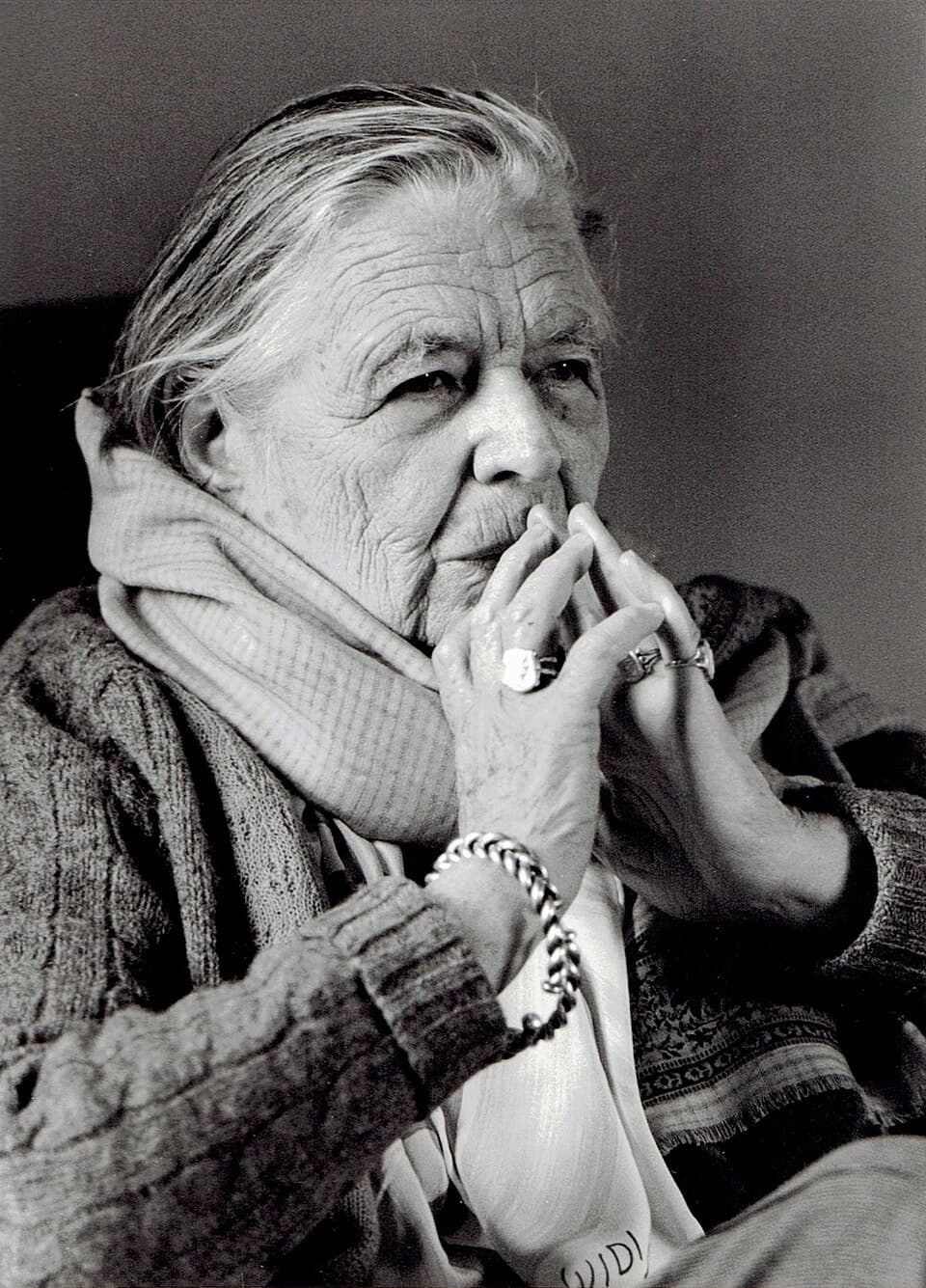
French, Belgian, American · Literature
Marguerite Yourcenar
June 8, 1903 – December 17, 1987
Early Life and Background
Marguerite Yourcenar was born Marguerite Antoinette Jeanne Marie Ghislaine Cleenewerck de Crayencour on June 8, 1903, in Brussels, Belgium. Her father, Michel Cleenewerck de Crayencour, was a member of the French landed gentry from the Nord region, and her mother, Fernande de Cartier de Marchienne, was Belgian. Fernande died of puerperal fever just ten days after Marguerite's birth, leaving the infant to be raised by her father, a cultivated, restless, and unconventional man who never remarried and took full charge of his daughter's upbringing.
Yourcenar's childhood was marked by frequent travel and an eclectic, largely home-based education. She spent her formative years moving between the family estate in northern France, Paris, the French Riviera, and various parts of England and Italy. Her father encouraged her early and voracious reading, and she was taught Latin and Greek from a young age—an education that would prove foundational to her later historical fiction. She never attended a conventional school and never received a formal academic degree, an unusual path that nonetheless produced one of the most erudite literary minds of twentieth-century France.
By her teenage years, Marguerite had already begun writing poetry, and her father—recognizing her talent—helped her self-publish her first collection, Le Jardin des chimères, in 1921, when she was just eighteen. It was around this time that she and her father devised the pen name "Yourcenar," a near-anagram of "Crayencour," which she would use for the rest of her literary career and eventually adopt legally.
Career Beginnings and Development
Yourcenar's early writing life in the 1920s and 1930s was peripatetic, reflecting her rootless upbringing. She traveled extensively throughout Europe—particularly Italy, Greece, and Central Europe—absorbing classical history, art, and mythology that would become the bedrock of her fiction. Her first novel, Alexis (1929), a psychologically probing epistolary work exploring homosexuality and personal identity, established her as a serious literary voice, though it drew a limited readership at the time.
She continued to publish steadily through the 1930s, including La Nouvelle Eurydice (1931), Denier du rêve (1934, revised 1959), and Feux (1936), a lyrical prose-poetry meditation on love. During this period she also began an important intellectual and romantic relationship with the writer and editor André Fraigneau, though it was unrequited in the romantic sense; more significantly, in 1937 she met Grace Frick, an American academic, in Paris. Frick would become Yourcenar's lifelong partner, translator, and closest collaborator for over four decades.
With the outbreak of World War II, Yourcenar left France for the United States in 1939, joining Frick, and the two settled eventually on Mount Desert Island in Maine, at a house they named Petite Plaisance. For a period, Yourcenar took on teaching work, including a position at Sarah Lawrence College, to support herself financially during the war years, a stark contrast to the literary fame that awaited her in the following decade.
Major Works and Accomplishments
Yourcenar's international reputation was transformed by the 1951 publication of Mémoires d'Hadrien (Memoirs of Hadrian), an extraordinary fictional autobiography of the Roman emperor Hadrian, written as a long letter to his successor Marcus Aurelius. The novel, the product of decades of research and multiple abandoned drafts dating back to the 1920s, was celebrated for its meticulous historical accuracy, philosophical depth, and hauntingly intimate first-person voice. It became an immediate sensation in France and was soon translated worldwide, establishing Yourcenar as one of the preeminent historical novelists of the century. The book's genesis, famously chronicled in her essay "Reflections on the Composition of Memoirs of Hadrian," reveals her painstaking process of historical immersion, including her practice of destroying earlier manuscript versions she found unsatisfactory.
She followed this triumph with other major works, including L'Œuvre au Noir (The Abyss, 1968), a dense philosophical novel set in 16th-century Flanders following the alchemist and physician Zeno, which won the prestigious Prix Femina. Her other significant works include Souvenirs pieux (1974) and Archives du Nord (1977), the first two volumes of an autobiographical family trilogy titled Le Labyrinthe du monde, and Comme l'eau qui coule (1982). She also produced influential essays, translations (including of Constantine Cavafy and Virginia Woolf's The Waves), and poetry throughout her career, demonstrating a rare range across genres and languages.
Awards, Honors, and Recognition
Yourcenar received numerous honors over her lifetime. She won the Prix Femina in 1968 for L'Œuvre au Noir and the Grand Prix national des Lettres in 1974. Her crowning institutional honor came on March 6, 1980, when she was elected to the Académie française, becoming the first woman ever admitted as a full member in the Academy's 345-year history—an event of enormous symbolic and cultural significance in France, breaking a barrier that had persisted since the institution's founding by Cardinal Richelieu in 1635. She was formally inducted in a ceremony on January 22, 1981.
She was also named a Commander of the Legion of Honour and received honorary degrees and international literary prizes, and was frequently mentioned as a contender for the Nobel Prize in Literature, though she never received it. Her work has since been the subject of extensive academic study, and she remains one of the most widely translated French-language authors of the twentieth century.
Personal Life
Yourcenar's personal life was defined above all by her decades-long partnership with Grace Frick, whom she met in Paris in 1937. The two women emigrated together to the United States in 1939 and lived together at Petite Plaisance in Northeast Harbor, Maine, from 1950 until Frick's death from breast cancer in 1979. Frick was instrumental in translating much of Yourcenar's work into English, helping to build her American and international readership. Yourcenar was notably private about her sexuality and relationships, though her early novel Alexis and other works reflect her lifelong engagement with themes of same-sex love and fluid identity, drawing partly on her own experiences and earlier relationships, including with André Fraigneau.
She never married and had no children. She became a naturalized American citizen in 1947 while retaining her deep connection to French language and letters throughout her life, embodying a transnational identity unusual for a major French literary figure of her generation.
Legacy and Later Life
After Grace Frick's death in 1979, Yourcenar continued to live and write at Petite Plaisance, supported in her final years by her secretary and companion Jerry Wilson, with whom she traveled extensively, including trips to Egypt and other historically resonant locations that inspired her late writing. She continued publishing essays and the third planned (though ultimately unfinished) volume of her family memoir trilogy.
Marguerite Yourcenar died on December 17, 1987, at the age of 84, at Petite Plaisance following complications from a stroke. She was buried in the Somesville Cemetery on Mount Desert Island, choosing to remain in her adopted American home rather than returning to France. Petite Plaisance has been preserved as a historic house museum dedicated to her life and legacy.
Yourcenar's legacy endures as one of the most significant literary figures of twentieth-century France: a historical novelist of extraordinary erudition and psychological insight, and a trailblazer whose 1980 election to the Académie française permanently altered the institution's history. Her novels, particularly Memoirs of Hadrian, remain widely read, taught, and admired for their fusion of rigorous historical scholarship with profound meditations on power, mortality, identity, and the human condition.
Dated achievements
3 indexed.
- Jun081903Literature
Born in Brussels, Belgium
Marguerite Yourcenar (born Marguerite Antoinette Jeanne Marie Ghislaine Cleenewerck de Crayencour) was born in Brussels to a French father and Belgian mother.
View details Marguerite Yourcenar - Wikipedia - Mar061980Literature
First woman elected to the Académie française
Yourcenar became the first woman ever elected as a full member ('immortelle') of the Académie française, ending 345 years of exclusively male membership.