← All women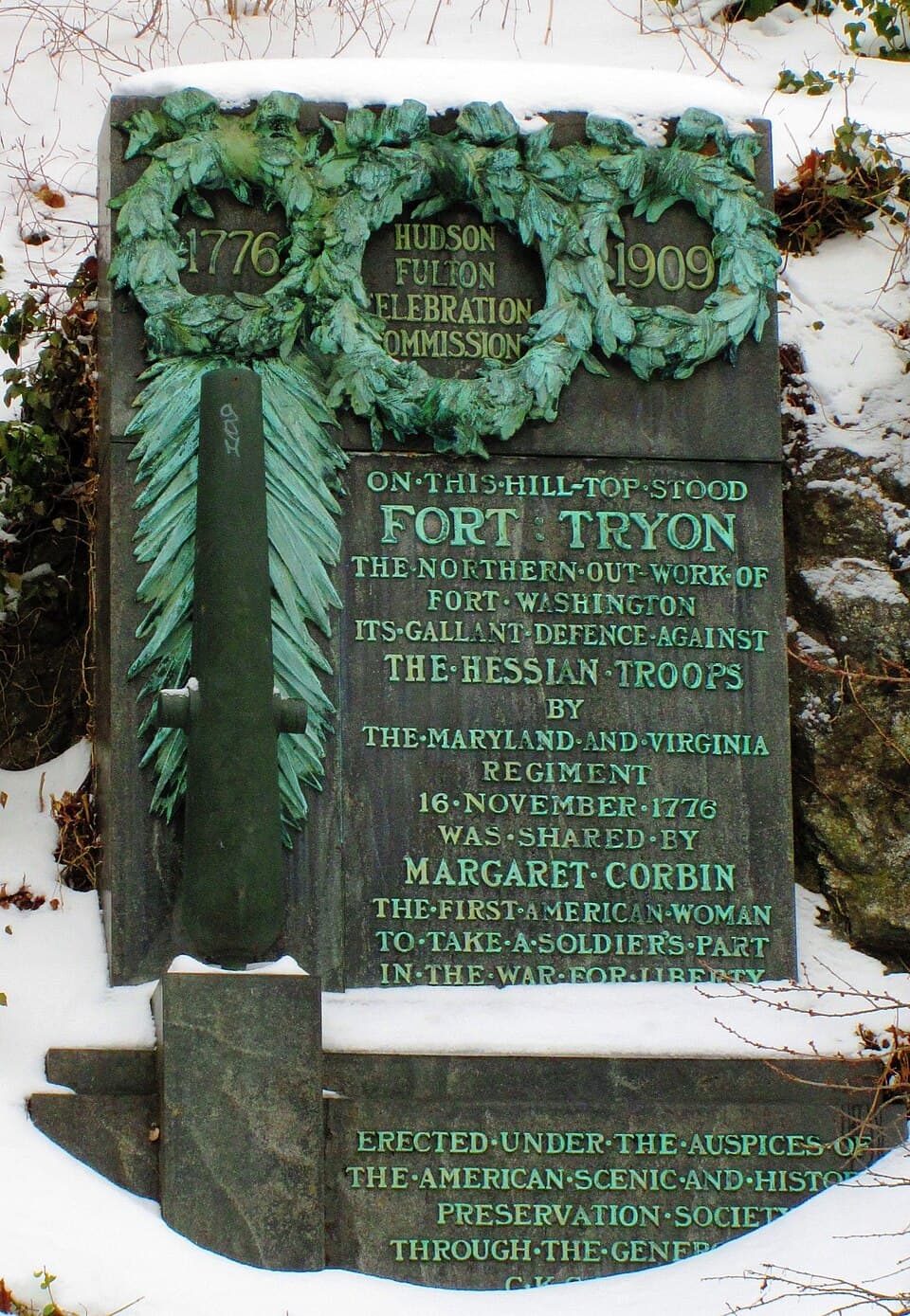
American · Activism
Margaret Corbin
November 12, 1751 – January 16, 1800
Early Life and Background
Margaret Cochran Corbin was born on 12 November 1751 in what is now Franklin County, Pennsylvania, to immigrant parents of Scotch‑Irish origin.[1][4] Her family lived on the colonial frontier, a region marked by frequent conflict between European settlers and Indigenous nations, as well as by economic hardship and relative isolation. Biographical accounts from the National Women’s History Museum and military history institutions emphasize that this frontier environment, combined with early trauma, shaped her resilience and capacity for hardship.[1][4]
Around 1756, when Margaret was about five years old, her family’s settlement was attacked during the violence associated with the French and Indian War and ongoing frontier conflicts.[1] Her father was killed in an Indigenous raid, and her mother was taken captive, with no record of her subsequent fate.[1] Orphaned along with her younger brother, John Cochran, Margaret was taken in and raised by relatives, likely grandparents or other kin in Pennsylvania.[1] This experience required her to assume responsibilities beyond her years, including caring for her brother, and has been cited by historians as foundational to the courage and stoicism she later displayed in wartime.
Formal schooling for girls on the frontier was limited, and there is no documentary record of Margaret receiving structured education. She almost certainly learned domestic and agricultural labor typical for rural girls: cooking, sewing, washing, and other tasks that sustained household and farm life.[1] These skills would later prove essential in the Revolutionary War camps, where women known as camp followers provided vital logistical support to the Continental Army.
Marriage and Move into Wartime Service
By 1773, in her early twenties, Margaret married John Corbin, a farmer who would later serve as an artilleryman in the Pennsylvania militia.[1][2] Sources agree that the couple lived on a small farm for several years before the outbreak of large‑scale Revolutionary fighting in the mid‑1770s.[2] Like many rural families, the Corbins faced the economic and political pressures that accompanied growing colonial resistance to British policies.
After the American Revolution began in 1775, John Corbin enlisted as an artilleryman in a Pennsylvania unit attached to the Continental Army.[2][3] Instead of remaining at home, Margaret chose to accompany him to war as a camp follower, joining thousands of other women who traveled with the army to provide services such as laundry, cooking, sewing, and nursing.[3][10] Camp followers, often poor and dependent on soldiers’ pay, were not formally enlisted but played a crucial role in sustaining the troops under harsh conditions.
Prior to direct combat service, Margaret’s wartime work included caring for wounded soldiers and performing laundry and other tasks for her husband’s artillery company.[3][1] Contemporary and later accounts note that camp followers like Margaret endured the same extreme weather, shortages of food and clothing, and risks of disease and enemy fire as the soldiers they supported.[4][10] Her decision to follow her husband into the army, rather than seek relative safety away from the front, reflected both personal commitment and the limited economic options available to women of her social position.
The Battle of Fort Washington and Combat Service
Margaret Corbin’s most famous act occurred during the Battle of Fort Washington on 16 November 1776.[1][4] Fort Washington, located on the northern end of Manhattan Island, was a key American stronghold defending the Hudson River and the approaches to New York City. On that day, British forces, including Hessian troops, launched a coordinated attack on the fort as part of their campaign to control New York.[7]
John Corbin served with the First Company of Pennsylvania Artillery, positioned on a ridge that would later be associated with Fort Tryon.[7] During the battle, Margaret initially worked in a supportive role, bringing water and ammunition and helping to load the cannon.[1][7] As the fight intensified, artillery crews suffered heavy casualties under British and Hessian fire. When John was killed at his post, Margaret stepped into the breach, taking his place at the cannon.
Accounts from the National Women’s History Museum, the National Museum of the United States Army, and later military histories describe how she loaded, cleaned, aimed, and fired the cannon herself, continuing to serve as an artillery operator despite having no formal enlistment and operating in the face of intense enemy fire.[1][4] Her actions defied common expectations that women should remain behind the lines and avoid direct combat.
During the course of the battle, Margaret was struck by grapeshot from an enemy cannon, which tore into her left shoulder, chest, and jaw.[1][10] The severity of these wounds left her permanently disabled, causing significant loss of function in her left arm and chronic pain for the rest of her life.[1][10] She collapsed at the cannon, and when the British ultimately captured Fort Washington, she was among those taken prisoner.[4][3]
Margaret was later paroled and sent to a hospital, where she received rudimentary treatment.[3] Medical care for soldiers and camp followers was limited, and women’s injuries often received less systematic attention than those of enlisted men. Nonetheless, the visible and lasting nature of her wounds made her case difficult to ignore. Her defense of the fort and the damage she suffered were widely reported within the Continental Army and contributed to an emerging recognition of women’s direct participation in the Revolution.[1][7]
Recognition, Pension, and the Corps of Invalids
After her release from captivity and partial recovery, Margaret remained disabled and unable to resume the heavy labor expected of camp followers or farm wives.[4][10] Her case came to the attention of the Continental Congress and the Board of War, which evaluated the circumstances of her service and injuries. On 6 July 1779, Congress approved a resolution granting Margaret Corbin a lifelong military pension. [1][6]
The pension awarded her one‑half of the monthly pay of a private soldier and a complete outfit of clothing or its cash equivalent annually.[1][6] This was a modest benefit, reflecting both the limited pension system of the era and a reluctance to treat non‑officers as fully deserving of generous support. However, the significance of the act lay not in its amount but in the recognition it conferred.
By this decision, Congress formally acknowledged Margaret as a wounded combatant whose injuries were sustained while "heroically" filling her husband’s post at the cannon.[6] Historical analyses by the American Revolution Institute and the National Women’s History Museum emphasize that this made her the first woman in American history to receive a military pension from Congress for her own combat service and to be recognized as a veteran on that basis.[1][4][6]
Following the pension grant, Margaret was placed in the Corps of Invalids, a Continental Army unit composed of soldiers disabled by wounds or illness who were assigned limited duties suitable to their capacities.[1][4] She was stationed in the West Point area, where the army maintained fortifications along the Hudson River. Life in the Invalid Corps offered some security and community but did not erase the hardships she faced as a disabled, poor woman in a society with minimal social welfare structures.
Later Life at West Point
For the remainder of her life, Margaret lived near West Point, New York, among soldiers and veterans associated with the fortifications and later the U.S. Military Academy site.[4][6] Despite her pension, she remained economically marginal. Historical commentary from the American Revolution Institute notes that she was known in the area for rough manners, swearing, and drinking—traits sometimes emphasized in accounts that underscore the contrast between her modest, difficult existence and her moment of revolutionary heroism.[6][10]
Her physical disabilities persisted. The loss of use in her left arm and the lingering effects of her chest and jaw injuries limited her ability to perform labor that might have supplemented her income.[1][10] As a woman veteran without a family wealth base, she depended heavily on the small pension and the informal support networks available in military communities.
There is little documentation of close family relationships in her later years. Her husband John had been killed at Fort Washington, and there is no reliable evidence that the couple had surviving children. Like many people of her social station, Margaret appears largely through institutional records—pension rolls, military correspondence, and later commemorative writings—rather than personal letters or diaries.
Margaret Corbin died near West Point, likely in Highland Falls, on 16 January 1800.[4][6] She was approximately forty‑eight years old. Her burial site was not prominently marked, and over time the exact location of her grave was lost to local memory.[6][9] The absence of a well‑documented gravesite reflected the broader neglect of many rank‑and‑file Revolutionary veterans, especially women, whose contributions rarely translated into enduring monuments or family‑maintained cemeteries.
Rediscovery and Commemoration
For much of the 19th century, Margaret Corbin’s story circulated only intermittently in historical literature and local tradition. She was known in some circles as "Captain Molly", a nickname shared with or sometimes confused with other women who aided artillery units, such as Molly Pitcher.[9] The specifics of her pension and her role at Fort Washington were preserved in Congressional records and occasional biographical sketches but did not receive sustained national attention.
In the early 20th century, the Daughters of the American Revolution (DAR) began efforts to identify and honor women of the Revolutionary era. As part of this work, DAR researchers focused on Margaret Corbin’s life and sought to locate her grave. In 1926, after investigations and ceremonial planning, the DAR in New York State arranged for what was believed to be her remains to be reinterred with full military honors at West Point Cemetery and erected the Margaret Corbin Monument on the grounds of the U.S. Military Academy.[9][10]
The monument, installed in 1926, is described by the Library of Congress and other sources as the only memorial on the academy’s grounds specifically dedicated to a woman veteran of the Revolutionary War.[10] Its placement among monuments to distinguished male officers signals institutional recognition of her military importance. While later research has raised some questions about whether the remains reinterred there are conclusively hers, the memorial nonetheless stands as a symbolic acknowledgment of her contributions. [9]
In addition to the West Point monument, a plaque in Fort Tryon Park in Manhattan commemorates her defense of Fort Washington and celebrates her "as the first woman to take a soldier’s part in the War for Liberty."[1] This commemorative language has helped popularize her story as an early example of female combat participation in U.S. history, even while historians note that other women also engaged in violent resistance during the Revolution.
Awards, Honors, and Institutional Recognition
Margaret’s principal formal recognition during her lifetime was the Continental Congress pension of 6 July 1779, which granted her half pay and an annual clothing allowance.[1][6] This act is consistently cited by museums, the Library of Congress, and veterans’ organizations as the first Congressional military pension awarded to a woman for combat service in United States history.[1][4][6]
In the 20th and 21st centuries, her legacy has been honored through a variety of institutional initiatives:
- The Margaret Corbin Monument at West Point serves as a central site for remembrance and educational programming on women in the armed forces.[10]
- The U.S. Military Academy has established the Corbin Women’s Leadership Forum, named in her honor, which addresses topics of diversity and inclusion and highlights the historical and contemporary roles of women in military leadership.[3]
- National museums and historical organizations—including the National Women’s History Museum, the National Museum of the United States Army, the American Revolution Institute, and the Daughters of the American Revolution—feature detailed biographies and educational materials about her life.[1][4][6][9]
These forms of recognition collectively affirm her status as a pioneering woman veteran and a symbol of women’s longstanding participation in American military history.
Personal Life and Character
Beyond her marriage to John Corbin and wartime service, relatively little is known about Margaret’s personal relationships. No reliable documentation confirms that she had surviving children. Her life story is preserved primarily through institutional and commemorative records rather than personal correspondence, leaving many aspects of her inner life and day‑to‑day experiences unrecorded.
Contemporary and later descriptions portray her as strong‑willed, blunt, and unafraid of harsh language, characteristics sometimes framed within the stereotype of the "camp follower" but also consistent with someone who had endured extreme hardship from childhood through war.[6][10] She is often depicted as embodying the ruggedness of frontier and military life: willing to perform heavy labor, confront danger, and challenge expectations of female passivity.
Legacy and Historical Impact
Margaret Corbin’s legacy rests on several intertwined themes: her direct combat role in the American Revolution, her status as the first woman formally granted a military pension by the United States Congress, and her posthumous recognition as a symbol of women’s contributions to national defense.[1][4][6]
Her actions at Fort Washington provide one of the clearest documented examples of a woman taking over an artillery position and continuing to fight after the death of her husband. This narrative has been used to challenge assumptions that women in the Revolutionary era were confined to non‑combat roles, instead highlighting the flexible and sometimes radical ways they participated in warfare. [1][7]
The 1779 pension established an important precedent: that a woman who had fought and been wounded in battle could be recognized by the state as a veteran deserving of compensation. Historians and institutions such as the American Revolution Institute and the National Women’s History Museum point to this case as an early, if limited, step toward acknowledging women’s military service on legal and financial terms similar to men.[1][6]
In modern discourse, Margaret Corbin is frequently cited in discussions of women’s eligibility for combat roles and veteran benefits. Newspaper commentary, such as a Washington Post opinion piece, and educational videos produced by museums and foundations reference her bravery to illustrate a "rich history" of women’s participation in warfare stretching back to the Revolution.[7][2][11] Her story is used to argue that debates over women’s military service must take into account long‑standing historical precedents.
Through monuments, leadership forums, and curricular materials, Margaret’s life now serves as a touchstone for broader conversations about gender, citizenship, and military duty. The fact that her recognition as a veteran was both groundbreaking and constrained—granting her a pension without social status or economic security—offers insight into the complexities of early American attitudes toward women who crossed into traditionally male domains of combat.
Later Evaluations and Ongoing Research
Scholars continue to examine the documentary record of Margaret Corbin’s life, including military muster rolls, pension documents, and commemorative efforts. Some research has questioned the exact identity of the remains reinterred at West Point in 1926, suggesting that the DAR may have selected an incorrect grave; nevertheless, the monument remains dedicated to her and functions as a symbolic representation of her story.[9][10]
Historians also situate her among other Revolutionary women who engaged in resistance or battlefield activity, exploring how narratives like hers have been celebrated or marginalized over time. In this context, Margaret is seen both as a singular figure—the first woman formally recognized as a combat veteran by Congress—and as part of a broader, often under‑acknowledged cohort of women who contributed to the American war effort in ways that exceeded conventional domestic roles. [1][6]
Today, biographies, museum exhibits, and educational programs present Margaret Cochran Corbin as an emblematic "daughter of the American Revolution" whose frontier childhood, wartime courage, disabling injuries, and belated commemoration illuminate the lived realities of women in the founding era. Her life underscores the fact that the fight for American independence involved not only famous male leaders but also ordinary women whose sacrifices were essential to the success of the cause—and whose recognition has often been long delayed.
Dated achievements
5 indexed.
- Nov121751Science
Birth of Margaret Cochran Corbin
Margaret Cochran was born in western Pennsylvania to immigrant parents of Irish/Scotch-Irish descent.
View details National Women's History Museum: Margaret Cochran Corbin - Nov161776Science
Combat service at the Battle of Fort Washington
After her husband was killed manning a cannon, Margaret Corbin took his place, loading and firing until severely wounded.