← All women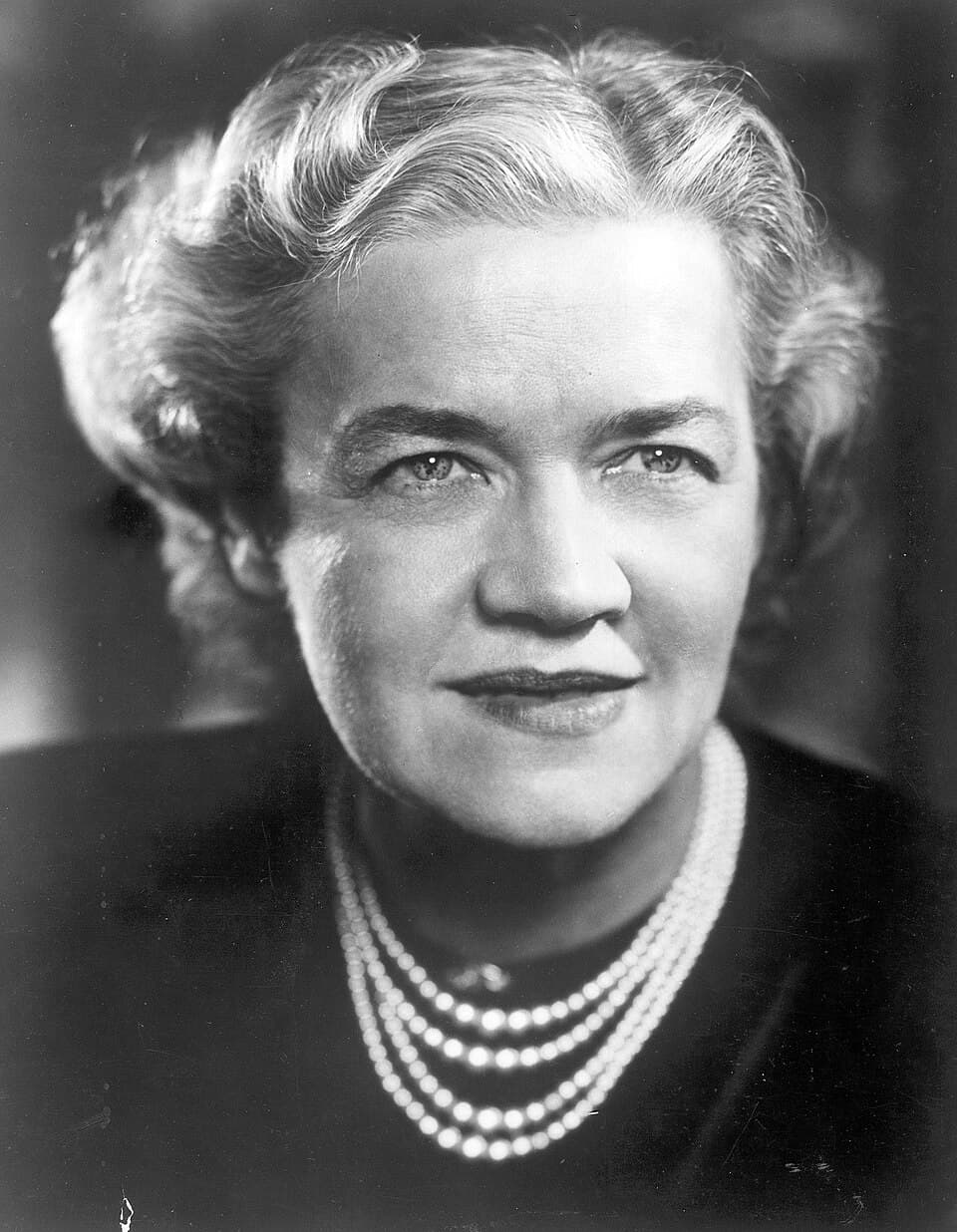
American · Politics
Margaret Chase Smith
December 14, 1897 – May 29, 1995
Early life and family background
Margaret Madeline Chase Smith was born on December 14, 1897, in Skowhegan, Maine, the eldest of six children in a working-class family. Her father, George Emery Chase, was a barber, and her mother, Carrie Murray Chase, helped sustain the household in a small-town environment shaped by thrift, hard work, and civic responsibility. Smith’s upbringing in central Maine gave her a strong sense of local community and a practical understanding of ordinary life that would remain central to her public image throughout her political career.
She attended local schools in Skowhegan and, like many women of her generation, did not have the opportunity to pursue a lengthy formal college education. Instead, she entered the workforce early, holding jobs in office work, a telephone company, and newspaper work. Those experiences exposed her to public communication, administration, and the economic pressures of family life. They also helped develop the self-reliance and organizational skills that later distinguished her as a legislator.
Smith came of age during a period when women’s political rights were limited and their public ambitions often discouraged. The Nineteenth Amendment would not be ratified until she was already in adulthood. Her rise from small-town Maine to national power therefore took place against a background of restricted opportunity for women, making her later achievements especially significant.
Marriage and early adult life
In 1919, Smith married Clyde Harold Smith, a prominent Republican politician from Maine who was twenty-one years her senior. The marriage brought her more directly into political life, though at first in a supporting role. Over the years, she became an assistant, adviser, and office manager in his political work, gaining first-hand experience with campaign strategy, constituent service, and legislative administration.
When Clyde Smith was elected to the U.S. House of Representatives in 1936, Margaret Chase Smith helped manage his office and became increasingly familiar with congressional business. Her work in Washington and Maine provided a foundation for her own political future. She was not a novice when she later entered Congress; she had already spent years observing and participating in the practical mechanics of political life.
Clyde Smith died in 1940, and Margaret Chase Smith won election to complete his term in the House of Representatives. That special election made her the first woman to represent Maine in Congress and marked the beginning of her own national career. She was re-elected to the House several times and soon built an identity independent of her husband’s legacy.
House of Representatives career
Smith served in the U.S. House from 1940 to 1949. In the House, she established herself as a serious and competent lawmaker rather than a symbolic figure. She worked on military and naval matters, and she developed a reputation for candor and discipline. During the Second World War era, she was especially active in supporting women’s contributions to the armed services and in encouraging a stronger role for women in national defense.
One of her best-known wartime-era achievements was her advocacy for the creation of the Navy’s Women Accepted for Volunteer Emergency Service (WAVES), which led to her being remembered informally as the “Mother of the WAVES.” She also became known as the first and only civilian woman to sail on a U.S. Navy ship in wartime, a striking demonstration of her interest in military affairs and her willingness to occupy spaces from which women had traditionally been excluded. These milestones did not always come with a single fixed calendar date in the historical record, but they formed an important part of her rise as a national figure.
Senate career and major political significance
In 1948, Smith was elected to the U.S. Senate in her own right, and on January 3, 1949, she was sworn in. That made her the first woman elected to both houses of Congress, a landmark that underscored her broader place in American political history. She would serve in the Senate until 1973, giving her a remarkably long tenure at the center of national debate.
In the Senate, Smith proved to be one of the chamber’s most independent voices. She was a Republican who took her party seriously, but she refused to be a rigid partisan. She worked extensively on defense and military matters and earned a reputation on the Senate Armed Services Committee as a tough and knowledgeable legislator. She deliberately avoided being confined to what contemporaries often called “women’s issues,” insisting instead on a broad legislative portfolio.
Her most famous act in the Senate came on June 1, 1950, when she delivered her “Declaration of Conscience” speech. In it, she denounced the politics of fear and smear associated with Senator Joseph McCarthy’s anti-communist crusade. The speech was courageous because it came from a Republican senator at a moment when McCarthy’s influence was growing and dissent carried real political risks. Smith did not merely criticize one man; she defended the broader principles of civil liberty, honest debate, and respect for unpopular opinions.
The speech secured her place in American political memory. It also revealed the core of her public identity: independence, integrity, and a willingness to stand alone when she believed democratic standards were threatened. That reputation would remain central to how she was remembered long after the immediate McCarthy controversy faded.
Barrier-breaking presidential candidacy and later Senate years
Smith’s national prominence grew further in 1964, when she sought the Republican presidential nomination. In July 1964, her name was formally placed in nomination at the Republican National Convention, making her the first woman nominated for president by a major U.S. political party. Although the exact day is not consistently preserved in accessible sources, the convention nomination itself is firmly documented and is one of the most important firsts in the history of women in American electoral politics.
Her candidacy was significant not because it was expected to win, but because it forced the political system to recognize that a woman could legitimately aspire to the highest office in the nation. Smith ran as a serious contender, not as a novelty. That distinction mattered, because it challenged a long-standing assumption that women could participate in politics but not lead it at the presidential level.
During this era, she also received recognition for a 1957 aviation milestone: she was the first woman in Congress to break the sound barrier during a training flight. The date is not documented precisely in the available sources, but the event is consistent with her long-standing interest in military and aviation issues. It further reinforced her public image as a woman who refused to be limited by the conventions of her time.
Her 1960 Senate re-election campaign was also historically notable because it was the first Senate race in which both major-party candidates were women. By the early 1970s, however, her long Senate service was nearing its end. She lost her bid for a fifth Senate term in 1972 and left office in 1973. Her departure ended twenty-four years in the Senate and left her, for much of that period, as the chamber’s only woman.
Awards, honors, and recognition
Smith received widespread recognition during and after her career. In 1989, she was awarded the Presidential Medal of Freedom, the nation’s highest civilian honor. That award reflected not only her legislative service but also her broader contribution to American civic life as a model of courage and principle.
She was also honored with a portrait in the U.S. Senate, unveiled in 2005, and she was inducted into the National Women’s Hall of Fame. Such recognitions confirmed that her significance extended beyond partisan politics. She became a civic symbol of forthrightness, independence, and the opening of national institutions to women.
Personal life and character
Smith and Clyde Harold Smith did not have children. After his death, she never remarried. Throughout her adult life she projected an image of disciplined independence, known for her trademark red rose and her refusal to conform to expectations that women in politics should be ornamental or deferential. Her public persona combined warmth, firmness, and a deeply practical approach to governance.
Colleagues often noted that she was both personally gracious and politically uncompromising. She was willing to work across party lines when she believed the issue demanded it, but she did not hesitate to challenge her own party. That combination helped make her one of the most respected public officials of her era.
Legacy
Margaret Chase Smith occupies a pivotal place in the history of women in American politics. She was the first woman to serve in both houses of Congress, the first woman to seek a major-party presidential nomination, and one of the earliest and clearest congressional critics of McCarthyism. Her career demonstrated that women could exercise national power on the same terms as men, not by adopting lesser roles but by competing at the highest levels of legislative and executive ambition.
Her legacy is also tied to the broader story of institutional change. Smith entered Congress at a time when women were rare in national office; by the end of her life, more women were beginning to break into positions once considered unreachable. She did not simply benefit from that change—she helped create the cultural and political conditions that made it possible. Her life remains a central chapter in the history of women’s political leadership in the United States.
She died on May 29, 1995, in Skowhegan, the town of her birth. Her life’s arc, from a small Maine household to the Senate floor and the national presidential stage, remains one of the most important barrier-breaking stories in U.S. political history.
Dated achievements
6 indexed.
- Dec141897Science
Birth in Skowhegan, Maine
Margaret Madeline Chase was born in Skowhegan, Maine, the eldest of six children in a working-class family.
View details Margaret Chase Smith - Britannica - Jan031949Science
Sworn in as U.S. Senator, first woman to serve in both houses of Congress
Smith took the oath as U.S. Senator from Maine, becoming the first woman ever to serve in both the House and Senate.