← All women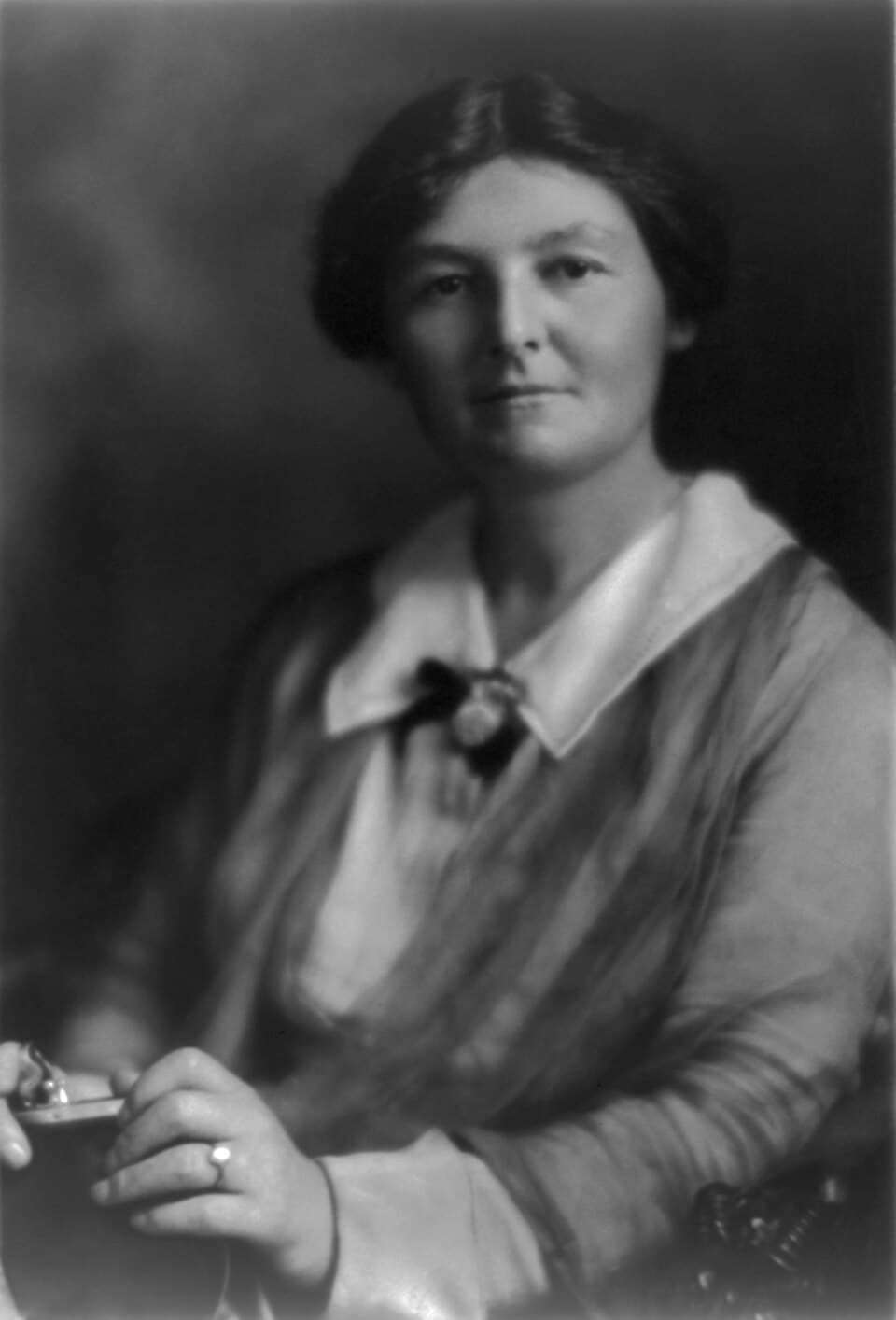
British · Politics · Activism
Margaret Bondfield
March 17, 1873 – June 16, 1953
Early life and background
Margaret Grace Bondfield was born on 17 March 1873 in Chard, Somerset, England, a small lace-making town in the south-west of the country.[1][2][5][8] She was one of eleven children of William Bondfield, a foreman in a lace factory, and Ann Taylor Bondfield, who was known for her Nonconformist religious beliefs and radical political views.[4][5][8] The family was working-class and lived in modest circumstances, but the home environment exposed Margaret to discussions of politics, religion, and social justice from an early age.
Bondfield received only elementary schooling and left formal education at around thirteen or fourteen.[2][4][8] Like many girls of her generation and class, she was expected to contribute to the household income. In her early teens she left Chard for the south coast, taking up an apprenticeship with a draper in Hove, Sussex.[4] The conditions she encountered were harsh. Shop assistants, especially young women, often lived on the premises under rules that treated them as semi-domestic servants rather than industrial workers.[3][11] Long hours, poor pay, and strict discipline were common, and these formative experiences profoundly shaped her later commitment to improving shopworkers’ rights.
After completing her apprenticeship, Bondfield moved to London to join her brother Frank and continued to work as a shop assistant.[1][4][8] In the capital she came into contact with a wider circle of labour activists and radicals. She began to read socialist literature and attended meetings where speakers argued for trade unionism, social reform, and women’s political rights.[5][12] This combination of lived experience in exploitative work and exposure to radical ideas laid the foundations for her future activism.
Career beginnings in trade unionism
Bondfield’s first major institutional engagement came through the National Union of Shop Assistants, formed in the 1890s to represent workers in retail and related trades.[2][5][8] As a shop assistant in London, she joined the union early and quickly gained a reputation as an energetic organizer, particularly among women workers. By 1898 she had become assistant secretary of the union, a position that brought her into national labour politics.[1][5][8][12] In this role she campaigned for reforms such as shorter hours, the abolition of oppressive "living-in" systems, and better enforcement of labour laws.
Her growing prominence was recognized when, in September 1899, Bondfield attended the Trades Union Congress (TUC) in Plymouth as the only woman delegate.[2][5][12] This was an extraordinary situation: the TUC, effectively a parliament of the British trade union movement, was overwhelmingly male in membership and leadership. Bondfield’s presence signaled both the emerging importance of shopworkers within the movement and the potential for women to claim a voice in national labour debates. She used this and subsequent TUC meetings to draw attention to the conditions of shop assistants and to argue that women’s issues were not peripheral but integral to labour politics.
During the early 1900s she broadened her activities beyond retail unionism. In 1904, Bondfield was a founding member of the Adult Suffrage Society (ASS), an organization that advocated for universal adult suffrage on equal terms for men and women, rather than the property-based franchise favored by many mainstream suffrage groups.[12][13] Two years later, in 1906, she helped to establish the Women’s Labour League, a body that sought to link women’s political organization with the Labour Party and promote women’s involvement in socialist politics.[1][5][12][13] These efforts reflected her distinctive stance: she was a socialist and trade unionist who supported women’s enfranchisement but did not align herself with the more militant suffragette organizations.
Rise to national prominence: union leadership and wartime work
During the decade before the First World War, Bondfield’s influence in the labour movement expanded. She became widely known as a skilled speaker and organizer, capable of articulating complex issues in accessible language.[5][12] By this time she was regularly attending the TUC and serving on committees concerned with industrial women’s organizations and social policy.
The outbreak of war in 1914 created new opportunities and challenges. In 1915, Bondfield served on the government’s Reconstruction Committee and other wartime advisory bodies, contributing to discussions on post-war labour policy and social reform.[5][8][10] Her participation indicated that ministers and officials recognized the value of her practical experience and her understanding of women’s employment.
A turning point came on 9 September 1918, when Bondfield was elected to the General Council of the TUC, becoming the first woman to sit on this executive body.[4][5][12] The General Council was responsible for coordinating the policies and strategies of the national trade union movement. Her election represented a significant breakthrough at a time when women were still largely absent from the leadership of major unions. It gave her a platform to influence decisions on wages, working hours, and social insurance, and to ensure that the concerns of women workers were taken into account in national policy.
In the post-war years she continued to hold prominent union positions. By 1920, Bondfield had become chair of the Standing Joint Committee of Industrial Women’s Organisations, a coordinating body representing women workers across different industries.[5][8][10] She also became chief woman officer of the National Union of General and Municipal Workers, a post she would hold until 1938, with interruptions when she served in Parliament and government.[8] These roles confirmed her status as a leading voice for industrial women in Britain.
Breakthroughs in the Trades Union Congress
Bondfield’s standing within the TUC culminated in a historic achievement in 1923. On 3 September 1923, she became the first woman to chair the General Council of the TUC, a position widely described as that of TUC President.[2][4][12] The TUC’s rota system meant that different members took turns in the chair, but Bondfield’s elevation to this role shattered a symbolically important barrier: for the first time, a woman presided over the highest representative body of Britain’s trade union movement.
As chair, she guided debates on industrial relations, unemployment, and the TUC’s political relationship with the Labour Party. Her leadership style combined firmness with an ability to find consensus among often fractious union leaders. Importantly, she used her position to assert that women’s employment issues—such as equal treatment, fair wages, and protection from exploitation—were central to the movement’s agenda rather than marginal concerns.
The 1923 chairmanship enhanced her national profile and demonstrated to the wider public that a woman could lead major representative institutions. This visibility contributed directly to her political prospects within the Labour Party, which was increasingly looking to experienced trade unionists to fill parliamentary and ministerial roles.
Parliamentary career: early years and junior ministerial office
Bondfield’s transition from union leadership to parliamentary politics came quickly. In the general election of 1923, she stood as the Labour candidate for Northampton and was elected to the House of Commons on 6 December 1923.[1][2][3][11] This made her one of the first women to sit on the Labour benches and brought a working-class woman with deep trade union experience into Parliament.
Her tenure as MP for Northampton coincided with the formation of Ramsay MacDonald’s first Labour government in January 1924. On 24 January 1924, Bondfield was appointed Parliamentary Secretary to the Minister of Labour, becoming the first woman to hold ministerial office in a British government.[2][5][8][14] As Parliamentary Secretary—a junior ministerial post—she worked closely with the Minister on issues including unemployment insurance and labour exchanges, bringing her expertise in shopworkers’ and industrial women’s issues to the legislative process.
The 1924 Labour government was short-lived, falling later that year, and Bondfield lost her Northampton seat in the subsequent election.[1][2][11] However, her experience as a junior minister and her visibility as a female office-holder solidified her position as a national figure. In 1926, she returned to Parliament as Labour MP for Wallsend, an industrial constituency in the north-east of England.[8] From this base she continued to focus on labour and social policy, consolidating her credentials for higher office.
First woman Cabinet minister and privy counsellor
Bondfield’s political career reached its peak following the general election of May 1929, in which the Labour Party again became the largest party and formed a minority government. On 7 June 1929, Prime Minister Ramsay MacDonald appointed her as Minister of Labour.[1][2][5][10][12][13] In accepting this office, she became the first woman Cabinet minister in Great Britain and the first woman privy counsellor, entering the highest levels of governmental decision-making.
The Ministry of Labour was a demanding portfolio. The late 1920s and early 1930s were marked by severe economic difficulties, including high unemployment and financial instability that would culminate in the global Great Depression.[1][11][12] As Minister, Bondfield oversaw labour exchanges, unemployment insurance schemes, and negotiations with employers and unions. She faced intense pressure from all sides: employers resisted higher wage costs; unemployed workers demanded more generous benefits; and the Treasury was concerned about the fiscal burden.
One of the most controversial aspects of her tenure involved decisions on unemployment benefits, particularly proposals to tighten eligibility and reduce payments. Some of these policies were seen by sections of the labour movement as overly harsh, leading to criticism of Bondfield from former allies who felt that a Labour government—and a minister with her background—should have resisted such constraints.[11][12] The situation was complicated by the wider crisis that engulfed the government, culminating in the collapse of the Labour ministry in 1931 and the formation of a National Government under MacDonald.
Despite the controversies, Bondfield’s appointment was a landmark for women’s political representation. She differed from contemporaries such as Nancy Astor in that she came from a working-class family and rose through trade union ranks rather than through aristocratic or wealthy connections.[1][11] Her presence in the Cabinet demonstrated that women from non-elite backgrounds could hold senior office and that expertise in labour and social issues was valued at the highest level.
Later parliamentary career and withdrawal from front-line politics
The crisis of 1931 proved damaging to Bondfield’s political fortunes. In the general election of that year, which saw heavy losses for Labour, she was defeated in the Wallsend constituency and lost her seat in the House of Commons.[2][3][8][11] This effectively ended her front-rank parliamentary career, although she remained active in public life.
After leaving Parliament, Bondfield continued to hold her union position as chief woman officer of the National Union of General and Municipal Workers until 1938, when she retired from trade union work.[2][8] She also engaged in cooperative and educational activities, including lecturing in the United States for the British Information Services, where she explained British labour and social policies to American audiences.[8]
While her reputation within the labour movement was complicated by memories of the 1929–1931 period, she remained respected as a pioneering figure. She was frequently invited to speak at events and conferences, especially those concerned with women’s work and political representation, and she served on committees and boards associated with social reform.
Writings, honours, and recognition
Bondfield documented her life and political philosophy in her autobiography, A Life’s Work, published in the late 1940s.[2][5][8][12] In this book she reflected on her experiences as a shop assistant, union organizer, and minister, offering an insider’s perspective on the development of the labour movement and the challenges facing women in politics. The memoir is an important source for historians, illuminating her motivations and the reasoning behind contentious decisions.
Her public service was formally recognized when she was appointed a Companion of Honour (CH), an order awarded for outstanding achievements in the arts, literature, music, science, politics, industry, or religion.[2][8] Sources differ slightly on the exact year, but it is generally associated with the same late-1940s period in which her memoir was published and her lifetime contributions were being reassessed.[2][8]
Over time, Bondfield’s pioneering status attracted renewed attention. Local history initiatives in Chard and Brighton & Hove have commemorated her with blue plaques and museum exhibits, emphasizing her journey from shop assistant to Cabinet minister.[6] The National Archives, scholarly articles, and media pieces such as BBC features have highlighted her story as that of a "forgotten pioneer" whose achievements were overshadowed by more famous figures but were no less significant.[3][4][11][12]
Personal life and beliefs
Bondfield’s personal life was distinctive in several respects. She never married and had no children, a fact noted in biographical accounts.[8] Instead, she devoted the bulk of her time and energy to trade unionism, political work, and public service. Her close relationships were often with fellow activists and colleagues in the labour movement, and her sense of identity was deeply tied to her role as a campaigner for social justice.
Ideologically, Bondfield was a lifelong socialist and, for much of her life, a committed pacifist, shaped by both religious and political influences in her family and early environment.[5][12] She differed from some women’s rights activists in that she was not primarily a suffragette; she supported women’s enfranchisement but focused on adult suffrage and broad social reforms rather than on the militant tactics associated with groups like the Women’s Social and Political Union. This positioning sometimes placed her at odds with suffrage organizations but also allowed her to maintain strong links with male trade unionists who viewed the women’s movement with suspicion.
Her lifestyle reflected the values of modesty and service. She lived relatively simply, often in accommodation tied to her work, and did not accumulate wealth. Biographical sketches emphasize her reputation for personal integrity, hard work, and a willingness to travel and speak wherever labor and women’s issues were at stake.[4][5][8]
Legacy and historical impact
Margaret Bondfield’s legacy lies in several overlapping areas: trade unionism, women’s labour organization, and parliamentary politics. As a union organizer and leader, she played a central role in improving conditions for shop assistants and industrial women workers. Her early campaigns helped draw attention to the long hours, poor pay, and quasi-domestic status of shopworkers, paving the way for later reforms in the retail sector.[3][5][11]
Within the trade union movement, her election in 1918 as the first woman to the TUC General Council and her assumption of the chair in 1923 were important milestones.[4][12] They demonstrated that women could exercise authority in national labour institutions and encouraged other women activists to pursue leadership roles. Her work with the Standing Joint Committee of Industrial Women’s Organisations and the National Union of General and Municipal Workers contributed to the institutionalization of women’s representation within unions.
In parliamentary and governmental politics, Bondfield’s achievements were even more groundbreaking. As the first woman minister in a British government (Parliamentary Secretary to the Minister of Labour, 1924) and the first woman Cabinet minister and privy counsellor (Minister of Labour, 1929), she opened offices that had previously been closed to women.[2][5][8][10][13] Her path from working-class origins to Cabinet rank challenged prevailing assumptions about who could govern and helped normalize women’s presence in high political office.
Her legacy is complex, however, because of the controversies associated with her tenure as Minister of Labour. Decisions about unemployment benefits and labour policy during the economic crisis of 1929–1931 led some of her contemporaries to view her as too cautious or too willing to accept cuts. As a result, she did not enjoy the unqualified hero status accorded to some other women pioneers. Yet historians increasingly interpret her actions within the constraints of the time, recognizing that she was operating in a context of intense economic and political pressure.[11][12]
In recent years, academic articles, museum exhibitions, and media features have sought to restore Bondfield’s place in the broader narrative of women’s history. She is now widely acknowledged as a "forgotten pioneer" whose contributions to the labour movement and women’s representation were foundational, even if they did not always align with later expectations of radicalism.[3][4][6][11][12][13]
Later life and death
After retiring from trade union work in 1938, Bondfield continued to engage in public service through lecturing, cooperative activities, and writing.[2][8] She spent time in the United States as a lecturer for British Information Services, explaining British social and labour policies to American audiences.[8] Her memoir, A Life’s Work, written in the late 1940s, represented an effort to interpret her own career and the evolution of the labour movement for a wider readership.[2][5][8]
In her later years she lived in Sanderstead, Surrey, a suburban area south of London. On 16 June 1953, she died there at the age of 80.[1][2][5][8] Obituaries noted her pioneering achievements and her role in advancing the cause of women in politics and the labour movement, even as they acknowledged the controversies of her ministerial tenure.
Since her death, commemorations in places like Chard and Brighton & Hove, along with recognition in national archives and scholarly works, have ensured that Margaret Bondfield’s name remains associated with key milestones in British labour and women’s political history.[4][6][12] Her life—from a shopgirl under harsh conditions to the first woman Cabinet minister—continues to serve as a powerful example of how structural barriers of class and gender can be challenged through collective organization, political engagement, and personal determination.
Dated achievements
8 indexed.
- Mar171873Activism
Birth in Chard, Somerset
Margaret Grace Bondfield was born in Chard, Somerset, England.
View details EBSCO History - Margaret Bondfield - Sep041899Activism
Only woman delegate at 1899 Trades Union Congress
Bondfield attended the 1899 TUC as the only woman delegate.
View details