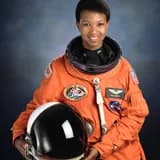
With STS-47's launch, Jemison became the first African American woman to orbit the Earth.
Concurrent with her historic launch on September 12, 1992, Mae Jemison became the first African American woman to orbit the Earth, completing dozens of orbits over the course of the eight-day STS-47 Spacelab-J mission. This distinction is sometimes noted separately from being the first African American woman "in space" because orbiting Earth signifies sustained spaceflight and mission duration, rather than simply reaching space altitude.
During the mission, Jemison and her six crewmates orbited the Earth at an altitude of roughly 190 nautical miles, circling the planet approximately 127 times. Jemison used this extended time in microgravity to conduct scientific research, including experiments she helped design related to bone cell growth and space adaptation syndrome.
The achievement resonated deeply within the African American community and among women scientists, as it demonstrated that opportunities in orbital spaceflight, long symbolically reserved for a narrow demographic, were expanding. Jemison's flight became a touchstone reference in discussions of diversity in STEM fields and provided visible representation for young Black girls interested in science and space exploration.
Her orbital flight remains a frequently cited milestone in space history timelines, museum exhibits, and educational materials about the history of NASA's astronaut corps.