← All women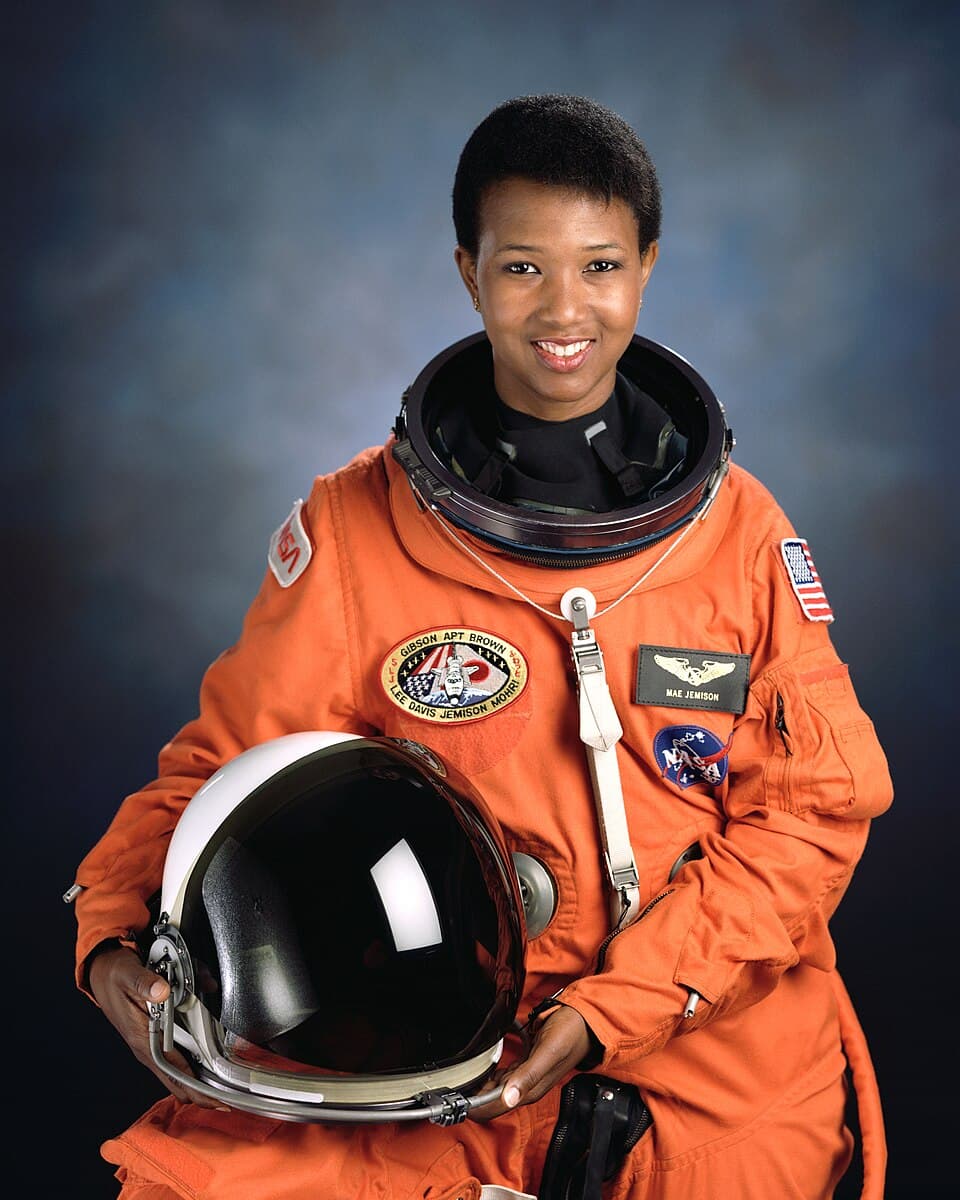
American · Science · Exploration · Medicine
Mae Carol Jemison
October 17, 1956 – present
Early Life and Background
Mae Carol Jemison was born on October 17, 1956, in Decatur, Alabama, United States.[3][7][8] She was the youngest of three children of Charlie Jemison, a maintenance supervisor, and Dorothy Green Jemison, an elementary school teacher.[7] When she was about three years old, her family relocated from Alabama to Chicago, Illinois, seeking better educational and economic opportunities for their children.[1][5][8] Jemison has often emphasized that she considers Chicago her hometown.[5]
Growing up on Chicago’s South Side in the 1960s, Jemison was immersed in a vibrant but challenging urban environment shaped by the civil rights movement and persistent racial segregation. Her parents encouraged her intellectual curiosity; her mother in particular supported her interest in science by bringing her to the library and allowing her to explore subjects from astronomy to anthropology.[4][8] Jemison later recalled being inspired both by school science lessons and by science fiction, particularly the television series Star Trek, whose multiracial crew suggested a future in which people of color could be explorers and leaders.
As a child, Jemison questioned why women and African Americans were largely absent from science textbooks and spaceflight imagery, and she resisted teachers’ suggestions that she should abandon science for more “feminine” paths.[1][8] Her self‑confidence, combined with parental support, helped her develop the conviction that she could become a scientist and, eventually, an astronaut, despite the lack of visible role models in those fields.
Education and Formative Influences
Jemison excelled academically in Chicago’s public schools, particularly in mathematics and science. According to NASA and biographical sources, she graduated from high school at the age of 16, earning a four‑year National Achievement Scholarship.[10] In 1972, she enrolled at Stanford University, one of the youngest students in her class.[3][4][8]
At Stanford, Jemison pursued a demanding combination of majors, earning a Bachelor of Science in chemical engineering and a Bachelor of Arts in African and Afro‑American studies
After graduating from Stanford, Jemison moved to New York City to attend Cornell University Medical College (now Weill Cornell Medicine).[10] She completed her Doctor of Medicine (MD) degree in 1981.[8][10] During medical school she studied abroad in Cuba and Kenya and worked at a Cambodian refugee camp in Thailand, experiences that deepened her interest in global health and the social dimensions of medicine. Following her MD, Jemison worked as a general practitioner in Los Angeles, California, where she provided primary care to a diverse urban population.[10] In 1983, she applied to and joined the Peace Corps, serving as a medical officer in Sierra Leone and Liberia in West Africa.[1][8][10] As Peace Corps medical officer, Jemison was responsible for the health care of Peace Corps volunteers and sometimes embassy personnel. Her duties included supervising the provision of medical services, developing health programs, conducting epidemiological surveillance, and treating injuries and illnesses ranging from malaria to meningitis.[1][8] She also worked with local health officials, gaining experience in public health, tropical medicine, and cross‑cultural communication. Jemison has emphasized that this period was crucial for her development as both a physician and leader. She learned to work effectively with limited resources, manage emergencies, and coordinate complex operations in challenging environments. These skills would later prove invaluable in the high‑stakes, team‑based setting of spaceflight. Jemison’s childhood fascination with space persisted through her medical training and early career. She has said that watching Sally Ride become the first American woman in space in 1983 was a turning point; seeing a woman astronaut made NASA seem more accessible and prompted her to seriously consider applying to the astronaut program.[1] After returning to the United States from the Peace Corps in 1985, Jemison settled in California, working as a general practitioner for CIGNA Health Plans while taking engineering courses at the University of California, Los Angeles (UCLA).[8] She prepared her application for NASA’s astronaut corps, bringing together her engineering background, medical expertise, and international experience. Jemison initially applied to NASA in the mid‑1980s, but the process was delayed after the Challenger shuttle disaster in January 1986.[8][10] When astronaut selection resumed, she reapplied. In 1987, NASA selected her as an astronaut candidate, and she entered training at the Johnson Space Center in Houston, Texas.[3][10] Multiple sources note that she became the first African American woman admitted to NASA’s astronaut training program, a milestone in the diversification of the astronaut corps.[1][2][8] Her training included intensive study of shuttle systems, robotics, navigation, survival training, and flight operations. She also worked in NASA’s Space Shuttle and Space Station support roles while preparing for potential missions. By 1988, Jemison had completed her initial astronaut training and was qualified as a mission specialist in NASA’s astronaut corps.[8] Sources identify her as the first Black female mission specialist, meaning she was the first Black woman to hold this core role in shuttle crews, responsible for scientific experiments and payload operations rather than serving solely in a supporting capacity.[8][6] As a mission specialist, Jemison was assigned to various technical duties at NASA, including work in the Shuttle Avionics Integration Laboratory and support for other missions. Her expertise in medicine and engineering made her particularly valuable for life‑science research missions involving Spacelab, NASA’s modular laboratory flown in the shuttle payload bay. Jemison’s breakthrough moment came with assignment to STS-47, the second flight of the Space Shuttle Endeavour and the Spacelab-J mission, a joint project of NASA and the National Space Development Agency of Japan (NASDA).[3][5][10] The mission focused on microgravity research in life sciences and materials science. On September 12, 1992, Endeavour launched from Kennedy Space Center with Jemison serving as a mission specialist and NASA’s first designated science mission specialist on a shuttle flight.[1][3][5][10] With this launch, she became the first African American woman in space and the first African American woman to orbit Earth, completing 126 orbits during the mission.[1][5][8] During the eight‑day flight, Jemison helped conduct more than 40 experiments, many of them related to life sciences. She participated in research on space motion sickness, the effects of microgravity on bone cell physiology, and frog embryo development in space, which helped scientists better understand how fundamental biological processes respond to weightlessness.[10] She also contributed to materials science studies examining how microgravity influences the behavior of alloys and other substances, knowledge that can inform industrial processes and future space manufacturing. Endeavour landed on September 20, 1992, after 7 days, 22 hours, and 30 minutes in orbit, completing the STS‑47 mission.[5] The flight demonstrated the feasibility of complex international collaboration in space science and provided data that would inform both shuttle operations and later long‑duration missions. In 1993, Jemison left NASA to pursue a broader array of interests in education, technology, and social change.[1][3][8] She settled in Houston for a time and later worked in academia and entrepreneurship. That year she received a Montgomery Fellowship from Dartmouth College and served as a visiting professor, teaching courses on ethics, science, and technology.[1][8] Jemison founded The Jemison Group, Inc., a technology consulting firm based in Houston, focusing on the social application of advanced technologies and science education.[1][3] The company has worked on projects related to satellite‑based telecommunication, sustainable development, and STEM curriculum design, emphasizing that science and engineering must be integrated with social and cultural understanding. Later, Jemison took on leadership of the 100 Year Starship initiative, a project originally seeded by the U.S. Defense Advanced Research Projects Agency (DARPA) and NASA.[4][5] The initiative aims to foster the research and interdisciplinary thinking necessary to enable human interstellar travel within the next century, while also encouraging innovations that benefit life on Earth. As principal of the 100 Year Starship, Jemison has promoted the idea that space exploration requires contributions from scientists, artists, ethicists, and communities worldwide. Beyond these roles, Jemison has become a sought‑after lecturer and public intellectual, speaking on topics such as STEM education, diversity in science, sustainability, and the importance of including the full range of human experience in technological futures. Jemison’s achievements have been recognized with numerous awards and honors from educational institutions, professional societies, and civic organizations. In 1988, she received the Essence Science and Technology Award, highlighting her pioneering status as a Black woman in NASA’s astronaut corps.[8] In 1992, following her flight, she was honored with the Ebony Black Achievement Award.[8] She has been awarded multiple honorary doctorates from universities in the United States and abroad, acknowledging her contributions to science, medicine, and education.[2][3] Jemison was inducted into the National Women’s Hall of Fame and has been celebrated by institutions such as the National Women’s History Museum and the New Mexico Museum of Space History.[1][6] Schools and educational programs have been named after her, reflecting her impact as a role model for young people. Popular culture has also recognized her influence. In 1993, she made a cameo appearance as Lieutenant Palmer in an episode of Star Trek: The Next Generation, becoming the first real-life astronaut to appear on the series.[22] The appearance symbolically linked her childhood inspiration from science fiction to her real‑world accomplishments in space. Public sources focus primarily on Jemison’s professional life and advocacy rather than detailed accounts of her private relationships. She has not emphasized marriage or children in her public narrative, and major biographical references do not document a spouse or offspring.[1][3][7][10] This absence itself is notable in women’s history, as it reflects a shift away from defining women’s significance primarily through domestic roles. Jemison is known to have strong interests outside of science and engineering, including dance and the arts. She studied dance seriously from a young age and has considered pursuing a professional dance career. At Stanford, she choreographed and performed in dance productions and took classes in modern, African, and jazz dance forms.[1][4] She has argued that art and science are both essential ways of understanding the world and that creativity is central to technological innovation. Mae Jemison’s legacy is multi‑layered, spanning space exploration, medicine, engineering, education, and social justice. Her 1992 STS-47 flight as the first African American woman in space stands as a landmark in both NASA history and the broader narrative of women’s progress in STEM fields.[1][3][5] It demonstrated that Black women could reach the highest levels of technical achievement in institutions that had long excluded them. Her presence in the astronaut corps helped normalize the idea that astronauts can be physicians, engineers, and scientists from diverse backgrounds, not just test pilots. By serving as a mission specialist and science mission specialist, she emphasized the centrality of research and interdisciplinary expertise in human spaceflight. Jemison’s advocacy for inclusive science education has influenced curricula, scholarship programs, and public perceptions of STEM. She has repeatedly stressed the importance of providing all children, regardless of race, gender, or socioeconomic status, with access to rigorous science and math education and to images of scientists and explorers who look like them.[1][4] Her work with The Jemison Group and the 100 Year Starship initiative has extended her impact into long‑term visions of humanity’s future. By insisting that interstellar exploration must include ethical reflection, cultural diversity, and environmental responsibility, she has helped shape a more holistic conception of “space age” progress. In women’s history, Jemison is often presented alongside figures such as Sally Ride and Katherine Johnson as part of a constellation of women who transformed NASA. Her story illustrates how the gains of the civil rights and feminist movements translated into new possibilities in high‑technology fields and how individuals from underrepresented communities can change not only who participates in science, but how science itself is imagined and governed. Since leaving NASA, Jemison has remained active as a scientist, educator, and public speaker. She has served on advisory boards and committees related to space policy, technology, and education, including roles with organizations like the Bayer Corporation’s national science education initiative.[1][3] She continues to promote the integration of science, engineering, arts, and social sciences. Jemison has authored and co‑authored books aimed at young readers and the general public, sharing stories of her experiences and perspectives on science and society. She remains a visible figure at conferences, in media interviews, and in documentary films, where she discusses topics ranging from STEM diversity to the future of space travel. As of the mid‑2020s, Jemison is alive and active, often described as a trailblazing astronaut, physician, and advocate for science literacy.[2][3][10] Her career continues to inspire new generations of students and professionals who see in her life a model of interdisciplinary excellence and social engagement. Through her ongoing work, Jemison has transformed her historic flight from a singular event into a sustained contribution to how society understands science, technology, and human possibility. Her legacy is not only that she went into space, but that she has used that experience to invite others—especially girls and students of color—to imagine themselves as full participants in shaping the future.Early Medical Career and Peace Corps Service
Path to NASA and Astronaut Selection
Becoming the First Black Female Mission Specialist
STS-47: Spacelab-J and Historic Spaceflight
Major Works, Projects, and Post-NASA Career
Awards, Honors, and Recognition
Personal Life
Legacy and Historical Impact
Later Life and Continuing Work
Dated achievements
6 indexed.
- Oct171956Science
Birth of Mae Carol Jemison
Mae Carol Jemison was born in Decatur, Alabama, the youngest of three children.
View details Mae Jemison | Britannica - Jan011988Science
First Black female NASA mission specialist (astronaut training completed)
By 1988, Jemison completed NASA astronaut training, becoming the first Black woman designated a mission specialist.